
Reviewed · OLD TOWN WALKING TOURS
Pula Roman Heritage Walking Tour
Pula’s Roman Arena is the star here, but the real value comes from seeing it as part of a larger Roman town. In about two hours, you move from the great amphitheater to the Temple of Augustus and the remains of the Small Roman Theatre, with a guide explaining how these places once worked together.
I like the small group size, capped at 15 people, and the choice of morning or afternoon departure. I also like the personal touch: guides including Dina, Jadranka, and Maslinka have tailored walks to individual interests, offered local tips, and in some cases spent longer than the advertised two hours.
The main consideration is price. At $107.06 per person for roughly two hours, this is not a budget stroll, especially since the listed inclusions are limited to a local guide. It makes the most sense if you value detailed explanation, a small group, and help making sense of Pula’s ancient center.
In This Review
- Key points to know before booking
- Why Pula’s Roman past is best seen on foot
- Starting at the Pula Arena
- The Temple of Augustus and Roman public life
- Finding the Small Roman Theatre on Zaro Hill
- Guides who make the difference
- Coffee, tea, and a slower pace
- Price, group size, and what you receive
- Who will get the most from this walk
- Booking timing and cancellation
- Should you book the Pula Roman Heritage Walking Tour?
- FAQ
- How long does the Pula Roman Heritage Walking Tour last?
- What language is the tour offered in?
- Where does the tour begin?
- Where does the tour end?
- Is admission to the Pula Arena included?
- Are admission fees charged at the Temple of Augustus and Small Roman Theatre?
- Is hotel pickup included?
- How large can the group be?
- Can I cancel for a full refund?
Key points to know before booking
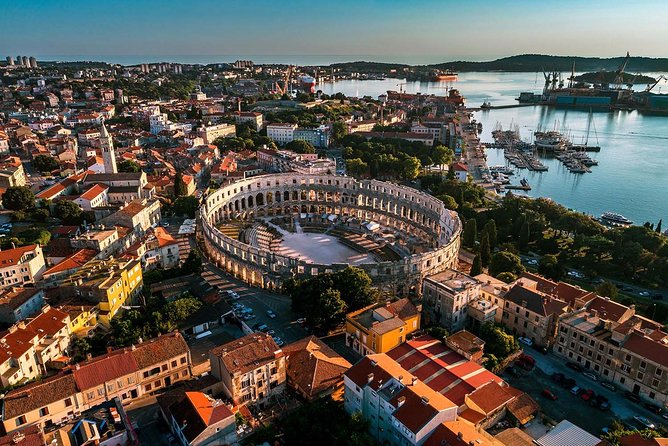
- The Pula Arena anchors the walk: You spend time at the famous Roman amphitheater where gladiators once fought, with admission included.
- Three Roman sites fit into one compact route: The walk covers the Arena, Temple of Augustus, and Small Roman Theatre.
- Guides shape the experience: Dina, Jadranka, and Maslinka are named in the feedback, with a reputation for clear explanations and flexible pacing.
- Coffee or tea adds a relaxed pause: This is more than a fast sequence of photo stops.
- Groups remain relatively small: The maximum is 15 people, a useful middle ground between a private tour and a large coach group.
- You must reach the Arena yourself: Hotel pickup and drop-off are not included, and the walk both starts and ends there.
Why Pula’s Roman past is best seen on foot
Pula is easy to underestimate. Many visitors arrive for the Arena, take a few pictures, and move on. That works if you only want the postcard view, but it misses the way Roman buildings shaped the city around them.
This walking tour links several ancient sites within the historic center. That connection matters. The Arena was built for mass entertainment, the Temple of Augustus represented imperial religion, and the Small Roman Theatre served a different performance space outside the old city walls. A guide can help you see these as parts of one Roman settlement rather than isolated ruins.
The tour lasts about two hours, so it is not an all-day history lesson. I see that as a strength for most people. You get a focused introduction without giving up half your day in Pula. The format also works well near the start of a visit, when you want someone to explain the city before exploring on your own.
The tour is offered in English and can be booked in the morning or afternoon. That flexibility helps if you have a full sightseeing schedule, a restaurant reservation, or a ferry and transport connection to manage.
More Old Town Walking Tours in Pula
- Pula: Historic Walking Tour with Local Guide & City Views
★ 4.8 · 143 reviews - Pula walking tour
★ 5.0 · 96 reviews - Pula: Historic Sites Guided Walking Tour
★ 4.8 · 78 reviews
Starting at the Pula Arena
The meeting point is the Pula Arena on Flavijevska Street. You need to arrive here independently, since hotel pickup and drop-off are not part of the experience. The location is near public transportation, which makes the starting point practical if you are staying outside the old center.
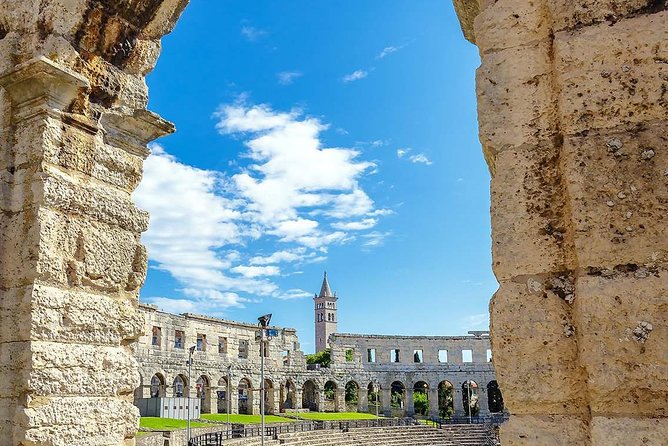
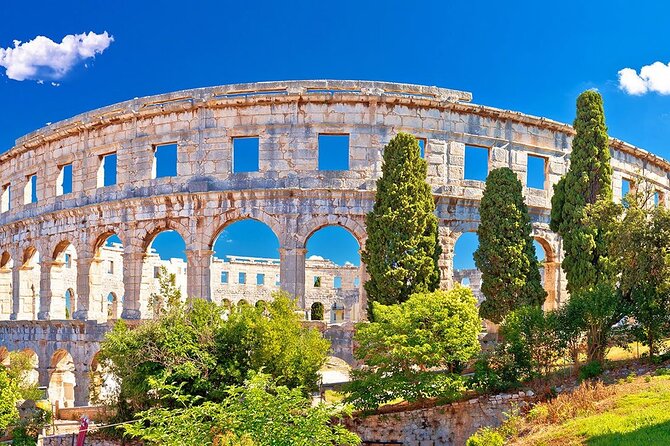
The Arena is a fitting place to begin. Its huge outer walls are the most immediately impressive Roman monument in Pula, and the building gives the tour a clear visual focus from the first few minutes. You do not need to spend time guessing which ruin you are looking at. This is the amphitheater where Roman gladiators fought, and the guide explains its role and construction.
About 15 minutes are scheduled here, with admission included. That is enough for an introduction, but not enough for an extended museum visit or a slow, detailed architectural study. If the Arena is your main reason for booking, keep your expectations in check. This experience includes the monument within a wider walk, rather than treating it as a full standalone Arena visit.
The surrounding exhibits and areas below ground can add useful context, depending on how the visit is handled. The guide’s explanation is especially helpful for understanding how the amphitheater was built and used, rather than simply viewing its stone arches from outside.
The strongest comments about the walk focus on the guides’ ability to explain this site in plain terms. Dina is described as professional, attentive, and able to adjust the conversation to the group’s interests. Jadranka is also praised for giving historical context without making people feel rushed.
The Temple of Augustus and Roman public life
The next major stop is the Temple of Augustus, dedicated to the goddess Roma and named for the emperor Augustus. The visit lasts about 10 minutes, and there is no separate admission charge listed for this stop.
This is a shorter visit, but it gives the tour a useful change of scale. The Arena shows Roman entertainment on a grand scale. The temple points you toward public religion, political power, and the way an emperor’s name became part of city life.
Ten minutes can pass quickly, especially if you want to take photographs or ask several questions. Still, the guide’s role is important here. A temple facade may look straightforward until someone explains who it honored and why it mattered in the Roman city.
This is also where the tour helps you look beyond the largest monument. Pula’s Roman identity is not only about the Arena. The smaller remains and surviving civic buildings give you a better sense of how ordinary public life was organized around ceremony, worship, and power.
Finding the Small Roman Theatre on Zaro Hill
The Small Roman Theatre is the least famous stop, which is part of its appeal. It was once an amphitheater outside the city walls on the hillside of Zaro. The visit lasts around 10 minutes, and admission is free.
You should not expect a complete theater in the condition of the Arena. The attraction here is the remaining structure and the chance to consider how Roman entertainment spaces were arranged beyond the main city core. The contrast helps explain that Pula had more than one venue for public performance.
Because this stop is less instantly recognizable, it benefits from a guide’s explanation. Without context, partial ruins can be difficult to read. With a clear account of what once occupied the site, the stones become easier to picture as a working theater rather than an empty archaeological patch.
The route also introduces a little walking beyond the most familiar square and monument. Anyone with limited mobility should consider that this is a walking tour and that the Small Roman Theatre is on a hillside. The supplied information says most people can participate, but it does not provide a detailed accessibility assessment.
Same stretch of coast, a completely different day out:
- Medulin -Kamenjak 5h boat trip with lunch & drinks on Sandra Boat
★ 5.0 · 1,621 reviews - Full-Day Boat Tour of the Medulin Archipelago from Medulin
★ 5.0 · 1,389 reviews - 3hours all inclusive Sunset&Dolphin Tour from Medulin on Sandra
★ 5.0 · 1,130 reviews - Dolphin Watching & Sunset Boat Tour With Dinner and Drinks
★ 5.0 · 1,075 reviews
Guides who make the difference
The experience rises or falls on the guide. Pula’s Roman sites do not need a hard sell, but they do need interpretation. A good guide explains what you are seeing, answers questions, and keeps the route from becoming a list of dates and building names.
Dina is singled out for a private tour of the Arena and nearby streets. Her strengths include professionalism, attention to personal interests, and useful advice for onward travel in the area. That last point is worth noting if you are using Pula as part of a larger Croatian trip.
Jadranka receives especially strong praise for historical and cultural explanation. She has tailored tours for families, avoided rushing, and sometimes continued well beyond the scheduled two hours. If you are hoping for a flexible, conversational experience, her approach sounds well suited to that style.
Maslinka is also praised for an excellent Roman walking tour and clear knowledge of the subject. The presence of several named guides suggests that the exact personality of your walk may depend on who leads it, but the repeated themes are clear: good organization, friendly communication, and strong historical context.
The published rating is 4.8 from 12 reviews, with 100 percent recommending the experience. That is a very positive record, though the number of reviews is still modest. I would treat it as encouraging evidence rather than a guarantee that every group will receive the same guide or spend extra time beyond the planned schedule.
Coffee, tea, and a slower pace
The tour includes coffee or tea, according to the experience details. That small pause changes the rhythm. You are not simply moving from one ruin to the next while trying to remember a string of facts.
A drink gives you a chance to ask follow-up questions and discuss what you have seen. It also makes the walk feel more like an introduction to the city than a formal lecture. For a short tour, that relaxed break can be one of the most pleasant parts.
The details do not specify the café, drink choices, or the exact timing. I would therefore treat it as a simple refreshment rather than a meal or a major part of the booking. If you want lunch, dinner, or a carefully planned food experience, you will need to arrange that separately.
One useful detail from the guide feedback is that Jadranka recommended a restaurant after the walk. That kind of local advice can add real value, especially if you have only one day in Pula and want help choosing where to eat next.
Price, group size, and what you receive
The listed cost is $107.06 per person. For a two-hour walking tour, that is a high price compared with a basic group orientation walk. The value depends on what you want from the guide.
You are paying for a local guide, access to the Arena, a compact route through three Roman sites, an English-language explanation, and coffee or tea. The maximum group size is 15, so this should feel more manageable than a large city tour, though it is not automatically private.
Admission is specifically included for the Pula Arena. The Temple of Augustus and Small Roman Theatre are listed with free admission. Hotel transfers are not included, so you need to account for your own transport to and from Flavijevska Street.
The strongest reason to pay this price is the quality of interpretation. If you already read extensively about Roman architecture and prefer to explore alone, the cost may be hard to justify. If you want the city’s major Roman sites explained in a short, personal format, the calculation looks better.
The minimum operating requirement is two full-price adult bookings. If that minimum is not met and the tour is canceled, you receive a full refund. That is worth knowing if your plans are fixed around this walk.
Who will get the most from this walk

I would recommend the tour to first-time visitors who want a quick introduction to Pula before exploring independently. It also suits couples and families who prefer a compact historical walk rather than a full-day excursion.
The small maximum group is helpful for people who dislike large guided groups. The guide can ask about your interests and, based on the detailed feedback, may adjust the focus toward architecture, local culture, travel advice, or the Roman period.
The walk also suits visitors with limited time. A two-hour morning tour leaves the afternoon open, while an afternoon departure can fit around earlier sightseeing. Since the route begins and ends at the Arena, it is easy to continue your own visit from the same central area.
You may want to skip it if you dislike guided tours, want a long visit inside the Arena, or are mainly interested in modern Pula rather than ancient sites. The tour focuses tightly on Roman heritage and does not promise hotel transport or a broad overview of every period in the city’s past.
Dress is smart casual. Service animals are allowed, and most people can participate. The tour is near public transportation, but the supplied details do not identify a specific stop or provide a full route accessibility breakdown.
Booking timing and cancellation
This experience is booked, on average, 37 days in advance. That does not mean you must book exactly that early, but it suggests that planning ahead is sensible, especially if you want a particular morning or afternoon time.
You receive confirmation when booking. Free cancellation is available up to 24 hours before the local start time. Cancellations made less than 24 hours ahead are not refunded, and changes within that period are not accepted.
The minimum of two full-price adults is the one condition outside your control. If the provider cancels because too few people book, you are offered another date or experience, or you receive a full refund.
Should you book the Pula Roman Heritage Walking Tour?
Book it if you want Pula’s main Roman remains explained by a local guide in a short, small-group setting. The Arena, Temple of Augustus, and Small Roman Theatre make a logical trio, and the coffee or tea break keeps the pace comfortable.
The price is the deciding factor. At $107.06, this is not the cheapest way to see Pula. I would choose it for the guide’s local insight, the chance to ask questions, and the personal style associated with Dina, Jadranka, and Maslinka. If you only want to photograph the Arena and read the signs yourself, spend your money elsewhere.
For a first visit, a family group, or anyone who wants a clear Roman introduction without losing a full day, this tour is a sensible choice. Just arrive at the Arena on your own, allow for walking, and book early if your schedule is tight.
FAQ
How long does the Pula Roman Heritage Walking Tour last?
The tour lasts approximately two hours, although the exact duration may vary. Some guide-led visits have continued longer than the scheduled time.
What language is the tour offered in?
The tour is offered in English.
Where does the tour begin?
It begins at the Pula Arena on Flavijevska Street, 52100, Pula, Croatia.
Where does the tour end?
The activity ends back at the meeting point, the Pula Arena.
Is admission to the Pula Arena included?
Yes. Admission to the Pula Arena is included.
Are admission fees charged at the Temple of Augustus and Small Roman Theatre?
The Temple of Augustus and Small Roman Theatre are listed with free admission.
Is hotel pickup included?
No. Hotel pickup and drop-off are not included, so you must make your own way to the Pula Arena.
How large can the group be?
The tour has a maximum of 15 participants.
Can I cancel for a full refund?
Yes. You can cancel at least 24 hours before the local start time for a full refund. Cancellations or changes made less than 24 hours before the start are not accepted for a refund.
More Walking Tours in Pula
- Pula Essentials Walking Tour
★ 4.8 · 64 reviews - Pula Essentials Walking Tour
★ 5.0 · 62 reviews - Pula Food Walking Tour
★ 4.5 · 22 reviews - Pula: Old Town Walking Tour for Foodies with Dinner and Wine
★ 4.6 · 18 reviews
More Historical Tours in Pula
- Olive Oil Guided Tasting and History in Pula
★ 4.5 · 34 reviews - Dubrovnik Old Town History Walking Tour
★ 5.0 · 1,684 reviews - Walking Tour of Split with a ‘Magister’ of History
★ 5.0 · 1,122 reviews - Split Walking Tour with Professor of History
★ 5.0 · 926 reviews
Just added around Pula
- 1-Hour Private E Foil Surfing Lessons in Istria★ 5.0 · 4 reviews
- Wine Tasting Experience at the organic winery in Šišan★ 3.5 · 13 reviews
- Transfer Pula – Poreč★ 5.0 · 5 reviews
- 3 Hours Private Wine and Sunset Tour★ 5.0 · 9 reviews
- Dolphin & Sunset tour with Brijuni panorama★ 5.0 · 119 reviews
- E-Bike swim & fortress tour Vodnjan★ 5.0 · 6 reviews
- Transfer Pula – Rovinj★ 5.0 · 4 reviews
- Stop on Island & National Park Day Cruise with Lunch Drinks★ 5.0 · 10 reviews
Old Town Walking Tours, compared.



Walking Tour of Split and Diocletian’s Palace
Read our review →


Krka Waterfalls tour with Trogir Walking tour and Krka panoramic boat cruise
Read our review →
City Walls Early Morning or Sunset Walking Tour
Read our review →
Plitvice Lakes with Boat Ride and Zadar Old Town Tour
Read our review →Browse the lists this tour appears in