
Reviewed · OLD TOWN WALKING TOURS
Dubrovnik Old Town History Walking Tour
Dubrovnik’s past comes into focus as you walk from the Large Onofrio’s Fountain down Stradun and toward the old harbor. In 90 minutes, this tour links the city’s major sights with stories about Ragusa, religion, trade, local customs, Yugoslavia, and the Homeland War.
I like the clear route and the local touch. Guides such as Ivana, Jelena, Sara, Joseph, and Pero are praised for mixing facts with personal stories, humor, and useful tips for the rest of your stay. The main drawback is the pace: you see a lot, but there is little time to enter sights or linger.
In This Review
- Key points to know before you book
- Starting beneath Dubrovnik’s Large Onofrio’s Fountain
- Holy Savior and the Franciscan Monastery
- Stradun, Dubrovnik’s main public room
- A side street, the Church of the Holy Annunciation, and religious variety
- Gundulic Square and the Rector’s Palace
- The Cathedral and the Richard the Lionheart legend
- Old Port, the Arsenal, and Dubrovnik’s quarantine system
- Luza Square, Orlando Column, and the final cluster of sights
- What the 90-minute format does well
- Guides, group size, and the feel of the walk
- Price, timing, and weather considerations
- Who should book this Dubrovnik walking tour?
- Should you book it?
- FAQ
- Where does the Dubrovnik Old Town History Walking Tour start?
- Where does the walking tour end?
- How long does the tour last?
- What language is the tour offered in?
- What attractions are covered?
- Is hotel pickup included?
- What is the cancellation policy?
Key points to know before you book
- The route covers Dubrovnik’s core sights: You pass the Franciscan Monastery, Stradun, Rector’s Palace, the Cathedral, Old Port, and Orlando Column.
- Local stories add texture: Guides may connect city history with family memories, daily life, traditions, and places to visit later.
- Ninety minutes is a useful length: You get oriented without giving up half a day, then have time to explore alone.
- The tour stays mostly on the main Old Town route: It offers a broad introduction rather than a detailed visit inside every monument.
- The group can reach 30 people: Ask questions early and stay close in busy spots so you do not miss the guide.
- It costs $24.19 per person: That is fair for a guided introduction in an expensive city, especially if you use the advice to plan the rest of your visit.
Starting beneath Dubrovnik’s Large Onofrio’s Fountain
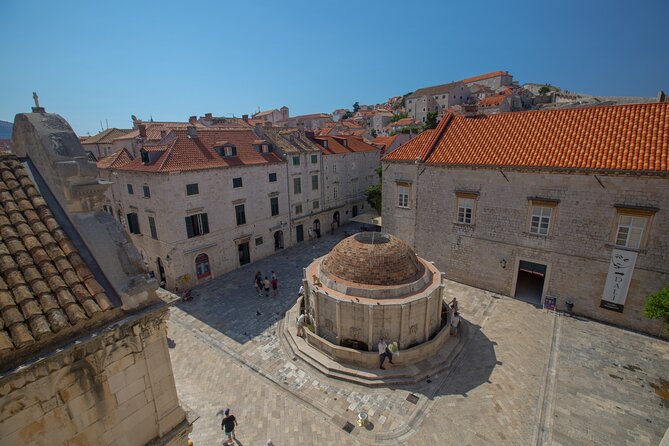
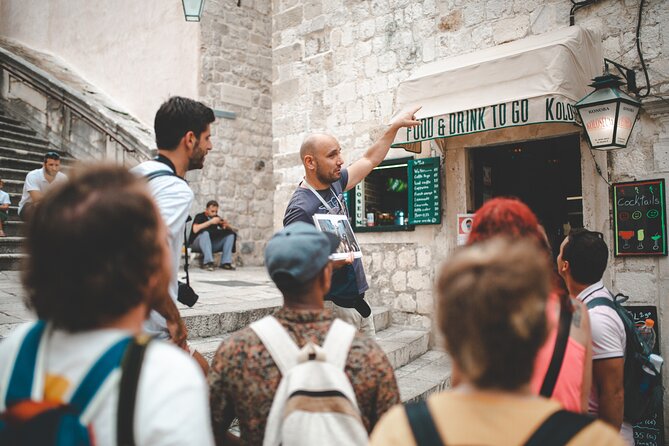
Meet at the Large Onofrio’s Fountain, next to the Hard Rock Cafe and the red umbrella used by Dubrovnik Walking Tours. The guide introduces the group, then leads you into the walled Old Town.
This is a practical meeting point because it is easy to identify once you are near the entrance. The fountain also gives the guide a useful opening scene. Before you start looking at churches and palaces, you learn how Dubrovnik grew from a small maritime trading city-state called Ragusa.
The fountain was part of an innovative aqueduct system. That detail tells you something important about Dubrovnik from the start: this was not simply a pretty fortified town. It was a careful, organized republic that invested in water, trade, law, defense, and public life.
The opening talk lasts about 10 minutes, followed by a short gathering period. Arrive ready to walk at the stated departure time. A large group may spread out quickly on the narrow streets, so keep within sight of the red umbrella or guide.
More Old Town Walking Tours in Dubrovnik
- Dubrovnik: Old Town Walking Tour
★ 4.8 · 5,174 reviews - Dubrovnik Discovery Old Town Walking Tour
★ 5.0 · 4,458 reviews - Dubrovnik: Game of Thrones Walking Tour
★ 5.0 · 1,732 reviews
Holy Savior and the Franciscan Monastery
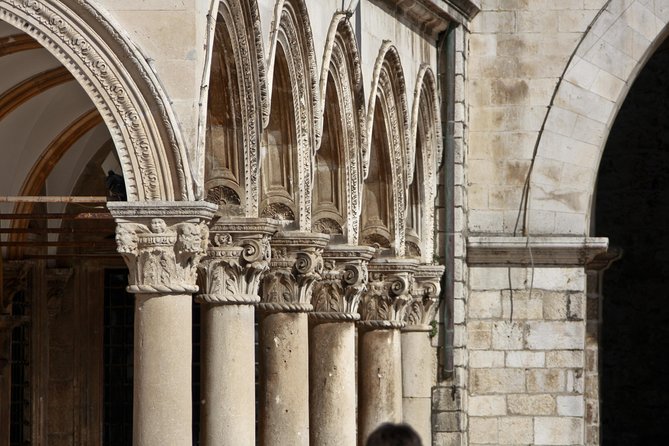
The walk begins along the main street, passing the small votive Church of Holy Savior. Here, the guide explains how religion shaped the city’s buildings, public ceremonies, and everyday life.
This stop is brief, but it helps you read Dubrovnik properly. Churches were not placed in the Old Town by accident. They formed part of the city’s social structure, its rituals, and its response to danger and disaster.
Soon you reach the Franciscan Church and Monastery, one of the most notable complexes along the route. It includes a church, monastery, library, and pharmacy. The pharmacy dates to 1317 and is regarded as the third-oldest functioning pharmacy in the world.
The library contains more than 20,000 books, including about 1,200 valuable old manuscripts. You do not spend the tour exploring these interiors, and admission is not included, but the guide’s explanation gives you a reason to return later if you have time.
The Franciscan complex also offers a chance to hear about customs that have lasted for centuries. That local detail is one of the tour’s best qualities. Instead of treating Dubrovnik as a row of grand facades, the guide connects the buildings to habits and traditions that still matter.
Stradun, Dubrovnik’s main public room
The route continues along Placa, better known as Stradun. This broad stone street divides the Old Town’s northern and southern sections and serves as its main promenade, business street, and gathering place.
Stradun is most impressive when you understand its role. Public feasts, processions, and civic events have taken place here, and the street remains the natural reference point for finding your way around.
The guide uses this stretch to explain how Dubrovnik was laid out and how the city functioned. You also get a short account of the fall of the Ragusa Republic in 1808, followed by the later story of Yugoslavia and the Homeland War of the 1990s.
That modern section matters. Dubrovnik can look so polished and old that it is easy to imagine its story ended centuries ago. It did not. The city endured serious damage during the war and rebuilt. A guide who treats that period with respect helps you see the Old Town as a living place, not a museum set.
The walk is not a specialist war tour, so expect an overview rather than a detailed account of military events. Still, the subject gives the rest of the route emotional weight.
A side street, the Church of the Holy Annunciation, and religious variety
Leaving Stradun, you turn into a narrower inner street on the way toward the port. This change of scale is welcome. The main street gives you Dubrovnik’s public face, while the smaller lanes suggest how daily life works behind it.
At the Orthodox Christian Church of the Holy Annunciation, the guide discusses the part played by Orthodox Christian, Jewish, and Muslim communities in the city’s story. This is an important correction to the idea that Dubrovnik had only one cultural or religious identity.
The stop also adds balance to the tour. You are not hearing only about rulers, walls, and wealthy merchants. You are learning how several communities helped shape the city over time.
Because the tour is offered in English, the guide’s speaking style matters. Past guides named in feedback include Ivana, Jelena, Sara, Joseph, Pero, Ivana, and Ermina. Their styles differ, but the strongest pattern is a mix of clear history, personal anecdotes, and a friendly pace.
Same stretch of coast, a completely different day out:
- Blue Cave Small-Group Boat Tour from Dubrovnik
★ 5.0 · 9,360 reviews - Full-Day Dubrovnik Elaphite Islands Cruise with Lunch and Drinks
★ 5.0 · 8,823 reviews - Dubrovnik: Epic Game of Thrones Tour + Lokrum & Saver Option
★ 4.9 · 5,995 reviews - Dubrovnik: Elaphiti Islands Full-Day Cruise with Lunch
★ 5.0 · 5,938 reviews
Gundulic Square and the Rector’s Palace
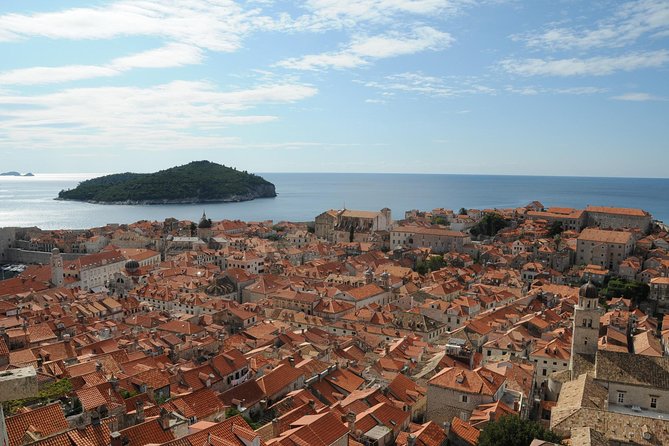
At Gundulic Square, you reach the green market and the Monument of Poet Ivan Gundulic. This is one of the route’s more everyday scenes. You can observe local produce while hearing about food, customs, and stories connected with the square.
I especially like this pause because it breaks up the sequence of monuments. A market gives you a glimpse of the city’s ordinary rhythm, even during a short tour. The guide may point out traditions that you would miss if you moved from church to palace without context.
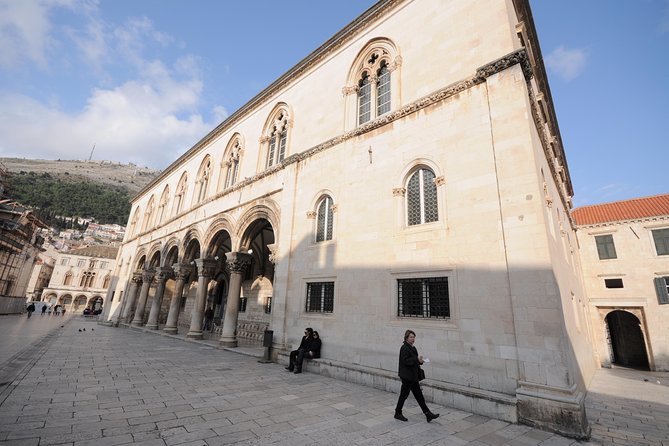
The route then takes you to the Rector’s Palace, once the seat of the Rector of the Republic of Ragusa from the 14th century until 1808. It also housed the Minor Council and much of the state administration.
The palace held an armoury, powder magazine, watch house, and prison. That list makes the building easier to understand. It was not just a residence or ceremonial palace. It was part office, part security center, and part symbol of government.
The guide’s explanation helps you picture how the republic operated. You learn to look at the palace as a working center of a maritime state, not simply as an elegant building for photographs.
The Cathedral and the Richard the Lionheart legend
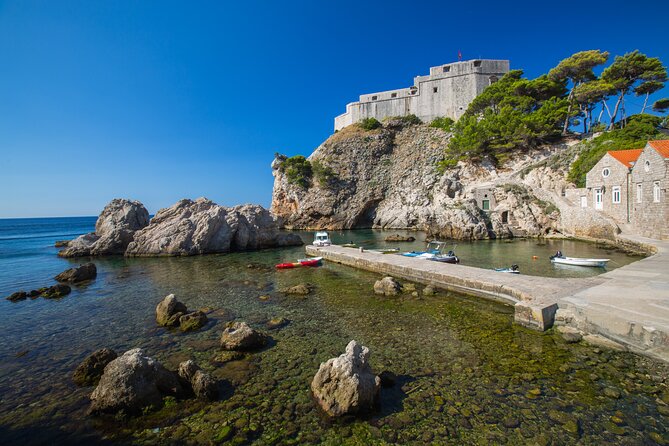
The Cathedral of the Assumption of the Virgin Mary is covered next. This part of the walk is short, lasting about five minutes, but the guide adds one of Dubrovnik’s most memorable legends.
According to the story, Richard the Lionheart was returning from the Crusades in 1192 when a storm wrecked his ship and cast him ashore on nearby Lokrum Island. Legends are not the same as confirmed fact, but they are part of how places explain themselves, and this tale gives the cathedral and island a strong connection.
The stop is best treated as an introduction. If you want to study the cathedral’s art or interior in detail, plan a separate visit after the tour. The walking route is designed to give you bearings and context, not extended time inside each attraction.
Old Port, the Arsenal, and Dubrovnik’s quarantine system
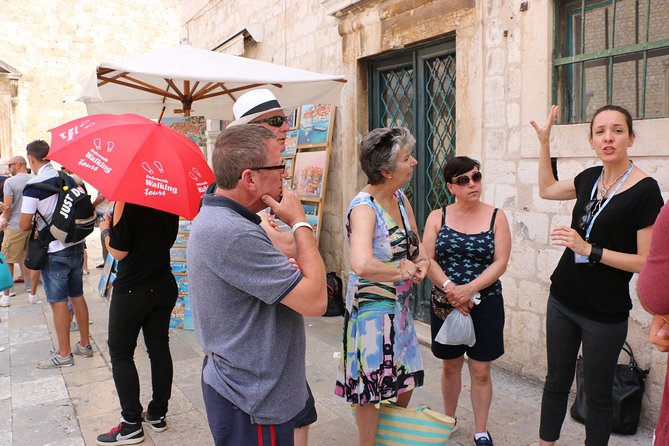
The tour reaches the City Harbor, one of its most revealing stops. Dubrovnik’s ships were known across the Mediterranean, and galleons from the republic served in naval fleets around Europe and beyond.
The guide explains the Arsenal, where ships were built and loaded. This helps you picture Dubrovnik as a working port and trading power. Its success depended on ships, sailors, cargo, diplomacy, and strict systems of control.
You also hear about the famous quarantine arrangements and the nearby fortresses of St. Luke and St. John. Quarantine was a serious part of life in a port city, especially one that welcomed ships and goods from far away.
The harbor stop lasts about 15 minutes, the longest scheduled stop on the route. That makes sense. The port ties together Dubrovnik’s trade, defense, public health, and international connections.
The Old Port is also a good place to pause mentally. Up to this point, the tour has shown you streets and buildings. Here, you see the sea-based reason Dubrovnik became important in the first place.
Luza Square, Orlando Column, and the final cluster of sights

Leaving the port, you return to the eastern end of Stradun and Luza Square, beneath the City Bell Tower. Several landmarks come together here, so the final portion feels like a compact lesson in Dubrovnik’s civic identity.
You see the Church of St. Blaise, dedicated to the city’s patron saint, along with Orlando Column, Sponza Palace, the Small Onofrio’s Fountain, and the tall bell tower.
The Orlando Column carries a legend about the knight Orlando. Sponza Palace offers another look at the republic’s commercial and administrative life, while the Small Onofrio’s Fountain provides a useful contrast with the much larger fountain at the starting point.
This final group of sights is efficient, but it can feel quick. You may want to return after the tour to photograph the details, enter the buildings that interest you, or simply sit in the square and watch the Old Town at its most public.
The walk ends back at the meeting point. That is convenient if you want to continue from a familiar location, and it makes the tour easy to fit into a first morning or afternoon in Dubrovnik.
What the 90-minute format does well
The tour’s greatest strength is its shape. Ninety minutes is long enough to cover the city’s central story, but short enough to leave you with energy for the walls, museums, shops, food, or a boat trip.
Several people specifically value it as a first activity. I agree. Dubrovnik’s Old Town is compact, yet its streets can feel confusing at first because many buildings look alike and the most important sights are packed close together.
A guide gives you a mental map. You learn that Stradun is the main spine, the harbor lies to the east, and major buildings cluster around the squares and side lanes. You also get suggestions for places to visit later, including advice as simple as a good gelato stop.
The short format has limits. You will not receive a room-by-room visit of the Franciscan complex, Rector’s Palace, or Cathedral. You also will not have much time for long question sessions if the group reaches the full maximum of 30 people.
Think of this as a city orientation with substance. It is not the right choice if you want a narrow subject studied in depth.
Guides, group size, and the feel of the walk
Guide quality is central to this experience. The named guides include Ivana, Jelena, Sara, Joseph, Pero, Ermina, Ivana, and Yvonna, and the strongest descriptions focus on their ability to make facts easy to follow.
Ermina, for example, has family ties to the Old Town, with a grandmother who still lives there. Stories like that can make the steep steps, old houses, and war damage feel more personal. Other guides bring humor, local recommendations, or personal memories into the route.
That does not mean every departure will feel identical. A group walking tour depends on the individual guide, group size, weather, and how many questions arise. The maximum is 30 people, which is manageable but not intimate.
The tour has also worked well for families because it keeps moving and finishes within 90 minutes. Most people can take part, and service animals are allowed. One important practical note is that Dubrovnik has many steps, even though this particular route is described as a useful step-free introduction. People with limited mobility should still consider the city’s crowded streets and steep routes beyond the tour.
Price, timing, and weather considerations
At $24.19 per person, the tour offers good value if you want history and orientation without paying for a longer half-day activity. Dubrovnik is an expensive city, so a short guided walk at this price can be a sensible way to spend your first few hours.
The value improves if you use the guide’s advice afterward. You can decide which sights deserve paid admission, where to return for a slower look, and how to organize the rest of your time.
You choose a departure time, and the tour is offered in English. It is often booked well ahead, with an average booking lead time of 37 days, so you should not assume a preferred time will remain open close to your visit.
The experience requires good weather. If poor weather forces cancellation, you are offered another date or a full refund. You can also cancel for a full refund up to 24 hours before the start time. Within 24 hours, the payment is not refunded, and late changes are not accepted.
There is no hotel pickup or drop-off. You make your own way to the Large Onofrio’s Fountain, and the activity finishes there as well.
Who should book this Dubrovnik walking tour?
I would choose this tour for a first visit, especially if you want a quick grasp of the Old Town before exploring on your own. It suits people who enjoy history but prefer stories tied to streets, markets, churches, and working harbor buildings.
It is also useful for families and short-stay visitors. The 90-minute length keeps the commitment modest, and the route gives you several ideas for the hours that follow.
You may want something else if you have already spent several days in Dubrovnik or want detailed access to interiors. In that case, a private tour or a museum-focused visit would give you more time with individual sites.
Should you book it?
Book it if you want a friendly, efficient introduction to Dubrovnik’s Old Town, with more than a list of dates and names. The route covers the essentials, and the best guides add local memories, humor, modern history, and practical tips.
Skip it if your main goal is to enter every monument or move at your own pace. For most first-time visitors, though, $24.19 is a reasonable price for getting oriented quickly and learning how Ragusa’s trade, religion, government, and survival shaped the city you see today.
FAQ
Where does the Dubrovnik Old Town History Walking Tour start?
It starts at the Large Onofrio’s Fountain at Poljana Paska Miličevića, next to the Hard Rock Cafe and the red umbrella meeting point.
Where does the walking tour end?
The tour ends back at the starting meeting point.
How long does the tour last?
The tour lasts approximately 1 hour and 30 minutes.
What language is the tour offered in?
The tour is offered in English.
What attractions are covered?
The route includes the Large Onofrio’s Fountain, Church of Holy Savior, Franciscan Church and Monastery, Stradun, Church of the Holy Annunciation, Gundulic Square, Rector’s Palace, Cathedral of the Assumption of the Virgin Mary, City Harbor, Orlando Column, Sponza Palace, Small Onofrio’s Fountain, and the City Bell Tower.
Is hotel pickup included?
No. Hotel pickup and drop-off are not included. You must reach the meeting point independently.
What is the cancellation policy?
You receive a full refund if you cancel at least 24 hours before the start time. Cancellations or changes made within 24 hours are not refunded or accepted. If poor weather cancels the tour, you can choose another date or receive a full refund.
More Walking Tours in Dubrovnik
- Dubrovnik: City Walls Early Morning or Sunset Walking Tour
★ 4.8 · 1,523 reviews - Dubrovnik: Ancient City Walls & Wars Walking Tour
★ 5.0 · 1,270 reviews - Dubrovnik: Game of Thrones Walking Tour
★ 4.9 · 981 reviews - ‘Game of Thrones’ Walking Tour in Dubrovnik
★ 4.5 · 945 reviews
More Historical Tours in Dubrovnik
- Game of Thrones & History of Dubrovnik Tour
★ 5.0 · 628 reviews - Dubrovnik: Old Town History Walking Tour
★ 4.9 · 474 reviews - Early Bird Dubrovnik History Tour – 7:30 Start
★ 5.0 · 198 reviews - Dubrovnik: Red History Museum Regular Ticket
★ 4.6 · 134 reviews
Just added around Dubrovnik
- Full- Day Private Speedboat Tour in Dubrovnik on Elaphiti Islands★ 5.0 · 21 reviews
- Elaphiti Islands Private Dubrovnik Boat Unique Experience★ 5.0 · 10 reviews
- Parasailing in Cavtat★ 5.0 · 62 reviews
- Wine tour peninsula Pelješac★ 5.0 · 3 reviews
- PRIVATE Wine Tour to Konavle country side★ 5.0 · 11 reviews
- Wine Lover’s Tour of Peljesac Peninsula★ 5.0 · 150 reviews
- Welcome to Dubrovnik Walking Tour★ 5.0 · 36 reviews
- Dubrovnik at War 1991-1992 Private Walking Tour★ 5.0 · 4 reviews
Old Town Walking Tours, compared.

Walking Tour of Split and Diocletian’s Palace
Read our review →
Krka Waterfalls tour with Trogir Walking tour and Krka panoramic boat cruise
Read our review →
City Walls Early Morning or Sunset Walking Tour
Read our review →
Plitvice Lakes with Boat Ride and Zadar Old Town Tour
Read our review →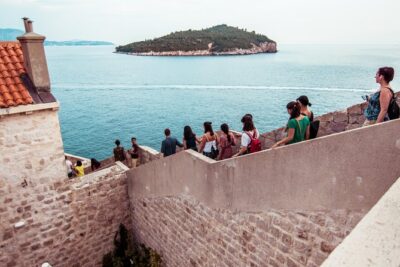
Browse the lists this tour appears in