

Reviewed · OLD TOWN WALKING TOURS
Walking Tour of Split and Diocletian’s Palace
Diocletian’s Palace is not a fenced-off monument you simply walk around. It forms the core of Split, with streets, shops, homes, cafés, and grand Roman remains woven together. This tour gives you the useful map: the Peristyle, Vestibule, palace substructures, Golden Gate, Riva Harbor, Fruit’s Square, and Split Synagogue.
I like the route for two clear reasons. First, it covers both the Roman palace and the later city around it, so you get more than a quick look at ancient stones. Second, the best guides, including Antonella, Anton, Mario, and Professor Marino, turn dates and names into stories you can remember.
The main caution is sound and crowd control. The group can reach 20 people, and several tours may gather in the same spaces. Some people had trouble hearing guides, especially when a guide spoke softly, and the paid museum section of the substructures is not part of the price.
In This Review
- Key points to know before you book
- Why start with Diocletian’s Palace
- Meeting at the Peristyle
- The Vestibule and the sound of Dalmatia
- What the substructures reveal
- The Golden Gate and Gregory of Nin
- Riva Harbor and Split’s waterfront
- Fruit’s Square and Marko Marulić
- Split Synagogue and the city’s Jewish past
- The guides make the biggest difference
- Group size, hearing, and pace
- Steps, transport, and who should choose it
- Is the Walking Tour of Split worth booking?
- FAQ
- How long does the walking tour last?
- What does the tour include?
- Are admission tickets included?
- Where does the tour begin and end?
- How large can the group be?
- Can I cancel for a full refund?
Key points to know before you book
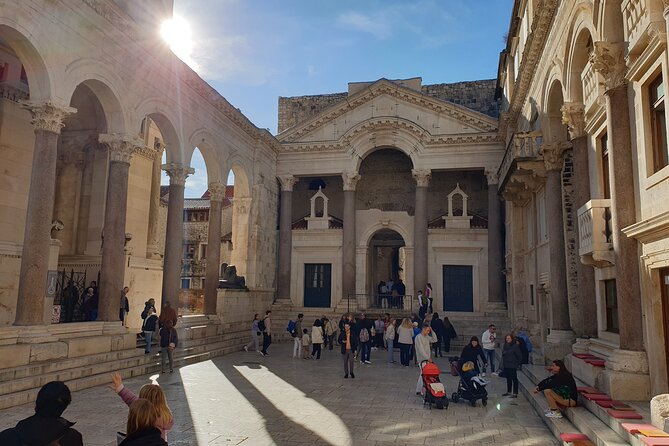
- The Peristyle is the tour’s central classroom: This grand square helps you understand how the palace was arranged and where the rest of the walk leads.
- The route mixes Roman, Venetian, Croatian, and Jewish history: You move from Diocletian’s imperial complex to the Golden Gate, a 15th-century Venetian citadel, Marko Marulić, and Split’s 16th-century synagogue.
- Several guides receive especially strong praise: Antonella is noted for clear English and humor, while Anton, Mario, and Marino are praised for passion and storytelling.
- The advertised length is about 90 minutes: One guide finished in less time, while another outing reportedly ran much longer, so allow some flexibility if your schedule is tight.
- Paid palace areas cost extra: The walk passes through the substructures but does not include the museum section or other admission tickets.
- Uneven steps matter: The route is not recommended if you have trouble with high steps, and the starting point on Peristil ulica can be difficult to spot.
Why start with Diocletian’s Palace
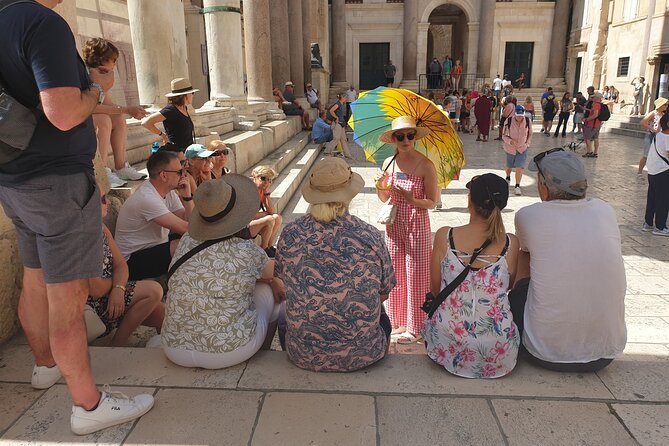
If you have only one day in Split, this is a sensible first activity. The palace is large enough to confuse you at first, since it is not laid out like a single museum. A guide can show you how the Peristyle connects to the Vestibule, the palace cellars, the Golden Gate, and the surrounding streets.
The tour is especially useful because Split’s center has several layers of time in one small area. Roman imperial architecture gives way to medieval and Venetian features, while later Croatian cultural and religious history appears along the same walk. You do not need to master every date. You need a clear sense of how the city developed, and this route aims to provide it.
At $48.37 per person, the price is not a bargain-basement walking tour. Still, it can be fair value if you want a local guide to explain what you are seeing and help you plan the rest of your time. The value depends heavily on the guide assigned to your group. A focused, clear storyteller can make the fee worthwhile. A soft-spoken or unfocused guide makes the same price harder to justify.
More Old Town Walking Tours in Split
- Split: Old Town and Diocletian Palace Walking Tour
★ 4.9 · 4,727 reviews - Krka Waterfalls tour with Trogir Walking tour and Krka panoramic boat cruise
★ 5.0 · 1,659 reviews - Split & Diocletian’s Palace Walking Tour
★ 5.0 · 1,125 reviews
Meeting at the Peristyle
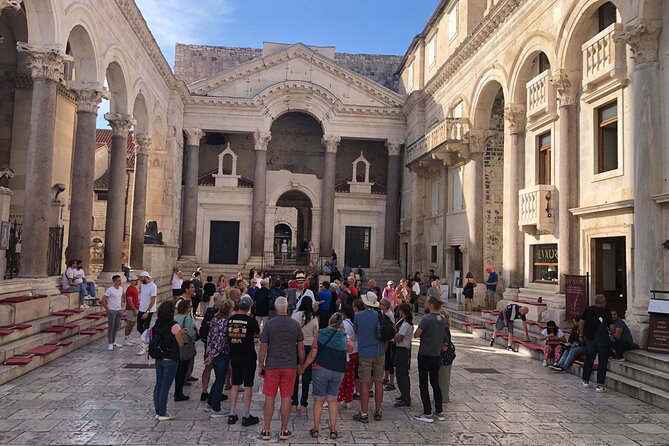
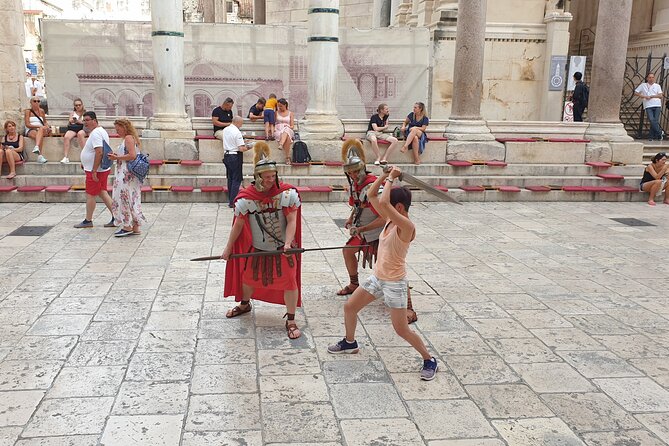
The tour begins at Peristil ulica, at the Peristyle of Diocletian’s Palace. Give yourself time to locate the meeting point. The central square is busy, and the starting place can be hard to identify if you arrive at the last minute.
The Peristyle is the right place to begin because it acts as the palace’s main junction. From here, you can reach much of the old complex. Your guide should explain the square’s role in the imperial plan before moving you into the smaller spaces nearby.
The stop lasts about 15 minutes and has no separate admission charge. It is also the point where group size matters most. If several guides are speaking at once, keep close enough to hear without blocking the view for others. Since headsets are not provided, your position in the group can affect how much you take in.
The Vestibule and the sound of Dalmatia
The Vestibule is a short stop, about five minutes, but it can be memorable. Here you learn about the entrance area associated with Emperor Diocletian. You may also hear traditional Dalmatian singing, depending on what is happening at the time.
That possible musical moment gives the walk a welcome human touch. It connects the old stone setting with local culture instead of treating the palace as a collection of dates. Do not count on a performance as a guaranteed part of the tour, but listen carefully if singing begins.
Because this space is brief and enclosed, a guide who speaks clearly makes a real difference. The route moves quickly, so this is a good place to ask a short question if you need context before continuing.
What the substructures reveal
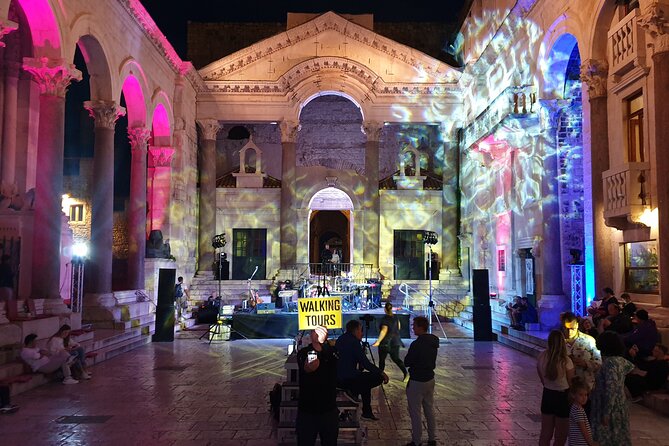
The substructures receive about 10 minutes. You pass through the lower level of Diocletian’s Palace and hear how it was built and how the space was used over the centuries.
This part is valuable because the lower rooms help explain the shape of the rooms above. They are not simply underground corridors. Their layout gives you a better sense of the palace’s construction and the way the complex changed over time.
There is an important limit: the museum section of the substructures is not included. Admission tickets are not included anywhere on the tour. You can visit the museum after the walk, but you should budget separately if you want a fuller look at the palace remains.
That arrangement makes the tour a useful introduction rather than a complete palace ticket. If you want detailed archaeological displays, plan extra time after the guided walk. If you mainly want orientation and explanation, the included pass-through may be enough.
Same stretch of coast, a completely different day out:
- Split: Krka Waterfalls Trip with Boat Cruise and Swimming
★ 4.8 · 10,519 reviews - From Split: Krka Waterfalls, Food & Wine Tasting Tour
★ 5.0 · 9,326 reviews - Blue cave, Mamma Mia and Hvar, 5 islands speedboat tour
★ 5.0 · 7,150 reviews - From Split: Krka Waterfalls, Food & Wine Tasting Tour
★ 4.9 · 6,598 reviews
The Golden Gate and Gregory of Nin
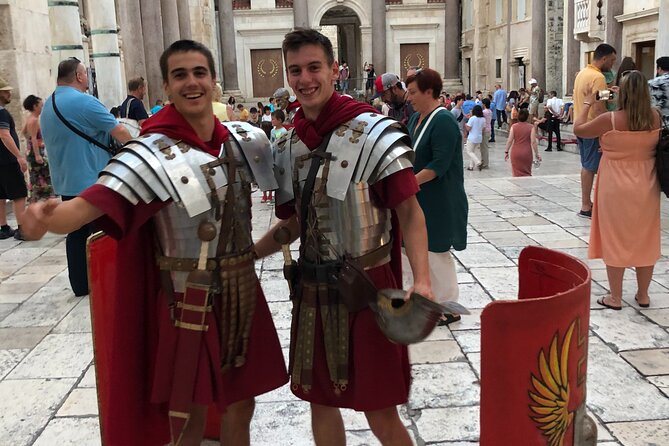
The Golden Gate is another 10-minute stop. It was the main entrance to the palace, and it gives your guide a chance to explain how people entered this imperial complex.
You also see the statue of Gregory of Nin and learn about his importance to Croatian history and language. This adds a national story to the Roman setting. The stop is not just about a doorway. It helps connect the palace to the wider Croatian story.
The route here can also help you understand the palace as a place that continued to matter after Diocletian. The most useful guides make that change over time easy to follow, rather than treating the Roman period as the only important chapter.
Riva Harbor and Split’s waterfront
At Riva Harbor, the tour spends about 15 minutes. You see a bronze model of Diocletian’s Palace and hear about the history of Split’s Riva promenade.
This is a welcome change of scale. After the tight lanes and monumental palace spaces, the waterfront gives you room to look back at the city as a whole. The bronze model can help you picture the palace’s original footprint, particularly if you found the interior streets confusing.
I like this stop for practical reasons, too. It helps you connect the old center to the public waterfront and gives you a better starting point for later independent wandering. The tour ends back at the meeting point, so you can return to the palace area after the walk if you want to revisit a place that went by quickly.
Fruit’s Square and Marko Marulić
Fruit’s Square, or Trg Braće Radić, receives about 10 minutes. Here you learn about a 15th-century Venetian citadel and the importance of Marko Marulić, often called the father of Croatian literature.
This stop broadens the tour beyond imperial architecture. The Venetian fortification and the story of Marulić show how Split’s identity developed after Roman rule. It is a good reminder that the city center is not one period preserved in amber. Different eras overlap in the same compact area.
The stop should appeal to you if you enjoy cultural context as much as buildings. If you want only Roman archaeology, it may feel like a detour, but the wider route gives a more useful picture of Split.
Split Synagogue and the city’s Jewish past

The final listed stop is Split Synagogue, where you pass by a 16th-century synagogue and learn about the Jewish community in the city. The stop lasts about 10 minutes, and admission is not included.
This is an important part of the route because it adds a religious and social dimension that is easy to miss when you focus only on Diocletian. The synagogue is presented as part of Split’s wider urban story, alongside Roman, Venetian, and Croatian landmarks.
Since this is a pass-by stop, do not expect a full interior visit as part of the tour. The value comes from the explanation and the chance to notice a place you might otherwise walk past.
The guides make the biggest difference
The strongest part of this experience is the person leading it. Several guides receive particularly warm praise for combining facts with humor and personal enthusiasm.
Antonella is described as organized, friendly, clear in English, and good at answering questions. Her background as a high school teacher is useful here because the tour calls for more than memorized dates. She has to explain a complicated site to people seeing it for the first time.
Anton, also referred to as Anthony in one account, is praised for energy, warmth, and a fun presentation of palace history. Mario is noted for answering questions beyond the main subject, while Professor Marino is described as deeply passionate about Split and its past.
That praise comes with an important qualification. Not every guide communicates in the same way. One group found a guide difficult to understand because he spoke softly and English was his second language. Another found the presentation unfocused and much longer than expected. Those experiences appear to be exceptions within a very high overall rating, but they are still relevant when you are paying this much.
Group size, hearing, and pace
The maximum group size is 20. That is smaller than a large coach excursion, but it is not an intimate private tour. In the narrow palace spaces, a group of 20 can spread out quickly.
The lack of headsets is the biggest practical weakness. Several people had trouble hearing when other groups were nearby or when the guide spoke softly. Stay near the guide, especially at the Peristyle and inside the substructures. If you have hearing concerns, this may not be the best format.
The stated duration is approximately 1 hour 30 minutes. One account says the tour lasted less than that, while another describes a much longer outing of about 2 and a half hours. The difference may come from the guide, questions, or an unusually extended presentation. I would allow two hours in your schedule, especially if you have a cruise departure or another fixed booking.
Several tour times are offered, which helps you fit the walk around meals, transport, or a short stay in Split. Your confirmation arrives at booking, but one reported booking problem caused a delayed start, and another cancellation occurred close to the planned departure. The experience has free cancellation up to 24 hours before the start time. Inside 24 hours, you should expect no refund.
Steps, transport, and who should choose it
The meeting point is near public transportation, and most people can take part. Service animals are allowed. The main physical concern is the palace itself, with high steps and uneven surfaces. If those are difficult for you, choose a different way to see the center.
Wear shoes with steady footing and keep your attention on the ground as you move between stops. This is a walking tour through an old city, not a smooth museum route. The short duration helps, but the surfaces still require care.
I think this tour suits first-time visitors who want a clear introduction, people stopping in Split for one day, and anyone who prefers stories to reading plaques alone. It also works well at the start of a longer stay because it gives you ideas for where to return.
You may want to skip it if you already know the palace well, need guaranteed access to the paid substructures museum, or require a private guide with audio equipment. At $48.37, you are paying mainly for interpretation and orientation, not admission.
Is the Walking Tour of Split worth booking?
Book it if you want a guided overview of Diocletian’s Palace and the surrounding center, especially early in your time in Split. The route covers a lot in 90 minutes, and a strong guide can make the palace much easier to understand.
I would book with realistic expectations. You are not buying entrance to every paid section, the group may be larger than expected, and sound can be a problem without headsets. Still, the 4.9 rating from 2,588 ratings and 99 percent recommendation point to a consistently well-received experience.
For the best chance of enjoying it, arrive early at the Peristyle, stay close to the guide, and leave extra time if your schedule is tight. If the guide is as focused and engaging as Antonella, Anton, Mario, or Marino, this is a useful and lively first look at Split. If you want a private, highly detailed archaeological visit, spend the money on a different format.
FAQ
How long does the walking tour last?
The advertised duration is approximately 1 hour 30 minutes. Some tours may finish sooner, while one reported experience lasted much longer, so allow extra time if you have a fixed schedule.
What does the tour include?
It includes a guided walk led by an educated guide with strong knowledge of the palace and surrounding locations. The route includes the Peristyle, Vestibule, palace substructures, Golden Gate, Riva Harbor, Fruit’s Square, and Split Synagogue.
Are admission tickets included?
No. Admission tickets are not included. The museum section of the palace substructures is not visited as part of the tour, though you can visit it afterward.
Where does the tour begin and end?
It begins at Peristil ulica, Peristil ul., 21000 Split, Croatia. The activity ends back at the meeting point.
How large can the group be?
The maximum group size is 20 people. Headsets are not provided, so staying near the guide is important if the area is noisy.
Can I cancel for a full refund?
Yes, if you cancel at least 24 hours before the experience start time. Cancellations or changes made less than 24 hours before the start time are not refunded or accepted.
More Walking Tours in Split
- Walking Tour of Split with a ‘Magister’ of History
★ 5.0 · 1,122 reviews - Split Walking Tour with Professor of History
★ 5.0 · 926 reviews - Split: Diocletian Palace & Old Town Guided Walking Tour
★ 4.7 · 882 reviews - From Split: Krka Waterfalls Cruise & Trogir Walking Tour
★ 4.7 · 681 reviews
Just added around Split
- Split Sunset Stand Up Paddle Tour★ 5.0 · 16 reviews
- Split: Sunset Guided Kayaking Tour★ 4.8 · 71 reviews
- Split&Sip: Educational wine tasting★ 4.9 · 52 reviews
- Stand Up Paddle Tour in Split★ 4.7 · 17 reviews
- Split: Guided Walking Tour in English★ 4.9 · 10 reviews
- Split – Walking in Khaleesi Footsteps in the City of Dragons★ 5.0 · 13 reviews
- Split Walking Tour with History Professor★ 5.0 · 23 reviews
- Split Walking Tour: History, Legends & Tales★ 5.0 · 9 reviews
Old Town Walking Tours, compared.

Krka Waterfalls tour with Trogir Walking tour and Krka panoramic boat cruise
Read our review →
City Walls Early Morning or Sunset Walking Tour
Read our review →
Plitvice Lakes with Boat Ride and Zadar Old Town Tour
Read our review →
Browse the lists this tour appears in