
Reviewed · OLD TOWN WALKING TOURS
Split Walking Tour with Professor of History
Split’s old town is not a museum behind glass. People live, work, eat, and meet inside the walls of Diocletian’s Palace, and this tour helps you read that remarkable mix of Roman stone and modern Split. A history professor leads you from the Riva to the palace substructures, cathedral, gates, squares, and local streets.
I like the strong historical focus, especially with guides such as Mario and Anita, and I like the route’s small-group limit of 17 people, which gives you a better chance to hear and ask questions. The main drawback is the pace: the advertised time is about 2 hours 20 minutes, but the tour may run closer to three hours, and most major interiors are viewed from outside.
In This Review
- Key points at a glance
- Why a professor-led walk helps in Split
- Starting at the Riva and Brass Gate
- The palace substructures and the Peristyle
- The Vestibule, cathedral, and Jupiter’s temple
- The Golden Gate and Gregory of Nin
- Marmontova Street, Prokurative, and Fruit’s Square
- The pace, group size, and guide style
- What $24.19 buys you
- Who should book this Split walk?
- Should you book the Split Walking Tour with a History Professor?
- FAQ
- Where does the Split walking tour begin?
- Where does the tour end?
- How long does the tour last?
- Is the tour offered in English?
- Are entrance tickets included?
- What is the maximum group size?
Key points at a glance
- Roman Split in everyday life: See how Diocletian’s Palace became the core of a living city rather than a frozen ruin.
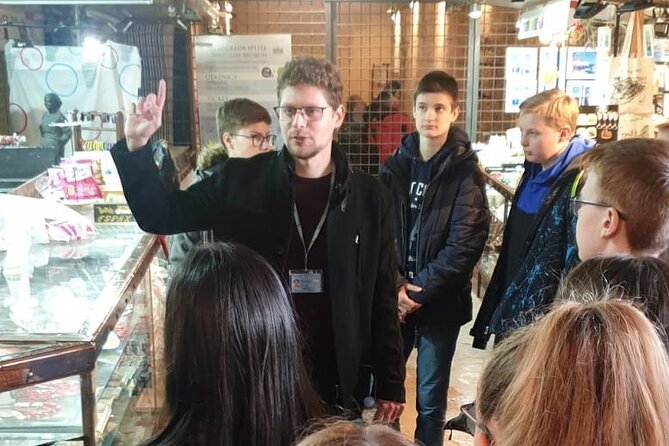
- History professors as guides: Mario and Anita combine dates and architecture with humor, local customs, food advice, and modern Croatian context.
- A useful first-day orientation: The route covers the Riva, palace, Golden Gate, Marmontova Street, Prokurative, and Fruit’s Square.
- Small group, limited to 17: This is more personal than a giant flag-following walk, though group size can still affect how easily you hear.
- A good price for context: At $24.19 per person, the tour offers a lot of explanation without charging separate entry fees.
- Plan for extra time: Some groups finish late, and the tour requires standing and walking through busy old-town streets.
Why a professor-led walk helps in Split
Split can look confusing at first. A Roman palace forms the old town, medieval homes fill its former corridors, and cafés and shops occupy spaces that once served an emperor. Without context, you may notice handsome stonework but miss the reason the city feels so unusual.
This walk gives you a framework. You learn where the imperial apartments stood, how the palace was arranged, why the cathedral began as a Roman mausoleum, and how later centuries reshaped the site.
The strongest part of the experience is the guide’s ability to connect big events with small details. Mario is repeatedly praised for mixing serious history with humor, trivia, local food suggestions, advice about ATMs and banks, and tips for onward travel. Anita brings a similarly personal touch, with clear pride in Croatia and careful attention to the people in her group.
That teaching style suits you if you want more than a list of dates. It also helps if this is your first visit to Split and you want to know which places deserve a second look after the walk.
The English-language tour is designed for a broad audience. You do not need specialist knowledge of Roman history, but you should enjoy listening. This is not a quick photo stop at each landmark. Your guide may pause to explain an inscription, correct a popular myth, or ask questions that make you look again at the building in front of you.
More Old Town Walking Tours in Split
- Split: Old Town and Diocletian Palace Walking Tour
★ 4.9 · 4,727 reviews - Walking Tour of Split and Diocletian’s Palace
★ 5.0 · 2,588 reviews - Krka Waterfalls tour with Trogir Walking tour and Krka panoramic boat cruise
★ 5.0 · 1,659 reviews
Starting at the Riva and Brass Gate
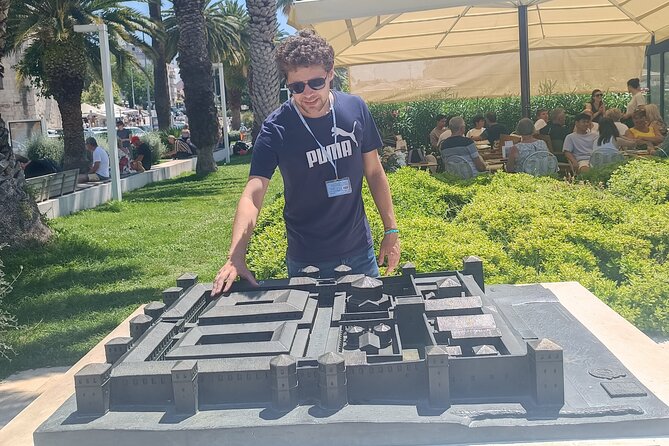
The meeting point is the Brass Gate, also called Porta Aenea, at Obala Hrvatskog narodnog preporoda 22. The tour begins beside a model of Diocletian’s Palace, near the Riva harbor promenade.
The Riva is more than a waterfront walkway. It is where people sit over coffee, enjoy the sun, and take part in the city’s daily social life. Starting here gives you a useful contrast: first you see modern Split at ease, then you move into the ancient palace that still shapes the town.
Allow a little time to find the Brass Gate. The old town has several entrances, and the waterfront can be busy. Since the activity ends back at the meeting point, you can easily use the tour as a first orientation and then return to places that caught your attention.
The first stop lasts about 15 minutes and has no admission charge. It is a gentle start, but do not dismiss it as filler. The Riva explains how Split works today, while the palace model gives you a visual map before you enter the stone maze.
The palace substructures and the Peristyle
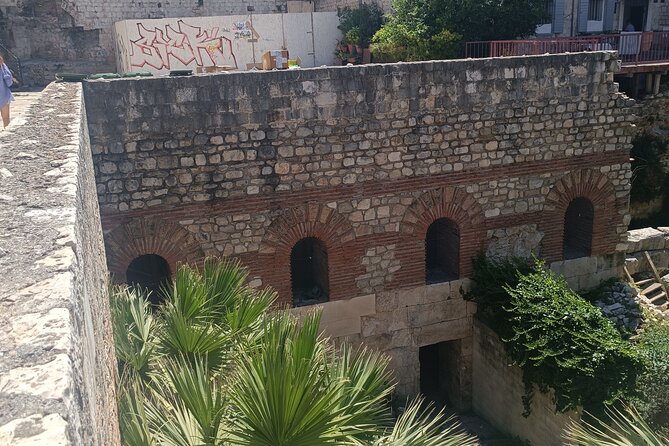
The basement halls of Diocletian’s Palace are among the best-preserved complexes from classical antiquity. These substructures also explain why Split’s historic center received UNESCO World Heritage status in 1979.
The tour allocates about 15 minutes here. That is enough for an introduction, though not for every corner or a long archaeological study. The key idea is that the lower level mirrors much of the palace plan above it, helping you understand the imperial complex as a designed residence rather than a random collection of old walls.
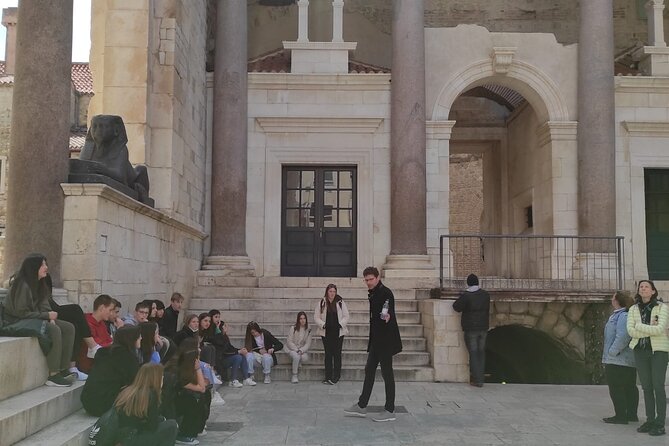
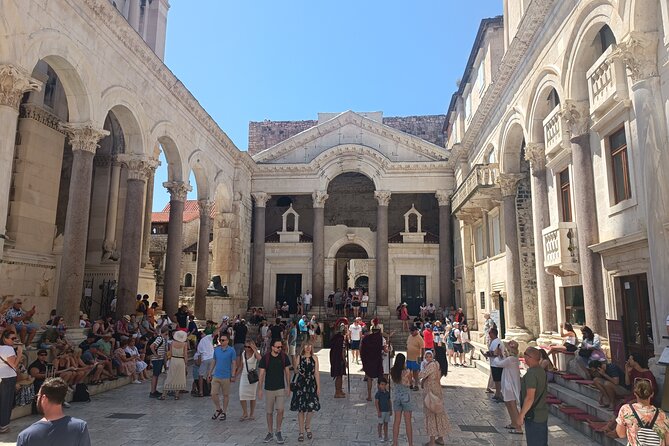
Next comes the Peristyle, the palace’s central square. This is where the emperor appeared beneath the central architrave of the Protyron, presenting himself as the living son of Jupiter. Your guide can help you picture the ceremony: subjects approached on their knees, kissed the edge of his scarlet cloak, or prostrated themselves before him.
The stop lasts about 10 minutes. The square can be crowded, and it is an open public space, so your listening conditions depend on the time of day. A skilled guide will keep the group together and position the explanation where possible, but you should stay close and watch for the group’s movement.
The Vestibule, cathedral, and Jupiter’s temple
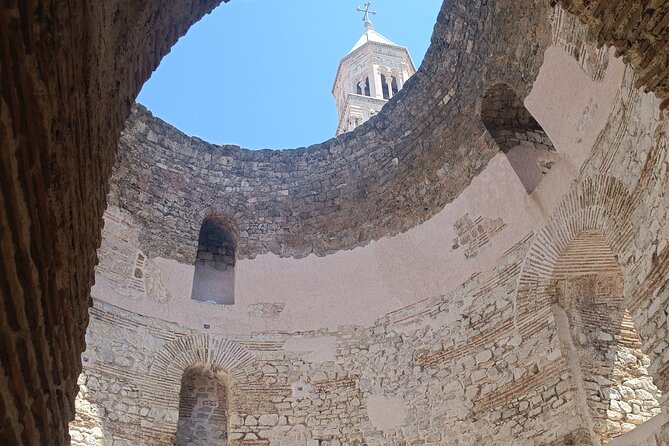
The Vestibule is a circular hall that once served as the formal entrance to the imperial apartments. It was built by the beginning of the fourth century and originally had a dome. The room measures about 17 meters high and 12 meters across, making its proportions easier to appreciate when your guide explains its role.
This was not a casual hallway. It was intended as a grand meeting space for selected audiences, including ambassadors. The tour spends about 10 minutes here, enough to connect the room’s shape and scale with the ceremony of imperial power.
The Cathedral of Saint Domnius adds one of Split’s most interesting layers. It began as a Roman temple and mausoleum, then became a church. You see it from outside during the tour, with about 20 minutes devoted to its story. Entry is not included, but the guide provides information if you want to visit the interior later.
This arrangement keeps the walking tour reasonably priced, but it also means you should budget separately if you want to enter the cathedral or other paid sites. The tour itself includes all fees and taxes, yet that does not cover optional admission to interiors.
The Temple of Jupiter is another outside stop. Jupiter was the Roman sky and thunder god and the supreme figure in Roman religion. The building later became a baptistery dedicated to Saint John the Baptist, a neat example of how Split’s religious life changed while the structure remained in use.
The stop takes about 10 minutes. On the way to the Golden Gate, you pass Let Me Pass Street, a narrow lane between the ancient temple and a medieval building. Local people consider it the narrowest street in the world. Treat that as a local claim and a fun bit of street lore rather than a fact you need to prove with a measuring tape.
Same stretch of coast, a completely different day out:
- Split: Krka Waterfalls Trip with Boat Cruise and Swimming
★ 4.8 · 10,519 reviews - From Split: Krka Waterfalls, Food & Wine Tasting Tour
★ 5.0 · 9,326 reviews - Blue cave, Mamma Mia and Hvar, 5 islands speedboat tour
★ 5.0 · 7,150 reviews - From Split: Krka Waterfalls, Food & Wine Tasting Tour
★ 4.9 · 6,598 reviews
The Golden Gate and Gregory of Nin
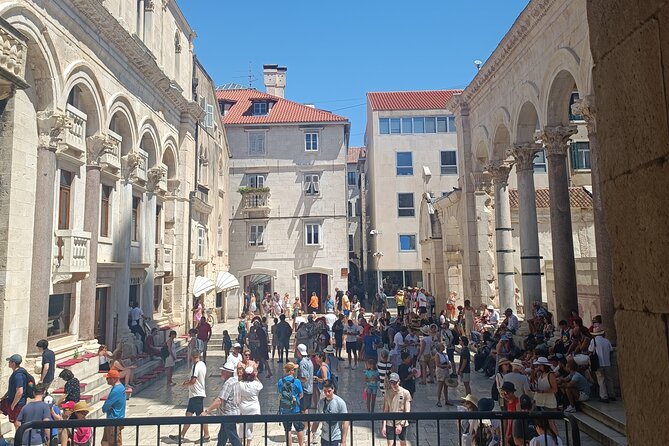
The Golden Gate, also called the Northern Gate, was one of the four main Roman entrances to the palace. It was the route used by Diocletian to enter the complex and originally had elaborate decoration to mark its importance.
Over the centuries, the gate lost columns and statuary and was sealed during the Middle Ages. It was later reopened and repaired, and today it provides one of the clearest views of how the palace controlled movement into the city.
The tour spends about 15 minutes here. This is a good moment to ask how the palace functioned as a secure imperial residence and how later residents adapted the old Roman structure.
Nearby, you find the 8.5-meter statue of Gregory of Nin by Croatian sculptor Ivan Meštrović. The statue is a popular stop, especially because rubbing its toe is said to bring good luck. Years of hands have polished the toe smooth and shiny.
You get about 10 minutes at the statue. It is an easy place for a quick photo, but the more useful point is Gregory’s place in Croatian cultural and religious history. Your guide can give the monument meaning beyond the familiar good-luck gesture.
Marmontova Street, Prokurative, and Fruit’s Square
The route then shifts away from the Roman core and shows you later chapters of Split. Marmontova Ulica is named for Napoleon’s marshal Marmont, who helped urbanize Dalmatian cities during the French period.
The street is described locally as one of Split’s most attractive. The stop lasts about 10 minutes, and it helps you see that the city’s character was shaped by more than Roman rule and medieval building.
Prokurative, officially Republic Square, is a broad open space enclosed on three sides by neo-Renaissance buildings. Its architecture differs sharply from the palace, which is exactly why it belongs on the route. You get about 10 minutes to take in the square and hear how Split expanded beyond its ancient walls.
The final stop is Fruit’s Square, or Trg Braće Radić. Its name recalls the women who once sold fruit there. The square also contains a statue of Marko Marulić, often called the father of Croatian literature.
This closing stop lasts about 15 minutes and is a smart place to finish. The square provides a setting for conversations about Croatian history, local food, and gastronomy. Guides such as Mario may also offer suggestions for eating and further sightseeing, which can be especially helpful if you are still deciding how to spend the rest of your time in Split.
The pace, group size, and guide style
The formal duration is approximately 2 hours 20 minutes. In practice, the walk can run longer, sometimes close to three hours, especially when the guide adds stories or answers questions.
That extra time may be welcome if you enjoy history. It may feel tiring if you have young children, limited mobility, or a tight cruise departure. You will walk between stops and spend time standing, often in public spaces where shade and seating are not guaranteed.
The group limit is 17 people. That is small enough for a more direct exchange than a large city tour, but it is not a private walk. If you want a fully tailored route and constant access to your guide, the private upgrade is the better choice.
The strongest guide feedback centers on Mario. He is described as funny, warm, well organized, and able to explain complex subjects in clear English. He also makes an effort to avoid blocking other groups, keep people in the shade when possible, and move the group often enough to reduce discomfort from standing.
Anita is also named as an excellent guide. Her approach is described as thoughtful and caring, with a clear sense of pride in Croatian culture. Since guide assignment can vary, you should not book on the assumption that you will receive a particular person unless the provider confirms it.
What $24.19 buys you
At $24.19 per person, this is a strong value if you want orientation and interpretation rather than included entry into major monuments. You cover a long stretch of Split’s story in one walk, from Roman imperial power to French-era urban planning and Croatian literary culture.
The price includes all fees and taxes. Alcoholic drinks are not included, though that is not a serious limitation for a daytime history walk. More important, admission to the Cathedral of Saint Domnius and the Temple of Jupiter is not included, and both are viewed from outside during the tour.
I see the tour as a good first investment. You can learn what matters, note the interiors you want to see, and pay for only the sites that interest you afterward. Several people have used the walk in exactly that way, returning to selected places for a closer look.
The tour is booked an average of 33 days ahead, so popular dates may fill early. That timing is useful if your Split visit falls during a busy season. Free cancellation is available until 24 hours before the start time, while poor weather may lead to another date or a full refund.
Who should book this Split walk?
I would choose this tour if you are visiting Split for the first time, enjoy history, or want a clear explanation of how an ancient palace became a modern town. It is also a good match if you like guides who teach through stories, jokes, questions, and local advice.
It suits couples, solo visitors, and small groups who want a shared experience without joining a huge crowd. The small-group cap helps, though you should still stay close to the guide in busy streets.
You may want a different option if you prefer to explore independently, dislike long explanations, or need guaranteed access to interiors. This experience is also less suitable for a strict schedule because it may run beyond the stated duration.
Wear comfortable shoes and bring water. Keep the meeting details handy, arrive at the Brass Gate with time to spare, and consider scheduling the walk early in your stay so the restaurant and sightseeing suggestions can guide the rest of your visit.
Should you book the Split Walking Tour with a History Professor?
Yes, if you want Split to make sense rather than simply look old. For $24.19, you get a well-planned route, a professor-led explanation, and a useful introduction to the Roman palace, later city life, and Croatian culture.
The best reason to book is the guide style. Mario and Anita bring teaching skill, humor, and local pride to a city that can otherwise feel like a maze of impressive stones. Just allow extra time, remember that key interiors cost more, and choose the private upgrade if personal attention matters most.
FAQ
Where does the Split walking tour begin?
The tour begins at the Brass Gate, also called Porta Aenea, at Obala Hrvatskog narodnog preporoda 22 in Split.
Where does the tour end?
The activity ends back at the meeting point.
How long does the tour last?
The listed duration is approximately 2 hours 20 minutes. It may run longer, with one account describing a finish closer to three hours.
Is the tour offered in English?
Yes. English is the offered language.
Are entrance tickets included?
The tour includes all fees and taxes, but admission to the Cathedral of Saint Domnius and the Temple of Jupiter is not included. Both are visited from outside during the walk.
What is the maximum group size?
The tour accepts a maximum of 17 people. A private upgrade is also available for a more personalized experience.
More Walking Tours in Split
- Split & Diocletian’s Palace Walking Tour
★ 5.0 · 1,125 reviews - Split: Diocletian Palace & Old Town Guided Walking Tour
★ 4.7 · 882 reviews - From Split: Krka Waterfalls Cruise & Trogir Walking Tour
★ 4.7 · 681 reviews - Diocletian’s Palace and Old Town SMALL GROUP Walking Tour
★ 5.0 · 502 reviews
More Historical Tours in Split
- Walking Tour of Split with a ‘Magister’ of History
★ 5.0 · 1,122 reviews - Split: History and Heritage Walking Tour
★ 4.9 · 650 reviews - Split History and Gastro Small-Group Tour with Food and Drinks
★ 5.0 · 375 reviews - SPLIT-PREMIUM Emperor’s Walking Tour for History Lovers + Museum
★ 5.0 · 333 reviews
Just added around Split
- Split Sunset Stand Up Paddle Tour★ 5.0 · 16 reviews
- Split: Sunset Guided Kayaking Tour★ 4.8 · 71 reviews
- Split&Sip: Educational wine tasting★ 4.9 · 52 reviews
- Stand Up Paddle Tour in Split★ 4.7 · 17 reviews
- Split: Guided Walking Tour in English★ 4.9 · 10 reviews
- Split Walking Tour with History Professor★ 5.0 · 23 reviews
- Split Walking Tour: History, Legends & Tales★ 5.0 · 9 reviews
- Split – Walking in Khaleesi Footsteps in the City of Dragons★ 5.0 · 13 reviews
Old Town Walking Tours, compared.
Walking Tour of Split and Diocletian’s Palace
Read our review →

Krka Waterfalls tour with Trogir Walking tour and Krka panoramic boat cruise
Read our review →
City Walls Early Morning or Sunset Walking Tour
Read our review →
Plitvice Lakes with Boat Ride and Zadar Old Town Tour
Read our review →Browse the lists this tour appears in