
Reviewed · OLD TOWN WALKING TOURS
Walking Tour of Split with a ‘Magister’ of History
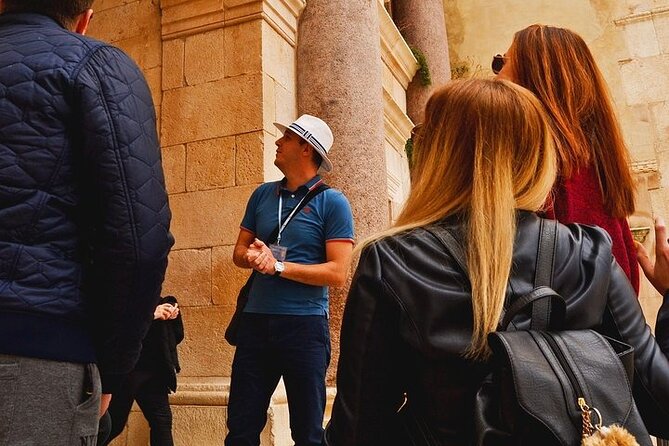
Split makes far more sense once you understand that its old town grew inside a Roman emperor’s retirement palace. On this walking tour, Toni Šare uses his own 3D reconstructions to show how Diocletian’s Palace looked in its prime, then traces the Roman, medieval, Venetian, and modern layers still packed into the streets.
I like two things right away: the tour gives you historical context before you start poking around the palace, and Toni brings a local’s connection to Split along with his academic background. The main consideration is that this is a walking and lecture-style tour, with no entry to the cathedral, temple, museums, or other paid sites.
In This Review
- Key points at a glance
- Why Split is best understood from inside Diocletian’s Palace
- Starting beside the Riva and the palace’s southern wall
- Reading the Peristyle as a Roman ceremonial square
- The Cathedral of Saint Domnius and Diocletian’s mausoleum
- Finding Roman mistakes at the Temple of Jupiter
- The Silver Gate and the surviving Roman road
- Grgur Ninski, language, and early medieval Croatia
- Entering the Vestibule and tracing the emperor’s private quarters
- The Golden Gate and the medieval reuse of Roman walls
- Ending at Pjaca and the Old Town Hall
- What the 3D reconstructions add
- Price, group size, and the value of the walk
- Timing, weather, and who should book
- Should you book Toni’s Split walking tour?
- FAQ
- How long does the Walking Tour of Split with a Magister of History last?
- Who leads the tour?
- Where does the tour begin?
- Where does the tour end?
- Are admission tickets included?
- Is the tour offered in English?
- What is the cancellation policy?
Key points at a glance
- Toni Šare leads the walk: He is a Split native, historian, teacher, and owner of DiocleSpot Tours.
- 3D images make ruins easier to read: You see how the palace’s missing buildings and decorations may have appeared in Roman times.
- The route covers several eras: Roman remains share space with medieval gates, Renaissance palaces, Venetian influence, and modern Split.
- You visit the key palace landmarks: The Riva, Peristyle, cathedral, Temple of Jupiter, Silver Gate, Vestibule, Golden Gate, and Old Town Hall all feature.
- The tour stays outside paid attractions: This keeps the cost down, but you will need separate tickets if you want to go inside.
- The small group size helps: Groups can include up to 18 people, and private upgrades are available.
Why Split is best understood from inside Diocletian’s Palace
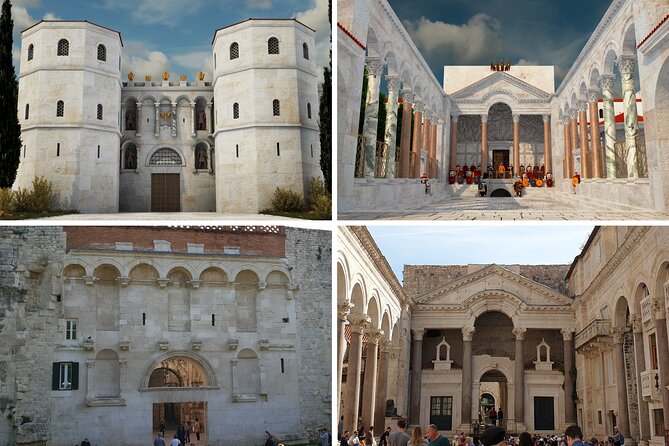
The old center of Split is not simply a Roman ruin with a town built nearby. Much of the town grew within and around the palace built for Emperor Diocletian, who retired to the Dalmatian coast in the early fourth century.
That basic fact is easy to miss when you are busy looking at cafés, laundry, shop signs, and polished stone alleys. Toni’s approach gives you a framework. He points out what is Roman, what came later, and how residents reused the imperial complex over centuries.
I especially like that the tour does not stop with ancient Rome. Split’s story includes medieval Croatians, Venetian rule, noble families, religious change, and modern local life. The Roman remains may draw you in, but the later layers explain why Split feels like a lived-in city rather than an open-air archaeological park.
The walk lasts about 1 hour 40 minutes to 1 hour 50 minutes. That is long enough for a useful introduction without taking up your whole day. I would place it near the start of your stay, so the lanes and courtyards you revisit later already have meaning.
More Old Town Walking Tours in Split
- Split: Old Town and Diocletian Palace Walking Tour
★ 4.9 · 4,727 reviews - Walking Tour of Split and Diocletian’s Palace
★ 5.0 · 2,588 reviews - Krka Waterfalls tour with Trogir Walking tour and Krka panoramic boat cruise
★ 5.0 · 1,659 reviews
Starting beside the Riva and the palace’s southern wall
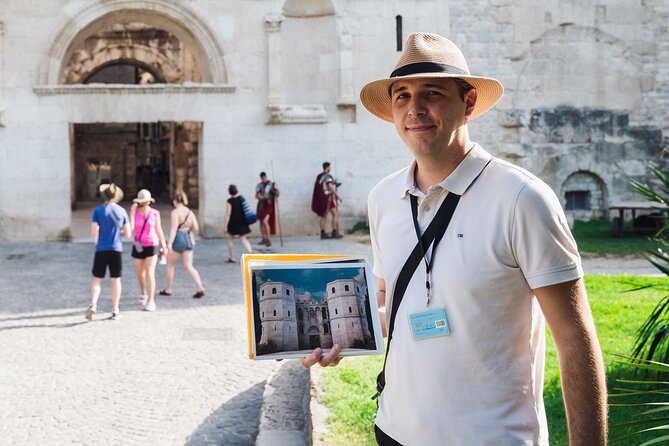
You meet Toni at the Brass Gate, also called Porta Aenea, on the Riva at Obala Hrvatskog narodnog preporoda 22. This is a practical starting point. The waterfront is easy to find, and the palace’s southern wall is clearly visible from here.
The Riva is more than a pretty promenade. It is a central meeting place for local residents and a good spot to understand Split’s relationship with the sea. Toni uses graphic displays and models here to explain what you are about to see inside the palace.
This opening matters because the palace can feel confusing at street level. Its original plan was designed as a fortified imperial residence, but centuries of building and rebuilding have softened the shape. A short explanation at the harbor helps you recognize the surviving walls and imagine the palace as a single planned complex.
The meeting point is outdoors, so arrive ready to walk. The tour is offered in English, and mobile tickets are accepted.
Reading the Peristyle as a Roman ceremonial square
The Peristyle is the central square of Diocletian’s Palace and one of the most striking spaces in Split. It is also one of the places where a guide adds real value. You can see the columns, stonework, and surrounding structures on your own, but it takes explanation to understand how the square functioned.
Toni uses his 3D reconstructions to show the original decoration and arrangement. This is one of the most useful parts of the experience because Roman buildings often survive as fragments. A digital or printed reconstruction can turn a few columns into a picture of a grand ceremonial setting.
You have about 10 minutes here. That sounds brief, but the tour continues through related palace spaces, so the Peristyle is not treated as an isolated photo stop. You should have time to look closely, ask questions, and connect the square to what comes next.
The square can be busy, and sound may carry unevenly among the stone walls. A group of up to 18 people is still fairly manageable, though you may want to stay close to Toni when he is explaining details.
The Cathedral of Saint Domnius and Diocletian’s mausoleum
The Cathedral of Saint Domnius occupies Diocletian’s former mausoleum. That change tells you a great deal about Split: a building created to honor a Roman emperor was later adapted for Christian worship and remains in use today.
Toni explains the original purpose of the structure, its conversion into a cathedral, and the related bell tower. He also discusses how the building fits into the wider palace complex.
You do not enter the cathedral on this tour. That is important to know if seeing the interior is a priority. The advantage is that you avoid adding an admission stop to a short walking tour, leaving more time for the story of the building and the surrounding streets.
If you want to go inside, you will need to arrange that separately and pay the relevant admission. The tour gives you the background first, which can make an independent visit afterward more rewarding.
Same stretch of coast, a completely different day out:
- Split: Krka Waterfalls Trip with Boat Cruise and Swimming
★ 4.8 · 10,519 reviews - From Split: Krka Waterfalls, Food & Wine Tasting Tour
★ 5.0 · 9,326 reviews - Blue cave, Mamma Mia and Hvar, 5 islands speedboat tour
★ 5.0 · 7,150 reviews - From Split: Krka Waterfalls, Food & Wine Tasting Tour
★ 4.9 · 6,598 reviews
Finding Roman mistakes at the Temple of Jupiter
The Temple of Jupiter is another well-preserved Roman structure, and Toni focuses on details that are easy to overlook. He points out construction anomalies and mistakes made during the building process.
That is a refreshing angle. Ancient monuments can seem too perfect and remote, especially when a guide only lists dates and architectural terms. Small flaws make the site more human. They remind you that Roman builders worked with real materials, real constraints, and the occasional error.
The temple is viewed from outside, with no admission included. Toni explains the relevant features without taking the group indoors. You get the benefit of interpretation while keeping the pace moving.
This stop is also a good example of the tour’s general method. The aim is not only to show famous places. It is to train your eye so you notice details in the stonework and layout that you might otherwise walk past.
The Silver Gate and the surviving Roman road
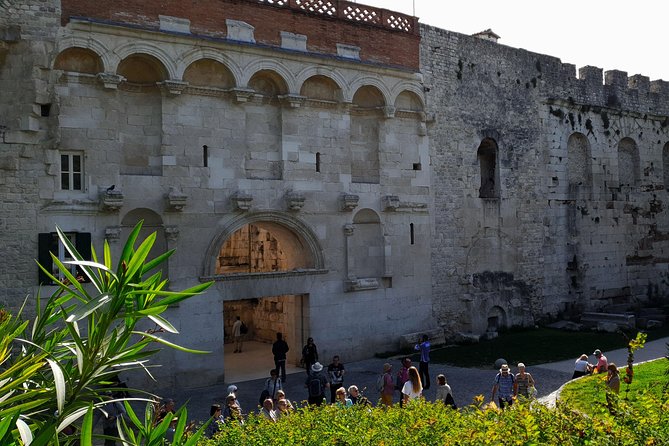
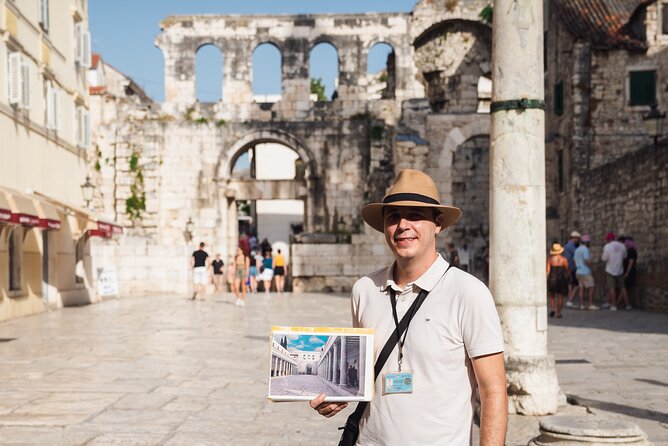
At the Eastern, or Silver, Gate, you get one of the clearest views of the palace’s relationship between Roman construction and later city life. From this point, you can see the cathedral on one side, the gate on the other, and a preserved section of the original road below.
The stop lasts about five minutes, so it is concise. Still, the view helps pull several earlier explanations together. The palace was not a collection of unrelated ruins. Its gates, roads, walls, and major buildings were planned as parts of one imperial residence.
The Silver Gate also shows how useful it is to tour on foot. From a vehicle, you would miss the scale and changes in paving under your feet. Here, you can pause, look down, and understand the old route through the palace.
Grgur Ninski, language, and early medieval Croatia
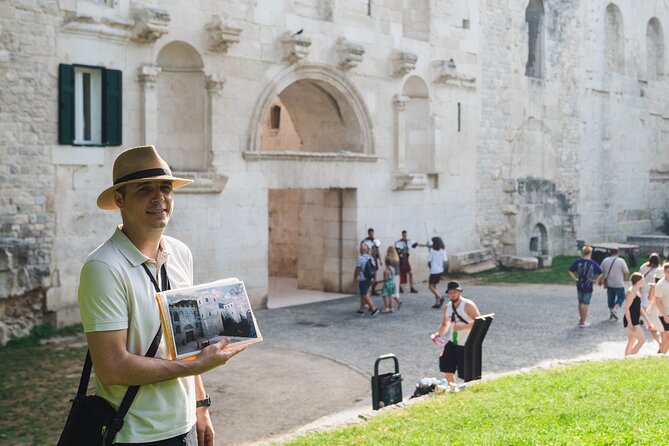
The statue of Grgur Ninski, or Gregory of Nin, is a major Split landmark. Toni explains what the figure represents and connects it with the Croatian language and culture of the early medieval period.
This is a welcome shift away from Roman architecture. Split’s identity is not frozen in the fourth century, and this stop gives you a glimpse of the political and cultural changes that followed.
The stop is short, about five minutes, but it adds national context to a city tour that could otherwise become too focused on emperors and columns. It also shows why a local historian can be useful. The statue is easy to photograph, but its meaning is less obvious without explanation.
Entering the Vestibule and tracing the emperor’s private quarters
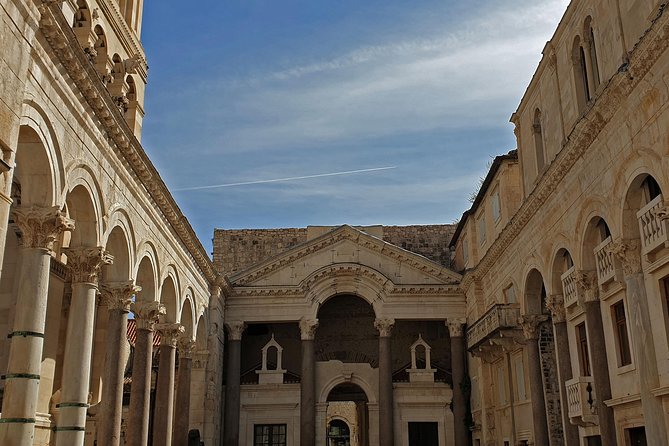
The Vestibule was the ancient entrance to Diocletian’s private residence. From here, Toni leads you around the remains associated with the emperor’s personal spaces.
This section helps you distinguish the palace’s public and private functions. The Peristyle served a ceremonial role, while the southern portion was tied to the emperor’s residence. The 3D reconstructions are particularly helpful here because the surviving walls do not always make the original rooms easy to picture.
You also pass various noble palaces along the route. These later residences show how aristocratic families adapted the old Roman setting for their own use. The walk moves naturally between imperial Rome and the later city, which is one of its strongest features.
Depending on the group’s interest, Toni may also point out Game of Thrones filming locations in Split and the nearby fan shop. This is an optional thread, not the central subject. It can be fun if you enjoy the series, but the tour remains worthwhile if you prefer architecture and local history.
The Golden Gate and the medieval reuse of Roman walls
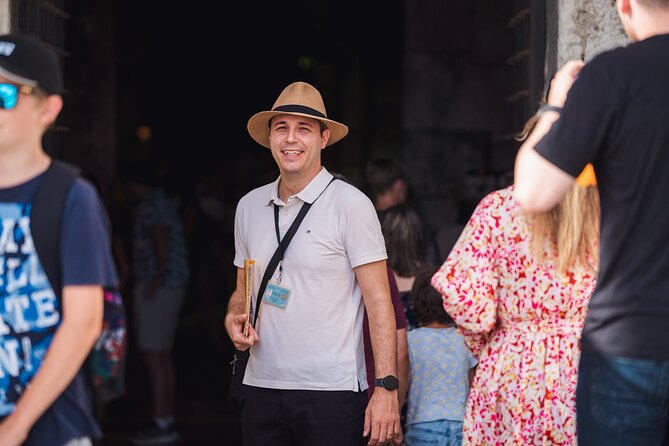
The Golden Gate is the best-preserved and most decorated of the palace’s four entrances. It is also a strong place to see the northern wall and understand how the medieval city reused Roman defenses.
Toni explains which parts remained useful and which elements were removed or changed. This is where the passage of time becomes visible. The old wall was not treated as a museum object. People adapted it for defense, homes, movement, and daily life.
The Golden Gate receives about 15 minutes, giving you time to study the details and ask questions. It is one of the more rewarding stops for photographs, though the surrounding area can have steady foot traffic.
Nearby, Toni shows you the courtyard of the City Museum of Split. You do not enter the museum itself. The courtyard sits within a Renaissance noble palace and provides a chance to discuss Venetian influence and the rise of this type of grand residence.
That stop is especially useful if you want to understand Split beyond its Roman beginnings. The city’s later architecture is not a footnote. It helps explain the streets, courtyards, and façades you see throughout the old center.
Ending at Pjaca and the Old Town Hall
The tour ends at Narodni trg, commonly called Pjaca or Piazza Square. This has been Split’s main square since medieval times, making it a fitting final stop.
Here you see the fourteenth-century Old Town Hall and other historic structures. More important for your day, this is a useful place to finish. From Pjaca, many parts of the old center are easy to reach, and Toni can help you orient yourself for the rest of your visit.
The final stop lasts about five minutes. It is not a grand finale in the theatrical sense. Instead, it leaves you in a central location with a clearer mental map and several possible directions for further exploring.
What the 3D reconstructions add
Many city tours rely on a guide’s spoken description. Toni adds his own visual reconstructions of Diocletian’s Palace, showing how the complex may have looked during its imperial period.
These images are not a substitute for the actual ruins, but they solve a common problem. When you look at a partial wall or a single column, your mind may struggle to rebuild the missing structure. The reconstructions give you a reference point, then you can compare the image with what remains.
The visual aid also supports Toni’s interest in construction details, changes over time, and the palace’s later use. I would consider this one of the clearest reasons to choose this walk over a basic orientation tour.
Price, group size, and the value of the walk
The listed price is $34.83 per person. For roughly 105 minutes with a historian-led route through Split’s most important central sights, that is a fair price, especially if you want interpretation rather than just directions.
The value depends on how you travel. If you enjoy wandering alone and reading plaques, you can see the exterior landmarks without paying for a tour. But you will miss the connected story, the 3D reconstructions, and the small details about construction, language, religion, and local culture.
The tour allows up to 18 people. That is not a private experience, but it is small enough for questions and for moving into tighter palace spaces. A private upgrade is available if you want more control over pace and discussion.
Group discounts may help if you are traveling with several people. The tour is offered in English and uses mobile tickets, which keeps the booking process simple.
Timing, weather, and who should book
A morning start works well if you want to use Toni’s suggestions to plan the rest of your day. An evening tour can be a smart choice during hot summer weather, based on the available start times and practical experience shared about the walk.
The route is outdoors and requires good weather. If poor weather cancels the experience, you can choose another date or receive a full refund. You can also cancel for a full refund up to 24 hours before the start time, but later cancellations and changes are not refunded or accepted.
I would choose this tour if you enjoy history, architecture, local culture, or seeing how a city changed over many centuries. It is also a good first activity in Split because it gives you a working map of the old center.
You may want another option if your main goal is entering the cathedral, Temple of Jupiter, museums, or other paid attractions. Those admissions are not included, and this tour focuses on exterior interpretation.
Should you book Toni’s Split walking tour?
I would book it, especially for your first day in Split. Toni’s strongest qualities are his passion for the city, his command of local history, and his ability to connect Roman remains with medieval, Renaissance, Venetian, and modern life.
The 3D reconstructions make the palace easier to picture, while the route covers more than the usual postcard stops. You also finish at Pjaca, where it is simple to continue exploring.
At $34.83, you are paying for explanation and context rather than admission tickets. If that is what you want, this is a strong use of about two hours. If you prefer to spend your time inside monuments, plan those visits separately and treat this walk as the historical introduction that makes them easier to understand.
FAQ
How long does the Walking Tour of Split with a Magister of History last?
The tour lasts approximately 1 hour 40 minutes to 1 hour 50 minutes.
Who leads the tour?
The guide is Toni Šare, the owner of DiocleSpot Tours. He is a local historian who grew up in Split and has studied and taught history.
Where does the tour begin?
The meeting point is the Brass Gate, or Porta Aenea, at Obala Hrvatskog narodnog preporoda 22 in Split.
Where does the tour end?
The walk ends at Narodni trg, also called Pjaca or Piazza Square, in the center of Split.
Are admission tickets included?
No. The tour does not include entry to museums, the cathedral, the Temple of Jupiter, or other paid sites. The listed stops are explained from outside or from free-access areas.
Is the tour offered in English?
Yes. The experience is offered in English.
What is the cancellation policy?
You can cancel at least 24 hours before the start time for a full refund. Changes or cancellations made less than 24 hours before the start time are not accepted or refunded. If poor weather causes the tour to be canceled, you will be offered another date or a full refund.
More Walking Tours in Split
- Split & Diocletian’s Palace Walking Tour
★ 5.0 · 1,125 reviews - Split: Diocletian Palace & Old Town Guided Walking Tour
★ 4.7 · 882 reviews - From Split: Krka Waterfalls Cruise & Trogir Walking Tour
★ 4.7 · 681 reviews - Diocletian’s Palace and Old Town SMALL GROUP Walking Tour
★ 5.0 · 502 reviews
More Historical Tours in Split
- Split Walking Tour with Professor of History
★ 5.0 · 926 reviews - Split: History and Heritage Walking Tour
★ 4.9 · 650 reviews - Split History and Gastro Small-Group Tour with Food and Drinks
★ 5.0 · 375 reviews - SPLIT-PREMIUM Emperor’s Walking Tour for History Lovers + Museum
★ 5.0 · 333 reviews
Just added around Split
- Split Sunset Stand Up Paddle Tour★ 5.0 · 16 reviews
- Split: Sunset Guided Kayaking Tour★ 4.8 · 71 reviews
- Split&Sip: Educational wine tasting★ 4.9 · 52 reviews
- Stand Up Paddle Tour in Split★ 4.7 · 17 reviews
- Split: Guided Walking Tour in English★ 4.9 · 10 reviews
- Split Walking Tour with History Professor★ 5.0 · 23 reviews
- Split Walking Tour: History, Legends & Tales★ 5.0 · 9 reviews
- Split – Walking in Khaleesi Footsteps in the City of Dragons★ 5.0 · 13 reviews
Old Town Walking Tours, compared.
Walking Tour of Split and Diocletian’s Palace
Read our review →

Krka Waterfalls tour with Trogir Walking tour and Krka panoramic boat cruise
Read our review →
City Walls Early Morning or Sunset Walking Tour
Read our review →
Plitvice Lakes with Boat Ride and Zadar Old Town Tour
Read our review →Browse the lists this tour appears in