
Reviewed · OLD TOWN WALKING TOURS
Split Walking Tour with History Professor
Split’s best surprise is that Diocletian’s Palace is only the opening chapter. This walking tour follows Roman ruins into medieval Split, then out toward streets shaped by Venice, the Ottoman era, and Napoleon. Along the way, history professor Mario adds Game of Thrones sites, local legends, and the sort of questions that keep a history lesson from turning dull.
I like the small-group setting, which gives Mario room to explain details and invite questions. I also like the range: you see the palace substructures and Peristyle, but you also reach Marmontova Street, Prokurative, and Fruit Square, places that show how Split works as a living city.
The main consideration is accessibility. The route is on foot through historic streets and is not suitable for wheelchair users. Also, the advertised timing varies slightly, with the activity described as two hours and the summary noting two hours and 15 minutes, so allow a little flexibility.
In This Review
- Key points to know before you book
- Why this Split tour feels different from a palace-only visit
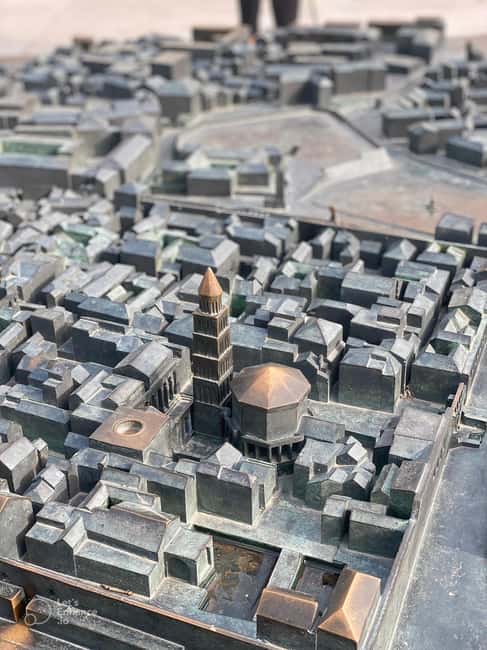
- Starting at Riva Harbor with a map of old Split
- Roman foundations in the palace substructures
- The Peristyle, where ancient and modern Split meet
- The Vestibule and the cathedral of Saint Domnius
- Jupiter’s temple and the palace’s religious changes
- The Golden Gate and Grgur Ninski’s giant toe
- Marmontova Street and modern Split
- Prokurative and Fruit Square
- What Mario brings to the two-hour walk
- Is $23 good value for Split?
- Who should book this walking tour?
- Should you book Mario’s Split history walk?
- FAQ
- How long does the Split Walking Tour with History Professor last?
- What language is the tour conducted in?
- Where does the tour meet?
- Who leads the walking tour?
- Are entrance fees included?
- Is the tour suitable for children and older adults?
- Is the tour wheelchair accessible?
Key points to know before you book
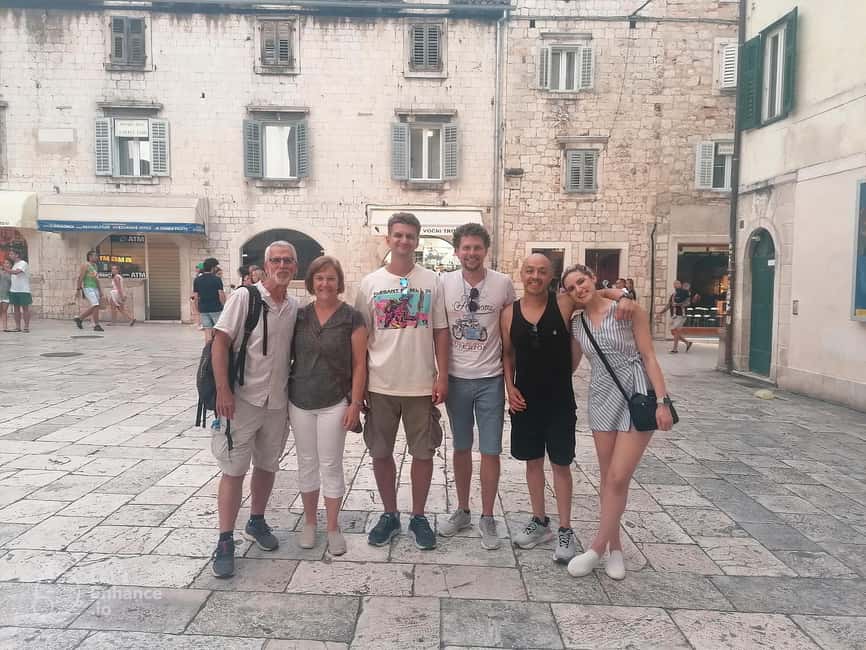
- A history professor leads the walk: Mario teaches through questions, humor, and clear explanations rather than a string of dates.
- The route goes beyond the palace: Medieval, Venetian, Ottoman, Napoleonic, and modern Split all enter the story.
- You see major Roman landmarks: The substructures, Peristyle, Vestibule, Temple of Jupiter, and Golden Gate are all included.
- Game of Thrones adds a pop-culture angle: The tour connects filming locations with the older buildings around them.
- The $23 price covers a broad central route: Admission to the Cathedral of Saint Domnius and Temple of Jupiter is not included.
- Comfortable shoes matter: You will spend the entire experience walking through an old city center.
Why this Split tour feels different from a palace-only visit
Many people come to Split for Diocletian’s Palace, and rightly so. But the palace is not an isolated ruin behind a fence. It forms the core of today’s city, with homes, shops, cafés, churches, and public squares built into and around its Roman walls.
That is the useful idea behind this tour. You begin at the Riva Harbor, looking at a model of Split’s historic center, then move through the palace before continuing into later parts of town. I like this order because you first get a clear map of the city, then watch its story expand century by century.
Mario’s approach also suits people who want more than a memorized speech. His teaching style includes questions and conversation, and his humor helps keep the Roman material approachable. One particularly strong point is the range of information. You can ask about ancient buildings, but the route also makes room for local life, legends, filming sites, and the ways Split changed after Rome.
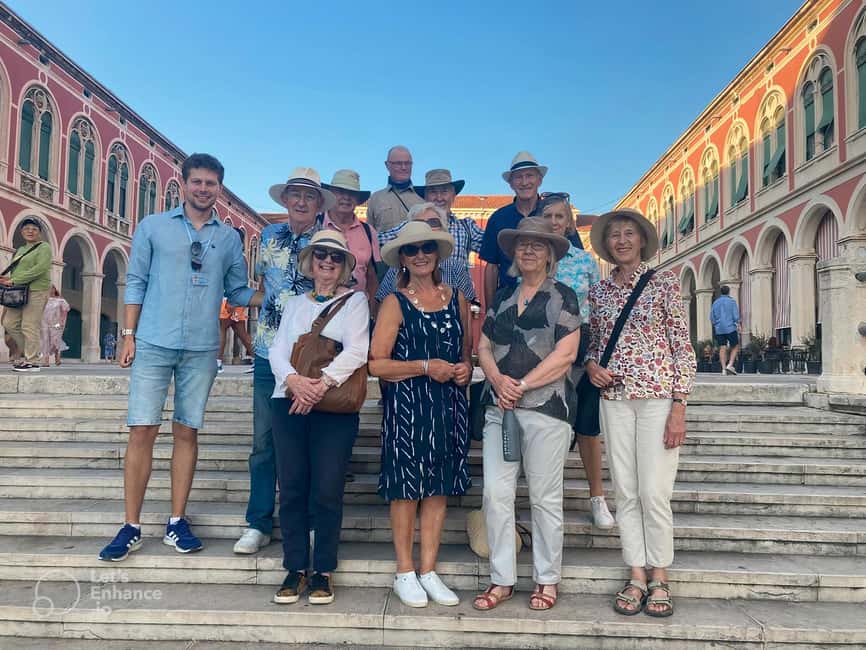
The group format matters here. A small group lets you hear the guide more easily in crowded stone lanes and makes it simpler to stop for questions. Private tours are available by request if you want the route tailored more closely to your party.
More Old Town Walking Tours in Split
- Split: Old Town and Diocletian Palace Walking Tour
★ 4.9 · 4,727 reviews - Walking Tour of Split and Diocletian’s Palace
★ 5.0 · 2,588 reviews - Krka Waterfalls tour with Trogir Walking tour and Krka panoramic boat cruise
★ 5.0 · 1,659 reviews
Starting at Riva Harbor with a map of old Split
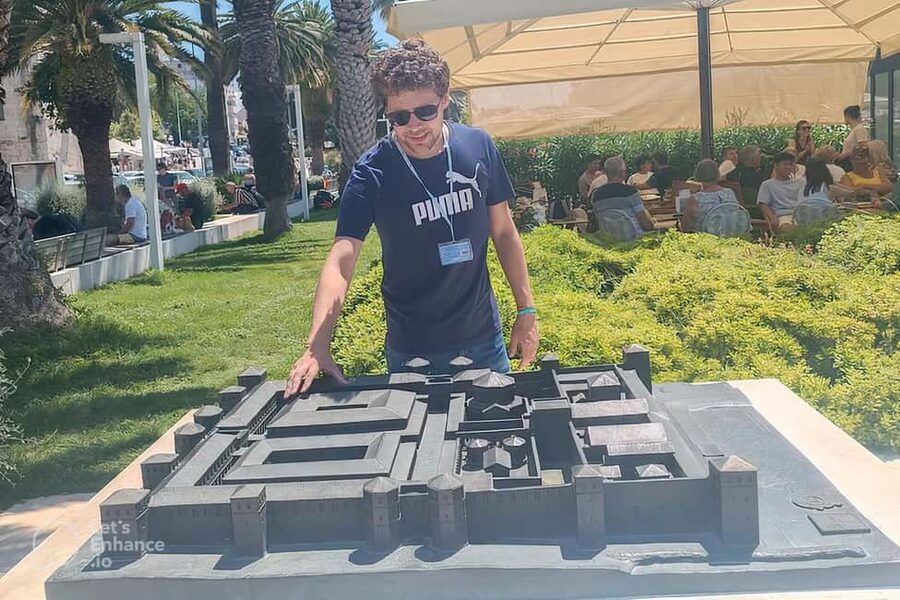
The meeting point is beside the Brass Gate of Diocletian’s Palace. The walk begins at the Riva Harbor, where Mario uses a model of Split’s historic core to give you your bearings.
This is a smart first stop. The old center can feel confusing at street level because Roman walls, later buildings, and modern roads overlap. A model helps you see how the palace sits beside the waterfront and how the main gates connect the interior with the city outside.
You spend about 10 minutes here. It is not just an introduction to the tour. It gives you a simple mental map that makes the rest of the walk easier to follow.
Roman foundations in the palace substructures
The next stop is the substructures of Diocletian’s Palace, with about five minutes set aside for the explanation. These lower chambers helped support the rooms above and preserve the basic shape of the Roman complex.
I find substructures valuable because they show the palace as an engineered place, not only as a collection of photogenic columns. You begin to understand the scale of the original compound and how later Split grew over the Roman plan.
This is also where a guide makes a real difference. On your own, you may see stone corridors and arches. With Mario, you get the larger story of how Roman building methods shaped the streets and rooms still used today.
The Peristyle, where ancient and modern Split meet
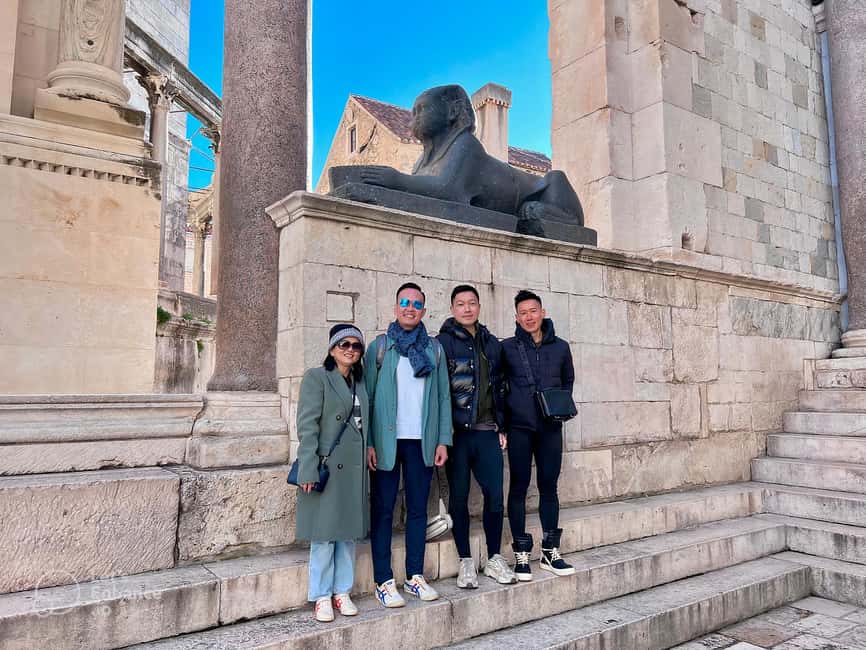
The Peristyle receives around 10 minutes. This is one of the palace’s key open spaces, and it is the place where the Roman design feels most formal and grand.
Look closely at how the square works as a transition between old and new. Roman columns and stonework frame a place that remains part of the daily city, not a sealed archaeological site. The setting also helps explain why the palace is so central to Split’s identity.
Mario’s question-led style should work well here because the Peristyle invites observation. Instead of simply naming features, he can get you to notice the shape of the space, its entrances, and the way later buildings press close around it.
Same stretch of coast, a completely different day out:
- Split: Krka Waterfalls Trip with Boat Cruise and Swimming
★ 4.8 · 10,519 reviews - From Split: Krka Waterfalls, Food & Wine Tasting Tour
★ 5.0 · 9,326 reviews - Blue cave, Mamma Mia and Hvar, 5 islands speedboat tour
★ 5.0 · 7,150 reviews - From Split: Krka Waterfalls, Food & Wine Tasting Tour
★ 4.9 · 6,598 reviews
The Vestibule and the cathedral of Saint Domnius
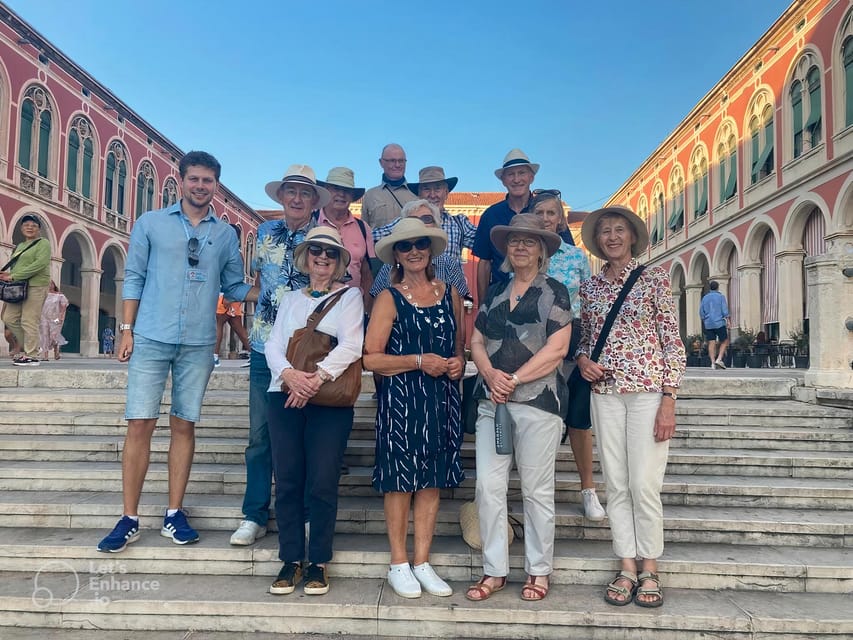
The Vestibule is another 10-minute stop. Its round form and imposing stone construction show the ambition of the palace’s original design, while its later use reflects the way Split adapted Roman spaces for new purposes.
From there, the route reaches the Cathedral of Saint Domnius for about 20 minutes. Admission is not included, so you should expect a separate entrance fee if the visit goes inside.
The cathedral is especially important because it links Roman and Christian Split in one place. It began as Diocletian’s mausoleum and later became a cathedral, a change that says much about how the city reused its old buildings instead of leaving them behind.
The admission detail is worth noting when you budget. The tour itself costs $23 per person, but the cathedral and Temple of Jupiter are listed with admission excluded. Ask Mario at the start how the entry timing will work, especially if you want to see the interiors rather than only discuss them from outside.
Jupiter’s temple and the palace’s religious changes
The Temple of Jupiter receives about 10 minutes, and admission is also excluded. This compact site helps explain the religious world of the Roman palace and the later Christian changes that shaped it.
You do not need to be a specialist to get value from this stop. Mario’s job here is to connect the building with the people and beliefs that once gave the palace its meaning. Taken with the cathedral, the temple shows how the same historic center can hold different religious eras within a short walk.
Because the stop is brief, I would treat it as a focused explanation rather than a long interior visit. If this temple is a personal priority, confirm the entry details and available time with the guide.
The Golden Gate and Grgur Ninski’s giant toe
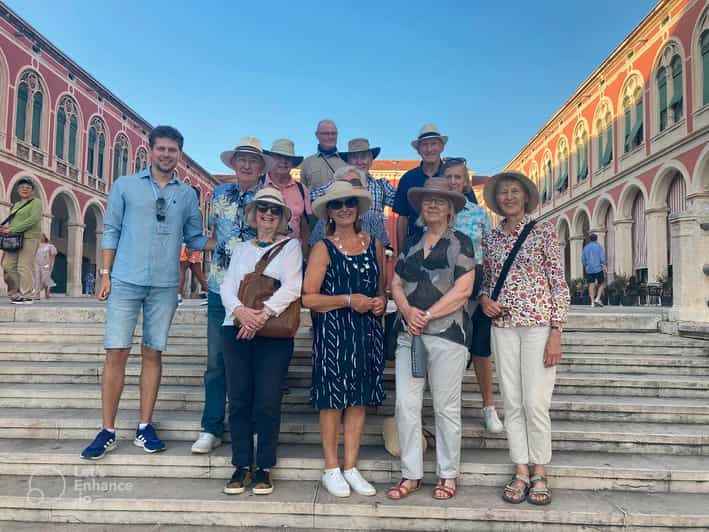
The Golden Gate takes around 10 minutes. It was one of the main entrances to the palace, and it gives you a clear sense of how controlled access worked in the Roman complex.
This is also a good place to think about scale. Palace gates were not decorative afterthoughts. They marked the boundary between the imperial residence and the world outside, while later Split grew around and beyond those old limits.
The next stop is the statue of Grgur Ninski, with another 10 minutes. The statue is one of the city’s familiar landmarks, and its large toe has become a local point of interest. You will likely see people touching it, a small custom that adds a lighter moment to a route otherwise full of emperors, churches, and political change.
I appreciate this kind of stop because it keeps the tour connected to present-day Split. You are not only looking at old stone. You are also seeing how residents and visitors use landmarks now.
Marmontova Street and modern Split
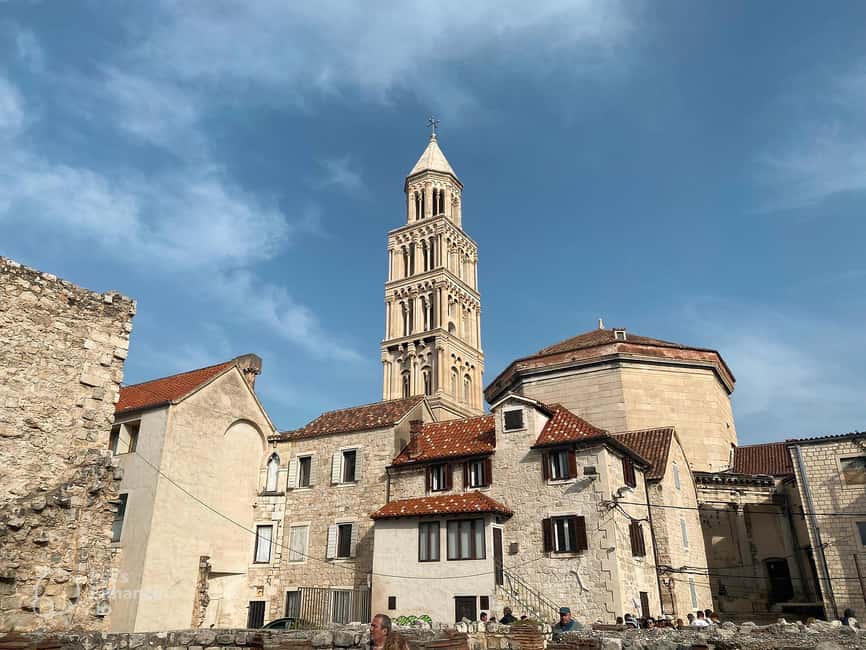
Marmontova Ulica receives about 10 minutes and shifts the focus away from the Roman palace. The street carries the name of Marshal Marmont and points to the Napoleonic period in Split’s story.
This is one of the route’s strongest choices. You can understand the palace better after seeing the city beyond it. Marmontova helps show that Split did not stop developing when Rome left. Different rulers and political eras added their own marks to the town.
The stop also gives the walk a more everyday feel. Instead of spending the full two hours inside ancient walls, you move through streets that connect historic landmarks with current city life. That balance is a major reason I would choose this tour over a shorter palace-only walk.
Prokurative and Fruit Square
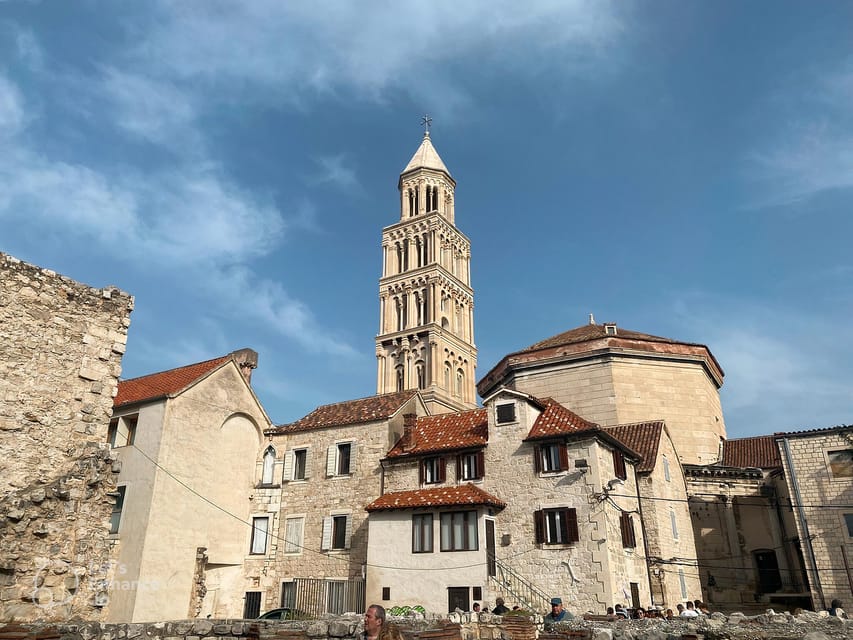
Prokurative, officially Trg Republike, is scheduled for about 10 minutes. Its architecture reflects a later period and gives you another clear contrast with the Roman core.
The square helps place Split within a wider Adriatic story. Its appearance and civic role point toward the influence of Venice and later urban planning, rather than the military and imperial logic of Diocletian’s Palace.
The final stop is Fruit Square, or Trg Brace Radic, with about 15 minutes. This is a fitting finish because it brings together several layers of the city in one urban space. You get old buildings, later architectural influence, local stories, and a sense of how central Split functions today.
The route also includes Game of Thrones locations. These references are not the main reason to book, but they add an easy way into the city’s built history. If you know the show, you will recognize the connection. If you do not, the locations still matter because they are part of the old center and its distinctive stone setting.
What Mario brings to the two-hour walk
Mario is a history professor, and that background shapes the experience. His strongest teaching tools are clear explanations, humor, and questions directed at the group. He does not simply pour information over you. He encourages you to think along with him.
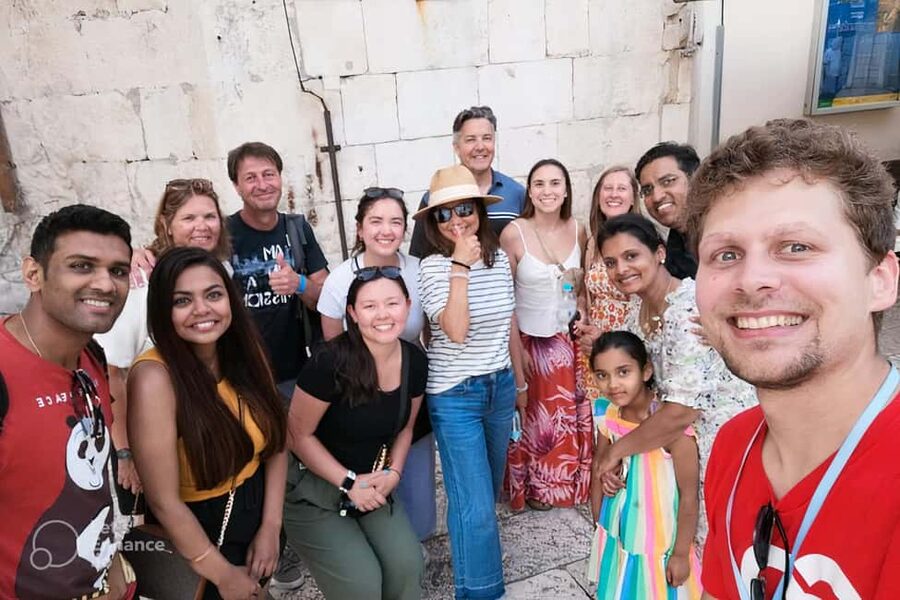
That style received especially strong praise from the people who took the tour. One person described it as among the best walking tours they had experienced, pointing to Mario’s ability to engage the group and invite questions. Another highlighted his friendly, personable manner and the way he made a large amount of information enjoyable.
I would recommend this walk to anyone who likes context but dislikes dry lectures. Mario’s enthusiasm is a central part of the value, and the route gives him plenty to work with: Roman imperial power, Christian reuse of old buildings, later European influence, popular legends, and modern city life.
You should still know your own preference. If you want a silent photo walk with little explanation, this may feel too talkative. If you want to understand why Split looks the way it does, the professor-led format is a strong fit.
Is $23 good value for Split?
At $23 per person, I consider this a good-value introduction to central Split. You get about two hours of live guiding, a route covering Roman, medieval, and modern areas, and access to a guide with a teaching background.
The value comes from the connections between stops. A cheaper or shorter walk might show you the Peristyle and Golden Gate, but this route continues to Marmontova, Prokurative, and Fruit Square. That wider range helps you see Split as a real city rather than a single Roman monument.
Budget separately for admission to the Cathedral of Saint Domnius and Temple of Jupiter. The tour price does not include those entries. The exact duration is also described in two ways, two hours and two hours 15 minutes, so do not schedule a tight departure immediately afterward.
The experience includes a live English-speaking guide. Cancellation is free up to 24 hours before the activity, and you can reserve now and pay later, useful if your schedule is still shifting.
Who should book this walking tour?
I would choose it if you want a first look at Split that combines major sights with a clear historical framework. It suits couples, families, and mixed-age groups because the activity is listed as appropriate for all ages.
It is especially good for you if:
- You want to see more than Diocletian’s Palace.
- You enjoy asking questions during a guided walk.
- You like history presented with humor and local stories.
- You are curious about Game of Thrones filming locations.
- You want a central walking route without arranging transport.
Comfortable shoes and comfortable clothes are essential. The route covers old streets and several stops, with no vehicle transfer to break up the walking.
I would be cautious if mobility is a concern. The tour is not suitable for wheelchair users, and the historic center may include uneven or difficult surfaces. You should also consider the separate admission charges if you want to enter both the cathedral and temple.
Should you book Mario’s Split history walk?
Book this tour if you want the Roman palace placed inside the full story of Split. The strongest reasons are Mario’s lively teaching style, the small-group setting, and the route’s reach beyond the usual palace highlights.
Choose another option if you only want a quick look at Diocletian’s Palace, need a wheelchair-accessible route, or prefer not to pay extra for interior admissions. For most visitors who want history, local character, and a useful introduction to the city in one walk, $23 is a sensible spend.
FAQ
How long does the Split Walking Tour with History Professor last?
The activity information gives a duration of two hours, while the summary describes the experience as two hours and 15 minutes. Allow roughly two hours and a little extra flexibility.
What language is the tour conducted in?
The tour has a live guide and is conducted in English.
Where does the tour meet?
The guide waits next to the Brass Gate of Diocletian’s Palace.
Who leads the walking tour?
The guide is Mario, a local history professor who explains Split’s past through questions, humor, and discussion.
Are entrance fees included?
Admission is excluded for the Cathedral of Saint Domnius and the Temple of Jupiter. The tour price does not cover those entries.
Is the tour suitable for children and older adults?
The activity is listed as appropriate for all ages. You should bring comfortable shoes and clothes because the entire experience takes place on foot.
Is the tour wheelchair accessible?
No. The tour is not suitable for wheelchair users.
More Walking Tours in Split
- Split & Diocletian’s Palace Walking Tour
★ 5.0 · 1,125 reviews - Split: Diocletian Palace & Old Town Guided Walking Tour
★ 4.7 · 882 reviews - From Split: Krka Waterfalls Cruise & Trogir Walking Tour
★ 4.7 · 681 reviews - Diocletian’s Palace and Old Town SMALL GROUP Walking Tour
★ 5.0 · 502 reviews
More Historical Tours in Split
- Walking Tour of Split with a ‘Magister’ of History
★ 5.0 · 1,122 reviews - Split Walking Tour with Professor of History
★ 5.0 · 926 reviews - Split: History and Heritage Walking Tour
★ 4.9 · 650 reviews - Split History and Gastro Small-Group Tour with Food and Drinks
★ 5.0 · 375 reviews
Just added around Split
- Split Sunset Stand Up Paddle Tour★ 5.0 · 16 reviews
- Split: Sunset Guided Kayaking Tour★ 4.8 · 71 reviews
- Split&Sip: Educational wine tasting★ 4.9 · 52 reviews
- Stand Up Paddle Tour in Split★ 4.7 · 17 reviews
- Split: Guided Walking Tour in English★ 4.9 · 10 reviews
- Split Walking Tour: History, Legends & Tales★ 5.0 · 9 reviews
- Split – Walking in Khaleesi Footsteps in the City of Dragons★ 5.0 · 13 reviews
- Split: Transparent SUP night Glow tour★ 4.9 · 73 reviews
Old Town Walking Tours, compared.



Walking Tour of Split and Diocletian’s Palace
Read our review →


Krka Waterfalls tour with Trogir Walking tour and Krka panoramic boat cruise
Read our review →
City Walls Early Morning or Sunset Walking Tour
Read our review →
Plitvice Lakes with Boat Ride and Zadar Old Town Tour
Read our review →Browse the lists this tour appears in