
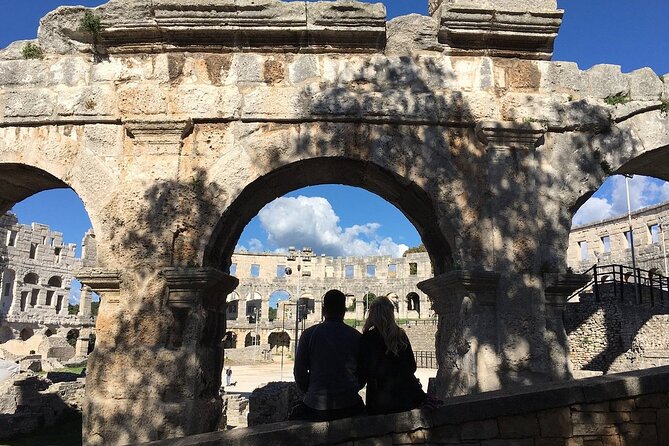
Reviewed · OLD TOWN WALKING TOURS
Pula walking tour
Pula’s Roman amphitheatre is the obvious star, but this walking tour does more than point at the arena and send you on your way. In about 90 minutes, you move through Roman ruins, a hilltop fortress, a cathedral, a market, and old city gates while a local guide connects the pieces.
I like two things here. First, the route gives you a quick, sensible introduction to Pula, which is useful when you have only a morning or an afternoon. Second, guides such as Sini bring local stories and clear explanations rather than simply reciting dates. The main drawback is just as clear: site admissions are not included, and most stops are explained from the outside.
In This Review
- Key points at a glance
- Why this short Pula tour works
- Starting beside the Pula Arena
- Kastel and the harbor view
- Cathedral, temple, and the Roman center
- Sergi Arch and the old city streets
- A market stop that connects old Pula with today
- The guide makes or breaks the experience
- Timing, walking effort, and weather
- What the tour does not include
- Who should book this Pula walking tour?
- Should you book it?
- FAQ
- How long does the Pula walking tour last?
- What language is the tour offered in?
- Where does the tour begin?
- Where does the tour end?
- Are admission tickets included?
- Is food or drink included?
- How many people can join the tour?
- Can I cancel for a refund?
Key points at a glance
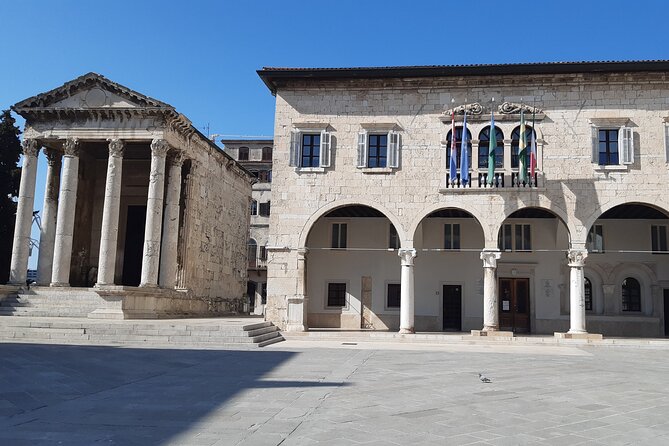
- The route begins at Pula Arena: You start beside one of Croatia’s finest Roman monuments, then walk into the old center.
- Eight historic stops fit into 90 minutes: The tour covers the arena, fortress, cathedral, Roman temple, arches, market, and ancient gates.
- The fortress brings the best change of scene: You get a view toward Pula’s harbor and a useful sense of the city’s position.
- The guide adds layers beyond Roman ruins: Expect discussion of Croatian, Venetian, Byzantine, Italian, and Austro-Hungarian influences.
- It is a good family introduction: The pace is manageable, and guides have kept teenagers interested with clear storytelling.
- Plan to visit interiors separately: The arena and other buildings are seen from outside, apart from possible entry to the cathedral if it is open.
Why this short Pula tour works
Pula is easy to underestimate. You can walk past a Roman arch, a temple, a market, and a fortress in a short stretch of the center, yet the city’s story reaches from antiquity to modern Croatia. Without context, those pieces can feel scattered. A local guide gives you a basic map of time and place.
The tour is designed as a compact city walk rather than a long archaeological visit. You are not spending an hour inside one monument. Instead, you get a broad look at Pula and finish with time to return to the sites that catch your eye.
That makes the experience especially useful at the beginning of a stay. I would book it early in your visit, then use the rest of the day to revisit the arena, explore the fortress interior, browse the market, or follow a restaurant recommendation from the guide.
The price is about $20.16 per person, which is fair for a professional local guide and a tightly planned 90-minute route. It is good value if you want orientation and historical context. It is less attractive if your main goal is to enter monuments, since those costs are extra.
The tour is offered in English and normally has no more than 15 people. The description also highlights a private-tour format and undivided guide attention, so check the booking details carefully if having a fully private outing matters to you. A smaller group will make questions easier, while a full group of 15 may feel more like a standard guided walk.
More Old Town Walking Tours in Pula
- Pula: Historic Walking Tour with Local Guide & City Views
★ 4.8 · 143 reviews - Pula: Historic Sites Guided Walking Tour
★ 4.8 · 78 reviews - Pula Essentials Walking Tour
★ 4.8 · 64 reviews
Starting beside the Pula Arena
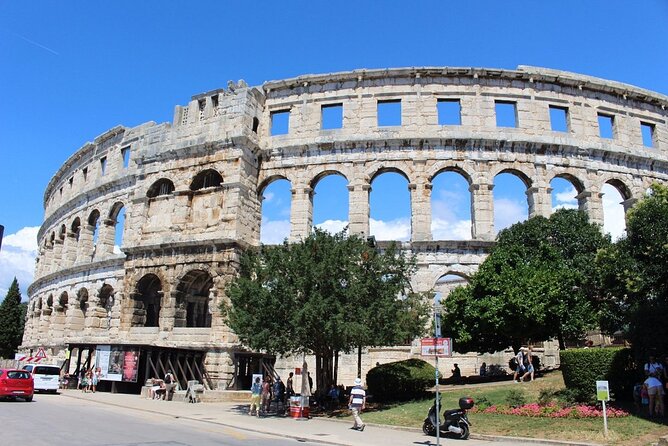
Meet at Pula Arena on Flavijevska ul. The meeting point is at the entrance, not simply somewhere in the general area around the amphitheatre. That distinction matters, since map apps can send you to a less useful location.
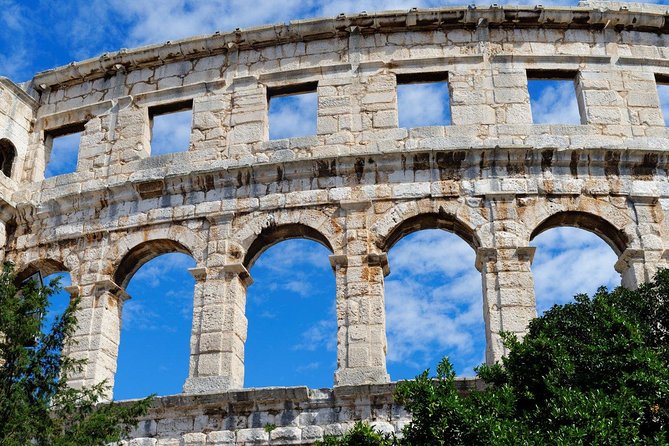
The arena is a strong place to begin. Its pale stone walls make the Roman past impossible to miss, and the guide can explain the building’s role before you move into the narrower streets of central Pula. You will hear about the monument from the outside, with roughly 20 minutes devoted to this first stop.
This approach gives you a good first look without using the ticket included in the tour price, because no site admission is provided. If entering the arena is high on your list, plan a separate visit. The walk gives you context, but it does not replace time inside the amphitheatre.
The guide’s explanation is most useful for helping you notice details you might otherwise pass without a thought. Pula’s Roman remains are not isolated museum pieces. They sit among shops, streets, and daily city life, and the tour begins showing you how old and modern Pula occupy the same ground.
Kastel and the harbor view
From the arena, the route continues to Kastel, Pula’s fortress. The stop lasts about 10 minutes and focuses on the exterior, with time to enjoy the view toward the harbor.
This is an important pause because it changes your view of the city. At street level, Pula can feel like a collection of old buildings. From the fortress area, you get a better sense of the city’s position and why this high point mattered for defense.
You should not expect a full fortress visit as part of the standard walk. Admission is not included, and the guide explains the stronghold from outside. Still, the stop earns its place because it adds military history and a broad outlook to a route otherwise centered on Roman architecture.
If you have already spent several days in Croatia, this may be one of the moments that helps Pula click into place. The city’s past is not only about emperors and arenas. It also includes centuries of conflict and changing powers, which the fortress makes easier to understand.
Cathedral, temple, and the Roman center

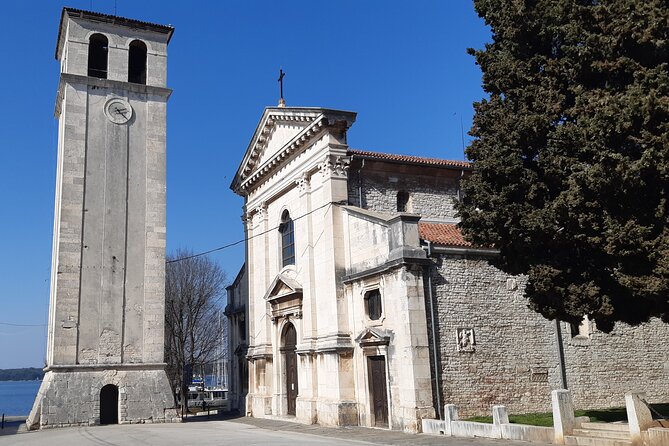
The route next reaches Pula Cathedral, where the guide explains the church from outside. If the building is open, you may be able to enter, but that is not guaranteed. The stop is brief, about five minutes, so think of it as a useful introduction rather than a full church visit.
The cathedral helps shift the story from ancient Rome to the later religious and civic life of the city. That change of subject keeps the walk from becoming a parade of similar-looking ruins.
At the Temple of Augustus, the guide again explains the building from outside, with about 10 minutes at the site. The temple is one of the clearest reminders that Pula was once an important Roman settlement. I like this stop because it makes the Roman presence feel spread through the city rather than limited to the arena.
The tour does not provide admission here, and the planned visit is external. You will get the historical setting and architectural explanation, but you should allow extra time if you want to study the site at greater length.
The sequence also helps you compare different eras in a small area. A cathedral and a Roman temple are not just separate photo stops. Together, they show how Pula’s public spaces changed use and meaning over time.
Same stretch of coast, a completely different day out:
- Medulin -Kamenjak 5h boat trip with lunch & drinks on Sandra Boat
★ 5.0 · 1,621 reviews - Full-Day Boat Tour of the Medulin Archipelago from Medulin
★ 5.0 · 1,389 reviews - 3hours all inclusive Sunset&Dolphin Tour from Medulin on Sandra
★ 5.0 · 1,130 reviews - Dolphin Watching & Sunset Boat Tour With Dinner and Drinks
★ 5.0 · 1,075 reviews
Sergi Arch and the old city streets

At the Arch of the Sergii, the guide spends around 10 minutes explaining the monument from outside. This is one of the route’s more personal Roman reminders, since the arch commemorates a local family rather than serving as a giant public arena.
The walk continues through the historic center, where Roman remains often appear alongside later buildings. This is where a local guide can add real value. You can read a guidebook description of an arch, but a person who knows Pula can help you understand how the monument fits into the streets you are actually walking through.
The tour also includes the Gate of Hercules, with about five minutes for an exterior explanation. It is a short stop, but it helps you picture the old entrance points into the Roman settlement.
At the Twin Gates of Pula, the final stop, you spend another five minutes hearing about the structure from outside. The tour ends here on Carrarina ul. 8, not back at the arena. That ending is practical: you finish inside the old city and can continue exploring without retracing the full route.
Because the last stops are short, do not expect a long archaeological lecture at each gate. Their value comes from the overall pattern. By this point, you have seen major and minor remains, and you can better understand how the Roman city was organized.
A market stop that connects old Pula with today
Gradska Trznica Pula, the city market, receives about 10 minutes. The guide explains it from outside, so food and shopping are not part of the tour price. Still, this stop gives the route a welcome change of rhythm.
Markets show how a city functions now, not only what happened centuries ago. You may see the market as a place to return for a later browse or lunch, while the guide points out how modern Pula fits into the older city center.
Food and drinks are not included, so bring your own plan for eating afterward. One useful benefit of having a local guide is the chance to ask for lunch suggestions at the end. The tour’s short length leaves you plenty of time to follow up on a recommendation.
The route’s mix of Roman monuments, shopping streets, market life, and later military history is one of its best features. You get more than a list of ancient stones, but you also avoid spending the entire day on a formal history lesson.
The guide makes or breaks the experience

The strongest part of this walk is the person leading it. The guide is expected to be professional, local, and fluent in English. Past experiences with Sini describe a friendly, charismatic guide who can explain Pula and the wider Istrian region in a way that works for families.
Sini is not the only guide you might receive, and the booking information does not promise a particular person. Still, the repeated praise for his clear communication and wide command of local history tells you what to hope for: direct answers, good pacing, and stories that link Pula’s 3,000 years to the visible streets around you.
The route has also worked well for families with teenagers. That is not a small point. Ancient history can lose younger attention quickly, especially when every stop looks like another ruin. A guide who mixes facts with human stories and keeps the pace moving makes the 90 minutes much easier.
You should ask questions as you go. The tour is short, so it cannot cover every detail of Pula or Istria. A good question about the arena, the fortress, local languages, or the city’s later rulers can turn a standard stop into a useful conversation.
Timing, walking effort, and weather
The stated duration is approximately one hour and 30 minutes. The walk is described as fairly easy, but you should have a moderate level of physical fitness. You will be on your feet through a historic center, with some movement toward the fortress.
Wear sensible shoes. The tour operates in all weather, so bring protection from rain or sun and dress for the conditions. There is no promise of indoor shelter, and most of the explanations take place outdoors.
The start time can be arranged to suit your schedule, which helps if you are fitting Pula between transport connections, a cruise visit, or another activity. If you are arriving by cruise ship, be especially careful with timing. A missed tour caused by a late or absent ship is not refundable.
The experience is usually booked about 28 days ahead, so reserving early is wise during busy periods. Confirmation is sent within 48 hours, subject to availability. Children must be accompanied by an adult.
What the tour does not include
The tour includes a professional local guide, but not food, drinks, or admission tickets. That keeps the headline price low, yet you need to budget separately for any monument you decide to enter afterward.
The arena is the biggest consideration. It is explained from outside for around 20 minutes, and that is enough for an introduction. It is not enough if you want to explore the seating areas, underground sections, or exhibitions at your own pace.
The same applies to Kastel and the Temple of Augustus. The guide gives you the setting and meaning, but the route is not built around interior access. The cathedral is the one possible exception, since you may enter if it happens to be open.
I see this as a strength for a short first look and a weakness for serious archaeology fans. You are paying for guidance through the city, not a bundle of entrance fees.
Who should book this Pula walking tour?
I would choose this tour if you want to get your bearings quickly, prefer learning from a local, or have limited time in Pula. It is also a good fit for families, first-time visitors, and anyone who enjoys seeing the main landmarks before exploring independently.
It works well for people who like history but do not want a half-day lecture. The 90-minute pace leaves room afterward for the arena, fortress, market, shopping streets, or lunch.
I would think twice if you dislike outdoor touring in poor weather, need guaranteed access to every building, or want a long, detailed visit inside the amphitheatre. In those cases, use the walk as an introduction only and plan separate site visits.
The tour is also a sensible choice for repeat visitors. Even if you know the central streets, a local explanation can reveal details you passed before, including Roman remains that are easy to miss and the layers of Byzantine, Venetian, Italian, Austro-Hungarian, and Croatian influence.
Should you book it?
At about $20.16 per person, this is a good-value orientation walk, especially if you are new to Pula. The route covers the essential historic center, the guide adds local context, and the finish at the Twin Gates puts you in a useful place to continue on your own.
Book it if you want a friendly overview with strong historical storytelling and do not mind seeing most sites from outside. Skip it if your priority is entering the arena and other monuments during the same 90 minutes. For most short stays, I would book the tour early, confirm the exact meeting point at the arena entrance, wear comfortable shoes, and save your remaining time for the interiors that interest you most.
FAQ
How long does the Pula walking tour last?
The tour lasts approximately one hour and 30 minutes.
What language is the tour offered in?
The tour is offered in English.
Where does the tour begin?
It begins at Pula Arena, Flavijevska ul., 52100 Pula, Croatia. The meeting point is at the arena entrance.
Where does the tour end?
The tour ends at the Twin Gates, Carrarina ul. 8, 52100 Pula, Croatia.
Are admission tickets included?
No. Entry tickets are not included for the arena, fortress, or Temple of Augustus. The cathedral may be entered if it is open, and no admission fee is listed for that stop.
Is food or drink included?
No. Food and drinks are not included.
How many people can join the tour?
The activity has a maximum of 15 travelers.
Can I cancel for a refund?
You can cancel up to 24 hours before the experience start time for a full refund. Cancellations or changes made less than 24 hours before the start are not accepted for a refund.
More Walking Tours in Pula
- Pula Essentials Walking Tour
★ 5.0 · 62 reviews - Pula Food Walking Tour
★ 4.5 · 22 reviews - Pula: Old Town Walking Tour for Foodies with Dinner and Wine
★ 4.6 · 18 reviews - Pula Roman Heritage Walking Tour
★ 5.0 · 12 reviews
Just added around Pula
- 1-Hour Private E Foil Surfing Lessons in Istria★ 5.0 · 4 reviews
- Wine Tasting Experience at the organic winery in Šišan★ 3.5 · 13 reviews
- Transfer Pula – Poreč★ 5.0 · 5 reviews
- 3 Hours Private Wine and Sunset Tour★ 5.0 · 9 reviews
- Dolphin & Sunset tour with Brijuni panorama★ 5.0 · 119 reviews
- E-Bike swim & fortress tour Vodnjan★ 5.0 · 6 reviews
- Stop on Island & National Park Day Cruise with Lunch Drinks★ 5.0 · 10 reviews
- Waves & Watercolors: A Seaside Painting Workshop★ 5.0 · 21 reviews
Old Town Walking Tours, compared.
Walking Tour of Split and Diocletian’s Palace
Read our review →
Krka Waterfalls tour with Trogir Walking tour and Krka panoramic boat cruise
Read our review →
City Walls Early Morning or Sunset Walking Tour
Read our review →
Plitvice Lakes with Boat Ride and Zadar Old Town Tour
Read our review →Browse the lists this tour appears in