
Reviewed · OLD TOWN WALKING TOURS
Pula Food Walking Tour
Pula’s food tour is really two experiences in one: an evening walk through Roman streets and a full local meal served in stages. You’ll see the Arena, Forum, ancient arches, and old squares, then pause at restaurants and food stops for dishes that can include bruschetta, octopus, cabbage, fish tacos, dessert, and regional drinks. I like the small group limit of 12 and the way the tour uses food to explain Istrian customs, not just monuments. I also like the 7 p.m. start, when Pula is cooler and its streets take on a pleasant evening feel.
The main caution is that the meal is not designed around familiar tastes. Octopus and cabbage appear in the food lineup, and the exact dishes are not provided in advance. The tour can also feel long if you mainly want a quick orientation walk. At $106.82 per person, it makes the most sense if you arrive hungry and plan to use the evening as both dinner and sightseeing.
In This Review
- Key points to know before you book
- Why this Pula tour works as an evening introduction
- Starting at the Arena, Pula’s great Roman landmark
- Ancient gates and a modern meeting place
- The Forum and Temple of Augustus
- Dante Square and the Arch of the Sergii
- Finishing at the Gate of Hercules with dessert
- What you will eat and drink
- How the guides shape the experience
- Is $106.82 a fair price?
- Who should book this food walk?
- Should you book the Pula Food Walking Tour?
- FAQ
- Where does the Pula Food Walking Tour start?
- What time does the tour begin?
- How long does the experience last?
- Where does the tour finish?
- What food and drinks are included?
- How many people can join the tour?
Key points to know before you book
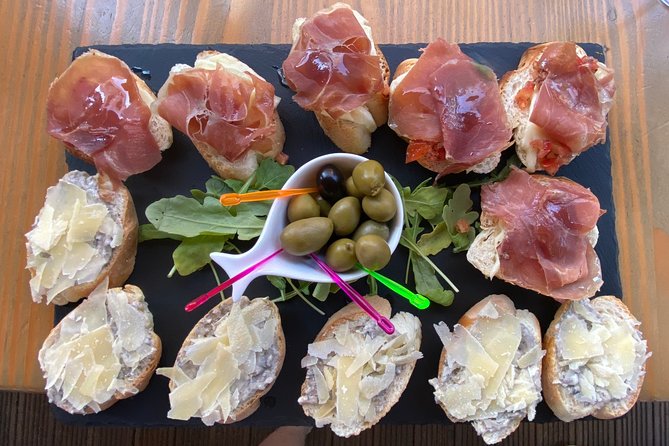
- Seven food experiences plus drinks: The tour includes five listed food tastings, with the full program described as seven food stations or food items, along with olive oil, three wines, and an aperitif.
- Pula’s Roman center is the backdrop: You visit the Arena, Twin Gates, Forum, Arch of the Sergii, and Gate of Hercules.
- Denis and Anna are named guides: Denis is praised for combining food knowledge with local history, while Anna is described by the operator as a licensed guide with fluent English and extensive tour experience.
- The group stays intimate: A maximum of 12 participants gives the guide room to explain dishes and answer questions.
- It is a substantial evening meal: Come hungry. The food portions are intended to add up to dinner, not just a few token samples.
- The tour ends near Pula Arena: The route begins at Istarska ul. 40 at 7 p.m. and finishes close to the Arena after about three and a half hours.
Why this Pula tour works as an evening introduction
I like food walks early in a city stay because they give you a map you can eat your way through. Here, the route links major Roman monuments with restaurants, food shops, and tasting stops, so you learn where the old center is while picking up ideas for later meals.
The timing helps. Pula can be hot in the daytime, and the 7 p.m. departure lets you walk after the strongest heat has eased. The route also passes through squares where street music and evening activity may add atmosphere, though the exact feel will depend on the date and season.
The tour lasts about three hours and 30 minutes. That is long enough for a proper city introduction, but it is not a quick snack crawl. You should expect a steady sequence of short sightseeing stops, restaurant visits, and tastings. If you prefer to linger over every monument, the schedule may feel brisk. If you want dinner with your orientation walk, the length is useful.
More Old Town Walking Tours in Pula
- Pula: Historic Walking Tour with Local Guide & City Views
★ 4.8 · 143 reviews - Pula walking tour
★ 5.0 · 96 reviews - Pula: Historic Sites Guided Walking Tour
★ 4.8 · 78 reviews
Starting at the Arena, Pula’s great Roman landmark
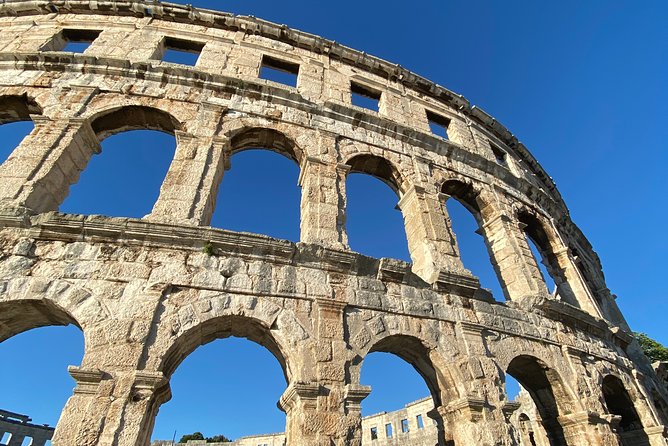
The first stop is the Pula Arena, the city’s best-known monument. Built in the first century AD, it once hosted gladiator games and could hold about 20,000 spectators.
The tour does not include an admission ticket, so this is an exterior introduction rather than a paid visit inside the amphitheater. That keeps the evening moving and avoids adding another ticket cost, but you should not book this experience expecting a detailed Arena interior tour.
Still, beginning here makes sense. The Arena gives you an immediate sense of Pula’s Roman importance, and a licensed guide can place the later gates, arches, and Forum in context. I would arrive a little early if you want your own photos before the group sets off.
Ancient gates and a modern meeting place
The Twin Gates are a brief stop, only about five minutes. These arches once formed an important entrance into the city and now frame the route toward the Archaeological Museum and the castle.
This is a quick look rather than a major visit. The value comes from seeing how Pula’s old defensive and civic layout still shapes the walking route. You will not spend long here, so keep your attention on the guide’s explanation and save detailed museum plans for another time.
Next comes Titov Park, where the planned stop lasts about ten minutes. Established in the 1950s, the park was once one of the city’s key intersections. It remains a popular evening meeting place, especially for younger people.
That contrast is one of the pleasant features of the route. You are not only moving from one Roman stone to the next. You also get a glimpse of how Pula’s public spaces work now, with old structures and ordinary city life close together.
The Forum and Temple of Augustus
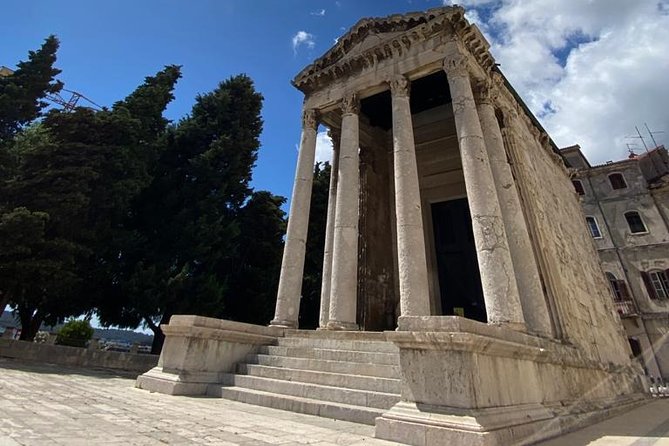
The Forum sits below the central hill and remains Pula’s main square. In Roman times it was the center of public life, and today it continues to serve as an administrative and civic center.
The guide explains the Temple of Augustus and the municipal building here. The stop lasts about ten minutes, which is enough for an overview but not for a full architectural study. You may want to return in daylight if you enjoy close looks at Roman details or want more time for photographs.
For me, this is one of the route’s most useful history stops because it explains the city’s basic structure. The Arena is the dramatic landmark, but the Forum shows where civic life happened. Pairing the two helps you understand Pula rather than simply collect a few photographs.
Same stretch of coast, a completely different day out:
- Medulin -Kamenjak 5h boat trip with lunch & drinks on Sandra Boat
★ 5.0 · 1,621 reviews - Full-Day Boat Tour of the Medulin Archipelago from Medulin
★ 5.0 · 1,389 reviews - 3hours all inclusive Sunset&Dolphin Tour from Medulin on Sandra
★ 5.0 · 1,130 reviews - Dolphin Watching & Sunset Boat Tour With Dinner and Drinks
★ 5.0 · 1,075 reviews
Dante Square and the Arch of the Sergii
Danteov trg, or Dante Square, is named for the Italian poet Dante Alighieri. The stop is short, around ten minutes, but it adds a cultural layer to the Roman story and reflects Pula’s links with the wider Italian and Adriatic world.
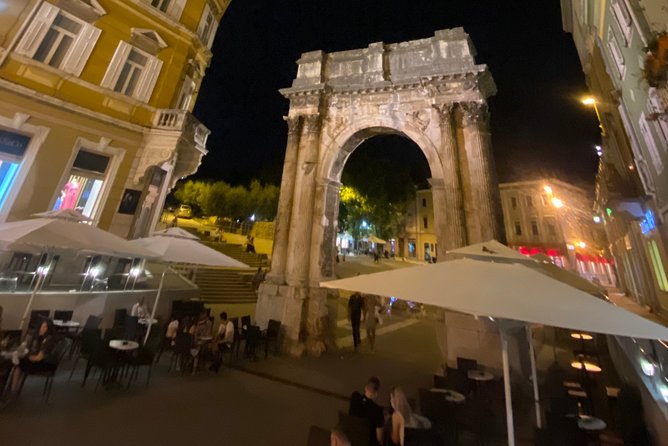
The Arch of the Sergii follows. Built in the first century by the important Sergii family, it honors members of that family and uses a Corinthian design. The arch and the square beside it now serve as a setting for theater, music, and other performances.
This part of the route should appeal to you if you like a city’s history in several periods rather than only ancient Rome. You see Roman family power, later urban development, and present-day public culture in a compact section of the old center.
The stops are short, so do not expect a long lecture at each site. The tour’s strength is the combination of many small explanations with food breaks. Some participants will find that lively and varied. Others may prefer fewer sights with more time at each one.
Finishing at the Gate of Hercules with dessert
The Gate of Hercules dates from Roman times and sits between two medieval towers. The route passes through the gate and finishes with a local dessert.
This is a fitting ending. You move from one of Pula’s early Roman entrances through a later layer of the city, then finish with something sweet. The stop itself is only about five minutes, but by this point the food and drink have done as much work as the monuments in shaping your sense of place.
The ending is close to Pula Arena, near the starting area. That makes it convenient for walking back to accommodation in the center or continuing your evening nearby. The exact final restaurant or food stop is not specified, so you should treat the published route as the sightseeing framework rather than a promise of named venues.
What you will eat and drink
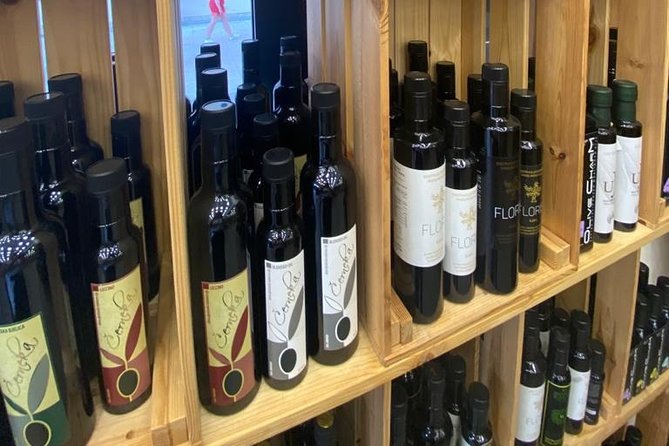
The food is the heart of the tour. The included program lists five food tastings, while the tour description also refers to seven food items or food stations. In practical terms, you should expect a multi-course evening rather than a single sample at each stop.
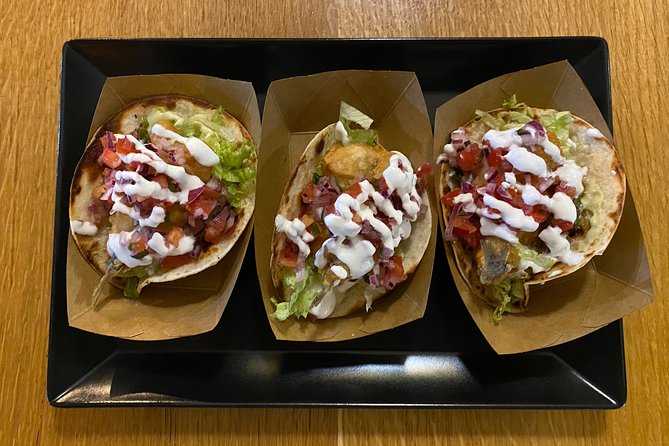
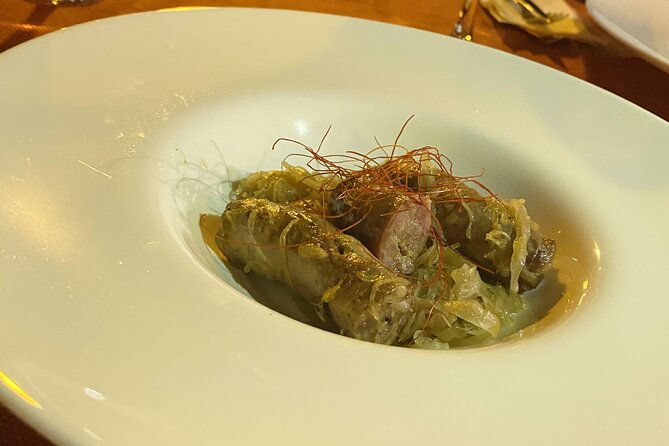
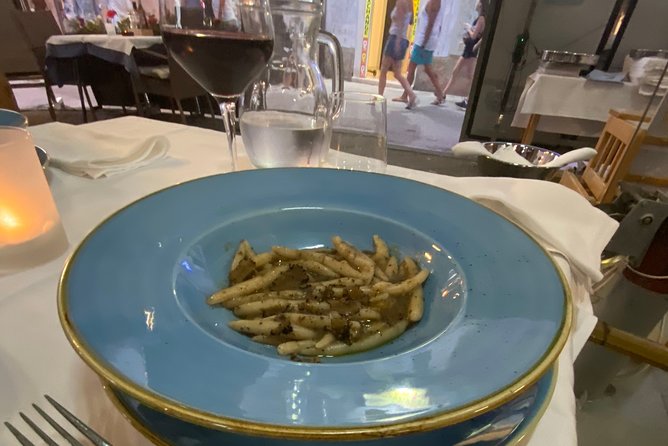
Past food examples include bruschetta, octopus, cabbage, and street fish tacos. A local dessert comes at the end. The octopus has been a particular success even for people who were unsure about trying it, but it is still worth knowing that seafood and less familiar vegetables are part of the experience.
The food is paired with three glasses of wine, an aperitif, and an olive oil tasting. One early tasting has been described as a wine spritzer with bruschetta, giving the evening a relaxed start. The drinks make the price easier to justify, especially since the meal is meant to replace dinner.
I appreciate that the menu is not reduced to only safe, international dishes. Local food makes the tour more useful, but it also means you should tell the guide about allergies or dietary limits when booking. The supplied information does not promise a vegetarian, vegan, gluten-free, or alcohol-free version, so do not assume substitutions are available.
How the guides shape the experience
The guide matters greatly on a food walk. Denis has been singled out for explaining both the history of regional food and the city itself, while also offering suggestions for Pula and its surroundings. That combination is valuable because it turns each tasting into more than a pause between monuments.
Anna is also named in the tour information. The operator describes her as a licensed local guide with fluent English and extensive experience leading this tour. Guide quality can vary from one departure to another, but the experience is intended to be led in English by a professional licensed guide.
The small group limit helps here. With no more than 12 people, you have a better chance of hearing explanations, asking about ingredients, and keeping the group together through narrow streets and restaurant stops. It also makes the meal feel more social than a large coach excursion.
One negative report describes a guide who struggled with English and questions. The operator disputed that account, said the guide was experienced, and provided a full refund. I would treat this as a reminder that guide performance can affect the whole evening, not as a reason to dismiss the tour outright.
Is $106.82 a fair price?
At $106.82, this is not a cheap walking tour. You are paying for a three-and-a-half-hour guided route, a full food program, three wines, an aperitif, olive oil, and a capped group size.
The value is strongest if you count it as dinner plus a city tour. Seven food stops or items can add up quickly in Pula, and the tour removes the work of choosing restaurants and ordering unfamiliar dishes. You also get a structured introduction to the old center without paying separate admission for the listed outdoor monuments.
The value is weaker if you eat lightly, avoid alcohol, or mainly want Roman sightseeing. Since admission tickets are not included and the stops at the monuments are brief, a history-focused visitor may prefer a dedicated city tour or a paid Arena visit.
I would also avoid booking this immediately after a large lunch. The portion count is intended to be generous, and the tour’s own advice is simple: come hungry.
Who should book this food walk?
I would recommend it to you if you want:
- A first-evening orientation to Pula
- A social group capped at 12 people
- A proper dinner built around local dishes
- Wine, olive oil, and aperitif tastings
- Roman landmarks explained in a relaxed setting
- A guide who can add restaurant and area suggestions
It suits couples, friends, and solo participants who enjoy trying unfamiliar food. History lovers will appreciate the Arena, Forum, gates, and arch, though the walking commentary is broken into short sections rather than presented as a long specialist lecture.
It may not suit you if you dislike seafood, cabbage, alcohol, or shared group pacing. It is also not ideal for anyone seeking a quiet, slow meal, since you move between several stops during the evening.
The tour is near public transportation, and most people can participate. The available information does not give a full accessibility description, so you should ask the operator about mobility needs before booking.
Free cancellation is available up to 24 hours before the 7 p.m. start. The experience depends on good weather and a minimum number of participants. If poor weather or low numbers force cancellation, you can receive a different date or a full refund.
Should you book the Pula Food Walking Tour?
Book it if you want your first look at Pula to include both ancient monuments and a full local meal. The best reason to choose it is the mix: you see the Arena and Forum, then taste octopus, regional drinks, olive oil, and other dishes you might not order on your own.
Skip it if you want a museum-heavy Roman tour, a short walk, or complete control over dinner. For most visitors who arrive hungry and enjoy an occasional food surprise, the small group, evening timing, and generous tasting program make this a practical way to get your bearings and eat well at the same time.
FAQ
Where does the Pula Food Walking Tour start?
It starts at Istarska ul. 40, 52100 Pula, Croatia.
What time does the tour begin?
The tour starts at 7:00 p.m.
How long does the experience last?
It lasts approximately three hours and 30 minutes.
Where does the tour finish?
It ends close to Pula Arena on Flavijevska ul., near the departure area.
What food and drinks are included?
The tour includes five listed food tastings, with the full program described as seven food items or stations, plus three glasses of wine, one local aperitif, and an olive oil tasting.
How many people can join the tour?
The group is capped at a maximum of 12 participants.
More Food in Pula
- Pula Food Walking Tour
★ 4.0 · 12 reviews - Pula Walking Food Tour
★ 4.5 · 4 reviews - From Split: Krka Waterfalls, Food & Wine Tasting Tour
★ 5.0 · 9,326 reviews - From Split: Krka Waterfalls, Food & Wine Tasting Tour
★ 4.9 · 6,598 reviews
More Food & Drink in Pula
- Istria: Guided Tour of Inner Istria with Food Tasting
★ 5.0 · 67 reviews - Pula: House of Istrian Olive Oil Museum and Guided Tasting
★ 4.9 · 35 reviews - Olive Oil Guided Tasting and History in Pula
★ 4.5 · 34 reviews - Istrian hill top cities tour with truffle and olive oil tasting
★ 5.0 · 18 reviews
Just added around Pula
- Kayaking to Island Saint Jerolim with snorkeling activitie★ 4.5 · 26 reviews
- Scuba Diving for Beginners in Pula★ 5.0 · 29 reviews
- Kamenjak Nature Park: Kayak Tour with Snorkeling & Cave Exploring★ 5.0 · 15 reviews
- 1.5-hour Clear Kayak Rentals: Explore Verudela Cave & Islands★ 5.0 · 39 reviews
- Clear Kayak Glow Night Tour★ 5.0 · 69 reviews
- Pula: Your Custom Full-Day Private Sail – Explore Istria’s Gems★ 5.0 · 10 reviews
- Southern Istria guided tour★ 5.0 · 3 reviews
- Pula Roman Heritage Walking Tour★ 5.0 · 12 reviews
Old Town Walking Tours, compared.



Walking Tour of Split and Diocletian’s Palace
Read our review →


Krka Waterfalls tour with Trogir Walking tour and Krka panoramic boat cruise
Read our review →
City Walls Early Morning or Sunset Walking Tour
Read our review →
Plitvice Lakes with Boat Ride and Zadar Old Town Tour
Read our review →Browse the lists this tour appears in