
Reviewed · OLD TOWN WALKING TOURS
Split: Private Walking Tour with Diocletian’s Palace
Split’s old center is not a museum behind velvet ropes. It is a living city built into the remains of a 1,700-year-old Roman palace. This private walk takes you from the Golden Gate through ancient courtyards, medieval squares, churches, palace rooms, and the waterfront, with the city’s long story explained as you go.
I like the private format, which lets you set the pace and ask as many questions as you wish. I also like the guide’s local focus. Guides such as Slavko, who was born and raised in Split, can connect the stones to modern city life, while Antonia and Vinka have been praised for their care and personal attention. The main drawback is practical: the old center has uneven walking surfaces and stairs, and the tour is not suitable for wheelchair users.
In This Review
- Key points to know before you book
- Why Diocletian’s Palace is more than one building
- Starting beneath the Golden Gate
- A brief stop at the Game of Thrones Museum
- People’s Square and Fruit Square
- Riva Harbor and the city’s public face
- Going below street level in Diocletian’s Cellars
- Peristil, the palace’s grand central court
- Saint Domnius and the unusual fate of Diocletian’s mausoleum
- The Vestibul and the way Roman spaces survive
- How much time should you choose?
- The value of a private guide at $117
- What the guide can add to your day
- Who should book this Split walking tour?
- Should you book it?
- FAQ
- Where does the private Split walking tour begin?
- How long does the tour last?
- Is this a private tour?
- Which languages are available?
- What sights are included on the walking route?
- What should I bring?
- Is the tour suitable for wheelchair users?
- What is the cancellation policy?
Key points to know before you book
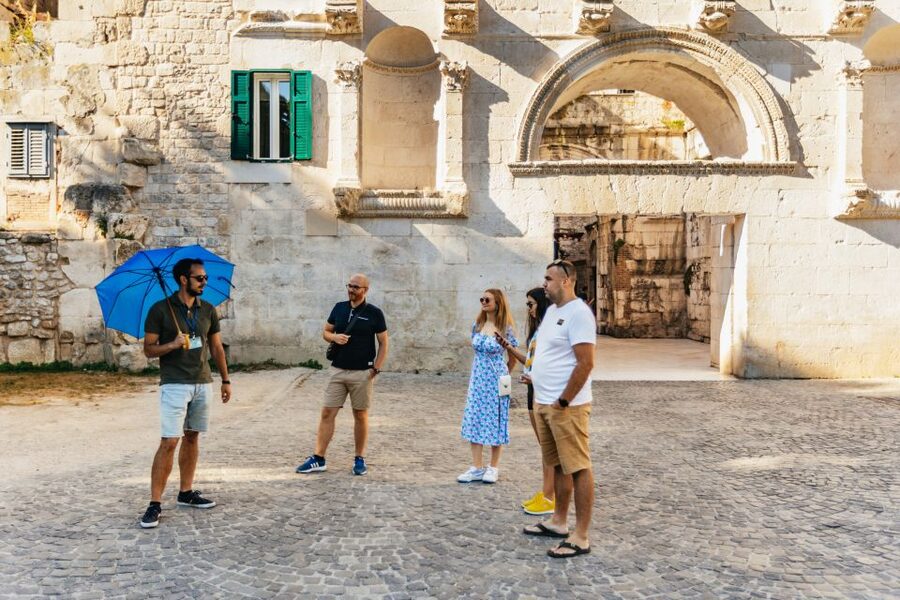
- The Golden Gate is your starting point: Meet at the north gate of Diocletian’s Palace and look for a guide carrying a blue umbrella.
- You explore a living Roman palace: Homes, shops, churches, cafés, and squares occupy the same area as ancient imperial remains.
- The private guide adapts the route: The walk can last from 90 minutes to five hours, depending on availability and how much detail you want.
- The route mixes major sights and local corners: You see Peristil, the Cathedral of Saint Domnius, the Cellars, Riva, People’s Square, and Fruit Square.
- Four guide languages are available: Tours are offered in English, German, Spanish, and French.
- The price is per group: At $117 for up to two people, the cost can make sense for couples or anyone who values a private conversation over a large group walk.
Why Diocletian’s Palace is more than one building
The name can fool you. Diocletian’s Palace is not a single palace you enter, inspect, and leave. It is the core of Split, spread through a compact old center where Roman walls form the framework for later streets and buildings.
Emperor Diocletian built the palace as a retirement residence and military complex. After his death, the site did not become a frozen ruin. People continued to live around it, adapt it, and build over parts of it. That is why your walk moves so quickly between Roman columns, medieval churches, Gothic façades, Renaissance details, and Baroque additions.
I find a private guide especially useful here because the remains are not always obvious. A weathered wall may be Roman. A narrow lane may follow an old palace passage. A later church may sit inside or beside an imperial structure. Without context, you can see attractive stonework but miss the reason the city feels so unusual.
The guide also helps place Split in time. Diocletian died in 311 AD, and the Cathedral of Saint Domnius was later built on the site of his mausoleum. That pairing gives the city one of its sharpest historical contrasts: a building connected to a Roman emperor who persecuted Christians became the center of Christian worship.
More Old Town Walking Tours in Split
- Split: Old Town and Diocletian Palace Walking Tour
★ 4.9 · 4,727 reviews - Walking Tour of Split and Diocletian’s Palace
★ 5.0 · 2,588 reviews - Krka Waterfalls tour with Trogir Walking tour and Krka panoramic boat cruise
★ 5.0 · 1,659 reviews
Starting beneath the Golden Gate
The tour begins at the Golden Gate, the palace’s north entrance. This is a sensible meeting point because it is one of Split’s most recognizable landmarks and a clear place to find your guide. Look for the blue umbrella.
The gate gives you an immediate sense of scale. It was designed as a formal entrance to the imperial complex, but the surrounding streets now feel like part of an ordinary Croatian city. That mixture is central to Split. Ancient stone is not separated from daily life.
You receive a guided look at the gate for about 10 minutes. Use this opening to tell your guide what interests you most. If you care about Roman planning, ask for more detail on the palace layout. If you are traveling with teenagers, ask for stories and visual clues that keep the history moving. A private walk gives you room to shape the conversation from the start.
Nearby is the statue of Gregory of Nin, a medieval Croatian bishop. His oversized figure is one of Split’s familiar public landmarks, and the statue adds a later chapter to the story after the Roman period. The route does not treat the palace as an isolated ancient site. It shows how different eras took possession of the same space.
A brief stop at the Game of Thrones Museum

The route includes a short guided stop at the Game of Thrones Museum, listed at about five minutes. This is a small part of the overall walk, not the main reason to book it.
If you know Split from television, the stop adds a modern pop-culture link to a much older setting. If you do not care about the show, it is brief enough that it should not take over the tour. You can also use this point to ask your guide about how filming affected interest in the city, though the exact amount of time spent can vary because the walk is private.
The strongest part of the experience remains the actual old center. The museum works best as a quick extra, not as a substitute for the Roman and medieval sights outside.
People’s Square and Fruit Square
From the palace area, you move into Split’s medieval quarter and reach People’s Square. This is a useful change of scene. The palace walls explain the Roman foundation, while the square shows how the city developed after the ancient period.
The planned 10-minute stop gives your guide time to point out City Hall and the surrounding architecture. Here, you begin to see the transition from Roman military residence to medieval and later civic center. The buildings are close together, so keep your eyes up. The character of Split often appears in upper façades, old windows, and details that are easy to miss while walking.
Fruit Square follows, also with about 10 minutes of guided explanation. The name comes from the former fruit market, and the square is tied to the everyday business of the city rather than only to grand monuments. This is one reason I like having a local guide. A guide can explain why a square mattered to residents, not just identify its architectural period.
The pace here should suit most people, but the private format matters if you want to pause for photographs or ask about a particular building. A large group may need to keep moving. With your own guide, you can spend more time where your curiosity takes you.
Same stretch of coast, a completely different day out:
- Split: Krka Waterfalls Trip with Boat Cruise and Swimming
★ 4.8 · 10,519 reviews - From Split: Krka Waterfalls, Food & Wine Tasting Tour
★ 5.0 · 9,326 reviews - Blue cave, Mamma Mia and Hvar, 5 islands speedboat tour
★ 5.0 · 7,150 reviews - From Split: Krka Waterfalls, Food & Wine Tasting Tour
★ 4.9 · 6,598 reviews
Riva Harbor and the city’s public face
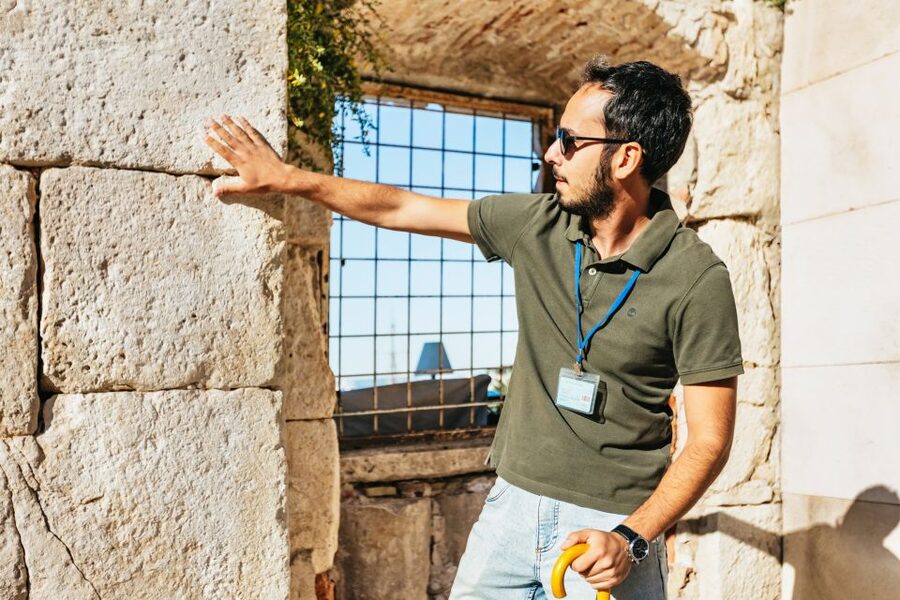
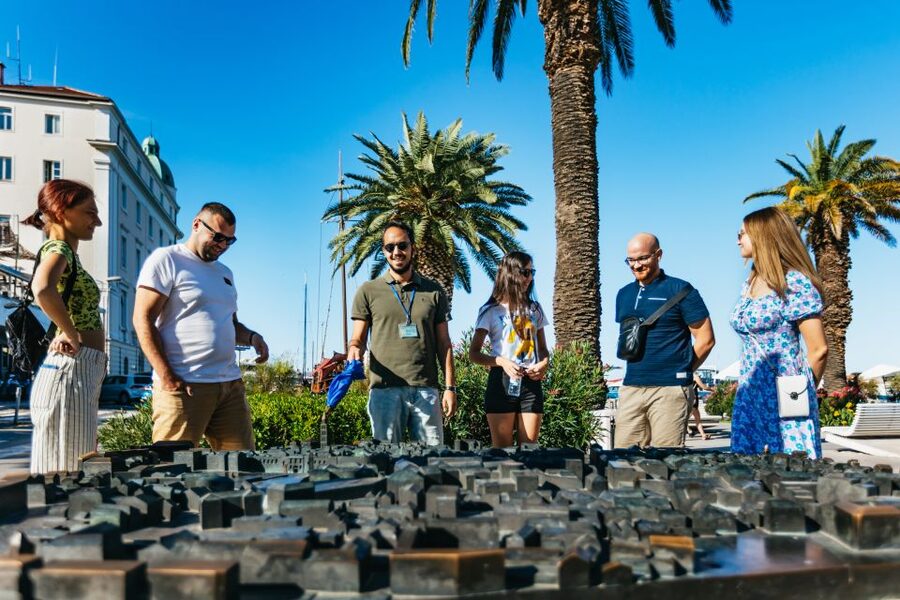
The walk continues to Riva, Split’s waterfront promenade. The change is welcome after the tight lanes and enclosed palace passages. You get open views across the harbor and a chance to understand how closely the old city is tied to the sea.
The Riva stop is planned for roughly 10 minutes. That is enough for an introduction, a few photographs, and some local context, though it is not a long waterfront stroll. If you want more time here, say so. The tour is advertised as flexible, and the guide can adjust the balance between sights.
I like Riva as part of this route because it keeps the tour from becoming a parade of ruins. Split is a port city, not only an archaeological site. The promenade is one of the places where you feel its present-day social life, while the palace remains just behind you.
The waterfront can also be sunny, so sunglasses and a sun hat are useful. Comfortable shoes matter throughout the walk, especially when you return to the older lanes and palace areas.
Going below street level in Diocletian’s Cellars
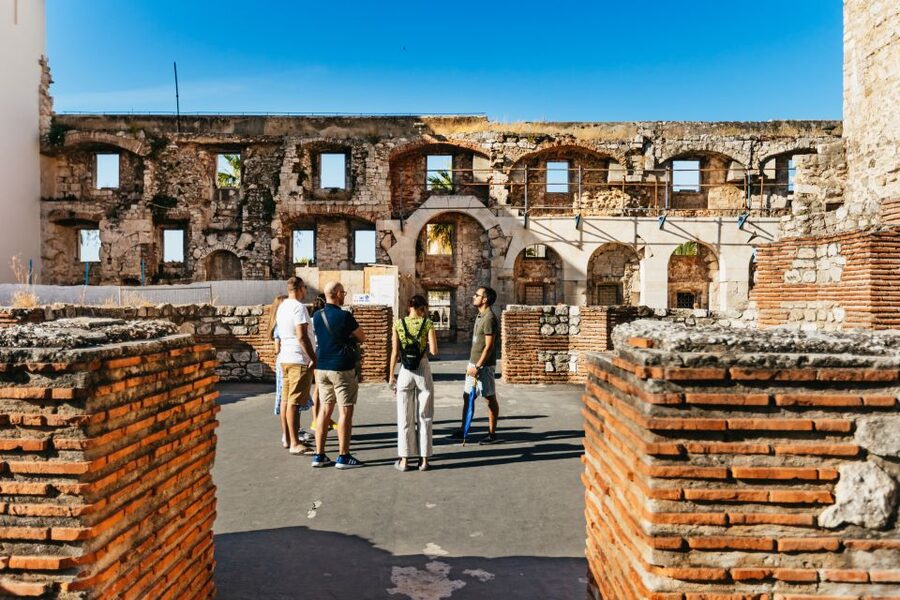
The Cellars are one of the most memorable parts of the walk. This underground section helped support the upper palace and preserves the Roman plan in a way that can be easier to read than the crowded streets above.
The guided visit is planned for about 15 minutes, making it the longest single stop on the route. Your guide can explain how the lower level relates to the imperial apartments and why the cellars are important for understanding the original palace design.
The atmosphere changes here. You leave the sunlight and enter a stone-built space with a stronger sense of the ancient structure. It is also a good place to ask detailed questions, since the layout can be confusing without an explanation.
Do not expect a full archaeological museum visit. This is a focused stop within a larger walking tour. If Roman engineering and palace design are your main interests, you may want to request extra time here or choose the longer version of the tour, if available for your date.
Peristil, the palace’s grand central court

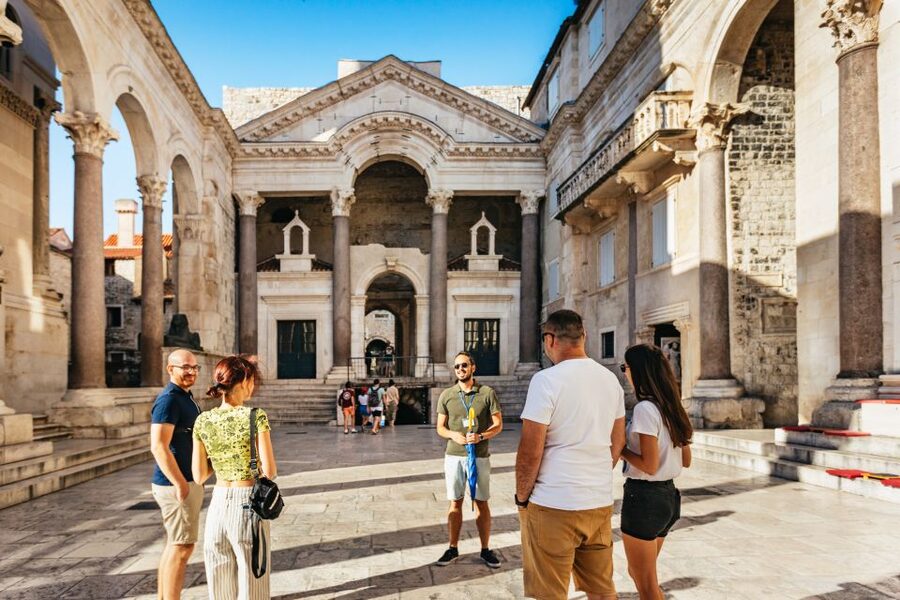
Peristil is the visual heart of the Roman section. This formal courtyard once served as a ceremonial approach to the emperor’s apartments and temple area. Today, it is one of the places where the scale and ambition of Diocletian’s complex become easiest to grasp.
The guided portion is listed at about 10 minutes, but you may find the square deserves a pause. Look at the columns, the surrounding stonework, and the way later buildings press close to the Roman setting. The space has changed function over time, yet its original authority is still clear.
Your guide can also help you read the relationship between Peristil and the Cathedral of Saint Domnius. The cathedral is not an unrelated church added somewhere nearby. It occupies the former mausoleum of Diocletian, making the square and cathedral part of one layered story.
Peristil can be one of the busier points in the old center. A private guide is useful here because you can stay together without being tied to a large group’s pace. You can also ask to move on if the square feels crowded.
Saint Domnius and the unusual fate of Diocletian’s mausoleum

The Cathedral of Saint Domnius, known locally as St Duje, is one of the essential stops. It was built in the fifth century on the site where Diocletian was buried in 311 AD. The building is often described as one of the best-preserved ancient Roman structures still standing.
That fact gives the cathedral unusual weight. You are not simply seeing a medieval church. You are seeing a Christian cathedral occupying the former tomb of a Roman emperor known as the last famous persecutor of Christians.
The guided stop is planned for around 10 minutes. The tour data does not specify whether a separate entrance ticket is included, so check the details for your chosen departure if entering the cathedral is important to you. The guide will explain the site and its place in Split’s story, but the exact indoor access may depend on local conditions.
This is another place where your interests can guide the conversation. Ask about the Roman mausoleum, the later Christian use, or the changes made to the building over the centuries. A short explanation can turn what looks like a compact stone church into one of the most meaningful sights in the city.
The Vestibul and the way Roman spaces survive
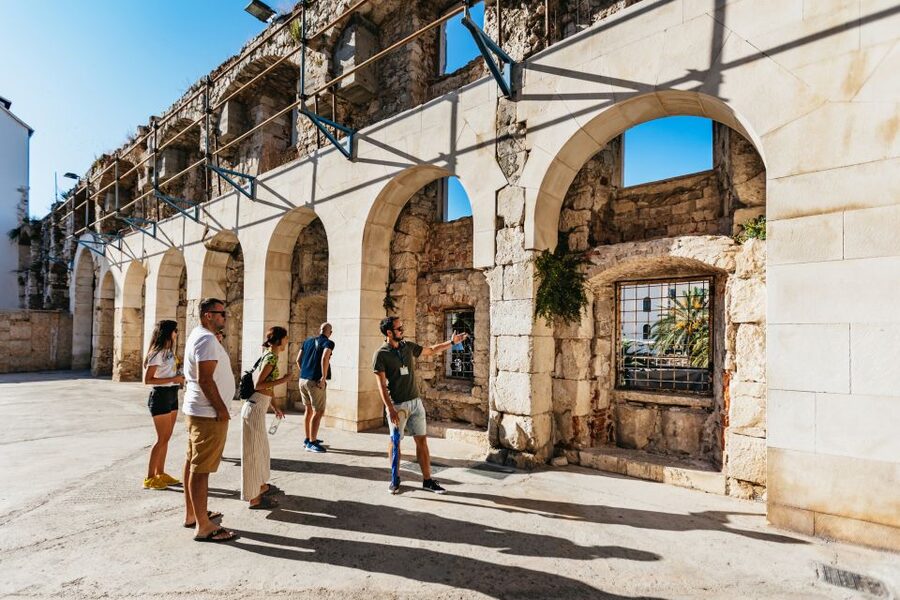
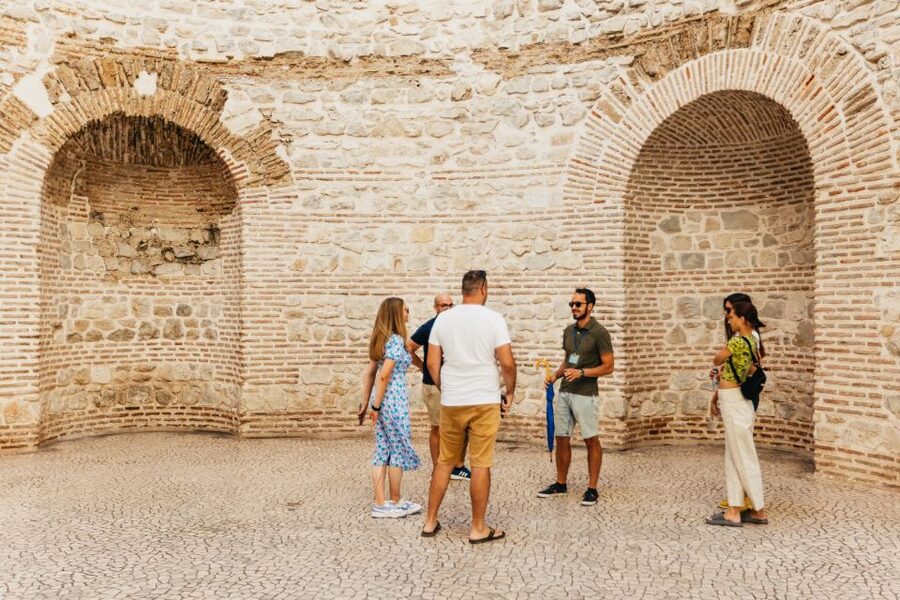
The Vestibul was the formal entrance area leading toward the emperor’s apartments. It is a round, domed space that shows the palace at its most ceremonial.
The tour allows about 10 minutes here. That may be enough to understand the layout and take in the structure, though the space is not large. The guide’s explanation helps you picture how this passage connected to the rest of the imperial residence.
The Vestibul also shows why Split rewards slow looking. The most impressive parts are not always marked by a huge sign. You may pass through a narrow opening, look into a court, or turn a corner and find a Roman element built into the modern city.
From here, the route returns to the Golden Gate. The walk makes a complete circuit rather than leaving you at an unrelated point, which is useful if you are arranging the tour around other plans in central Split.
How much time should you choose?
The advertised duration ranges from 90 minutes to five hours. That is a wide span, and it reflects the private nature of the experience more than a fixed schedule.
A 90-minute version should suit you if you want a brisk orientation to the main Roman and medieval sights. It can introduce the Golden Gate, Cellars, Peristil, Cathedral, Vestibul, Riva, and the central squares without giving every site a long explanation.
Choose a longer option if you enjoy history, architecture, photography, or questions. The extended format gives you a better chance to linger at Peristil, explore the medieval quarter at a slower pace, and ask about Split’s Roman, Christian, Gothic, Renaissance, and Baroque layers.
Families may also benefit from a flexible duration. Younger children may do better with a shorter walk and frequent changes of scene. Teenagers can be drawn in through the Game of Thrones connection, the statue of Gregory of Nin, and stories about how an ancient palace became a living city. One guide, Antonia, was specifically praised for adjusting her explanations to answer questions and keep younger participants involved.
The value of a private guide at $117
The price is $117 per group of up to two people, not a per-person rate. For a couple, that works out to $58.50 each. For a solo participant, it is a more expensive way to see the old center, but you are paying for personal attention rather than a standard group walk.
The value rises if you want to set your own pace or have a particular interest. A private guide can spend more time on Roman architecture, Croatian history, religious buildings, local life, or filming locations instead of giving everyone the same script.
The price includes a professional local guide, a private sightseeing tour, and taxes, fees, and handling charges. The supplied details do not clearly state that attraction admission tickets are included, so confirm that point if the cathedral or another interior visit is essential to your plans.
You also get flexibility at the booking stage. You can reserve and pay later, and cancellation is free up to 24 hours before the tour for a full refund. Starting times depend on availability.
What the guide can add to your day
The guide is the main reason to choose this experience over walking through Split with a map. You still see the same streets and monuments, but the order begins to make sense when someone explains how the Roman palace became the medieval town.
Several guide names have received specific praise. Slavko is a local guide born and raised in Split, and his approach includes historical perspective and local recommendations. Antonia has been described as patient with questions and deeply interested in the architecture and unusual place of the palace in city history. Vinka has also been singled out for a professional approach, while a German-speaking guide was noted for offering individual tips.
The available languages are English, German, Spanish, and French. That matters in a private setting because you can ask follow-up questions without worrying about holding up a group.
Still, guide quality can vary from person to person, as it does on any human-led tour. The best way to get more from the walk is to explain your interests before or at the beginning. Tell the guide if you want fewer facts and more stories, a focus on Roman remains, help with family pacing, or local suggestions for the rest of your time in Split.
Who should book this Split walking tour?
I would recommend it to a couple who wants a clear introduction to Split without joining a large group. It also fits families who need a guide willing to adjust the pace and explanation level.
History and architecture fans will appreciate the sequence from Golden Gate to Cellars, Peristil, Saint Domnius, and Vestibul. The route also works well as an early visit because it gives you a useful map of the old center before you explore on your own.
You may prefer a self-guided walk if you want complete freedom, dislike scheduled meeting points, or only want to see the outside of the main sights. The price is harder to justify for one person, and the route is not suitable for wheelchair users.
Wear comfortable shoes, bring sunglasses and a sun hat, and expect a fair amount of walking on old city surfaces. Meet at the Golden Gate, the north gate of Diocletian’s Palace, and look for the blue umbrella.
Should you book it?
Book this tour if you want Split’s Roman remains explained as part of a living city, not presented as disconnected ruins. The strongest reasons are the private pace, the local guides, and the chance to connect Diocletian’s mausoleum with Saint Domnius, medieval squares, the Riva, and later palace buildings in one compact walk.
Skip it if you prefer to wander alone or need a fully step-free route. For everyone else, especially couples and curious families, $117 for up to two people is a fair price for a flexible introduction to the heart of Split.
FAQ
Where does the private Split walking tour begin?
It begins at the Golden Gate, the north gate of Diocletian’s Palace in central Split. Look for a guide carrying a blue umbrella.
How long does the tour last?
The duration can range from 90 minutes to five hours. Starting times and available durations depend on the date you select.
Is this a private tour?
Yes. The tour is for a private group, with a personal guide who can adjust the sightseeing route to your pace and interests.
Which languages are available?
Guides are available in English, German, Spanish, and French.
What sights are included on the walking route?
The route includes the Golden Gate, Game of Thrones Museum, People’s Square, Fruit Square, Riva, Diocletian’s Cellars, Peristil, the Cathedral of Saint Domnius, and the Vestibul. The walk returns to the Golden Gate.
What should I bring?
Bring comfortable shoes, sunglasses, and a sun hat.
Is the tour suitable for wheelchair users?
No. The tour is listed as not suitable for wheelchair users.
What is the cancellation policy?
You can cancel up to 24 hours in advance for a full refund. You can also reserve now and pay later, subject to the booking conditions.
More Walking Tours in Split
- Split & Diocletian’s Palace Walking Tour
★ 5.0 · 1,125 reviews - Walking Tour of Split with a ‘Magister’ of History
★ 5.0 · 1,122 reviews - Split Walking Tour with Professor of History
★ 5.0 · 926 reviews - Split: Diocletian Palace & Old Town Guided Walking Tour
★ 4.7 · 882 reviews
Just added around Split
- Split Sunset Stand Up Paddle Tour★ 5.0 · 16 reviews
- Split: Sunset Guided Kayaking Tour★ 4.8 · 71 reviews
- Split&Sip: Educational wine tasting★ 4.9 · 52 reviews
- Stand Up Paddle Tour in Split★ 4.7 · 17 reviews
- Split: Guided Walking Tour in English★ 4.9 · 10 reviews
- Split – Walking in Khaleesi Footsteps in the City of Dragons★ 5.0 · 13 reviews
- Split Walking Tour with History Professor★ 5.0 · 23 reviews
- Split Walking Tour: History, Legends & Tales★ 5.0 · 9 reviews
Old Town Walking Tours, compared.



Walking Tour of Split and Diocletian’s Palace
Read our review →


Krka Waterfalls tour with Trogir Walking tour and Krka panoramic boat cruise
Read our review →
City Walls Early Morning or Sunset Walking Tour
Read our review →
Plitvice Lakes with Boat Ride and Zadar Old Town Tour
Read our review →Browse the lists this tour appears in