
Reviewed · OLD TOWN WALKING TOURS
Split: Private Walking Tour in the Historical Town Center
Split’s old town is not a museum behind velvet ropes. It is a living neighborhood built inside a 4th-century Roman palace, with cafés, homes, shops, churches, and narrow lanes filling spaces once meant for imperial life. This private walk with Sanja gives you a clear way into that puzzle, from the bronze city model on the Riva to the Palace’s ancient core and the later streets beyond it.
I like the private format, especially for a group of four or fewer, because you can hear the guide easily and ask questions without waiting for a crowd. I also like the historical range: Roman, medieval, Venetian, French, Austro-Hungarian, and Yugoslav periods all appear during one compact walk. The main consideration is the price, $153 per group of up to 15, and the separate entrance fee for the Palace Substructures.
In This Review
- Key points to know
- Why a private walk makes Split easier to read
- Meeting the tour beside the bronze city model
- Inside Diocletian’s Palace, Split’s unusual town center
- Peristil and the Roman center of power
- Cathedral of Saint Domnius and Jupiter’s Temple
- The Substructures: the one extra-cost stop
- Beyond the Palace walls: Pjaca and Fruit Square
- Prokurative and the waterfront finish
- Timing, walking conditions, and group size
- Is $153 a good value?
- Who should book this Split tour?
- Should you book it?
- FAQ
- Where does the tour meet?
- How long does the walking tour last?
- What language can I choose?
- Is the tour private?
- Is entrance to the Palace Substructures included?
- Does the tour visit Diocletian’s Palace?
- Which squares are included outside the Palace?
- Is the tour suitable for wheelchair users?
Key points to know
- Sanja leads a private walk for up to 15 people in English, French, Italian, or Spanish.
- The Substructures require a separate entrance ticket, so budget for that extra cost.
- Peristil, the Cathedral, Jupiter’s Temple, and the Golden Gate make up the Roman heart of the route.
- Pjaca, Fruit Square, and Prokurative show how Split grew beyond the Palace walls.
- The tour takes 105 minutes, a useful first look before exploring the old town on your own.
- The route is not suitable for wheelchair users, and much of the historic center is on foot.
Why a private walk makes Split easier to read
The central problem with Split is not a shortage of sights. It is knowing what you are looking at. A stone wall may be Roman, a doorway medieval, and the building above it much later. Diocletian’s Palace is so woven into modern Split that the boundaries of an archaeological site can disappear.
Sanja’s tour gives you a framework before you start wandering. She explains how an imperial residence became the core of a medieval town, then connects the later squares and buildings to the governments that ruled Split. That context is useful long after the 105 minutes are over.
A private group also changes the pace. You can ask about a detail that catches your eye, request a clearer explanation, or spend a little longer at a place that matters to your group. The value is strongest when several people share the $153 cost. For one or two people, it is a more expensive introduction than a group walk, but you get personal attention and no strangers to accommodate.
Sanja has been especially praised for her French and English. French-speaking visitors found her explanations clear, well presented, and easy to follow, while English-speaking groups appreciated her strong command of the language and approachable style. If you want the tour in Italian or Spanish, those languages are also offered.
More Old Town Walking Tours in Split
- Split: Old Town and Diocletian Palace Walking Tour
★ 4.9 · 4,727 reviews - Walking Tour of Split and Diocletian’s Palace
★ 5.0 · 2,588 reviews - Krka Waterfalls tour with Trogir Walking tour and Krka panoramic boat cruise
★ 5.0 · 1,659 reviews
Meeting the tour beside the bronze city model
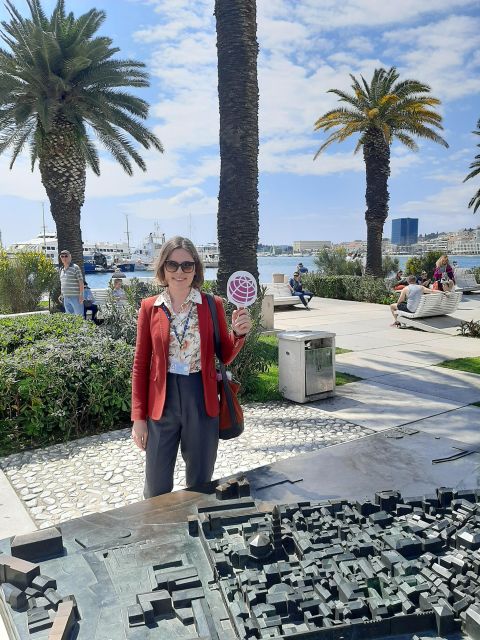
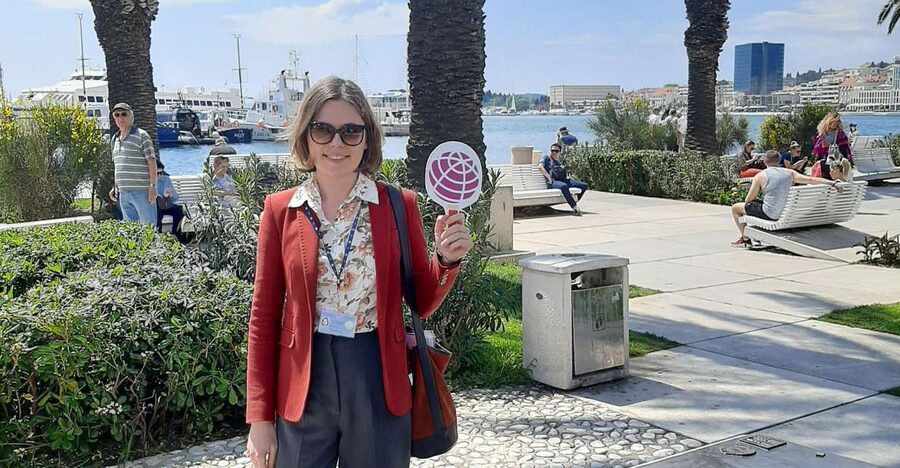
You meet on the Riva promenade, beside the bronze model of Split’s historical center. The model is in front of the Palace’s south entrance, making it a sensible starting point rather than just a convenient landmark.
This first stop helps you see the basic shape of the old town. The Palace is not a small isolated ruin. It forms the historic center, with the waterfront on one side and later neighborhoods extending beyond its original walls.
The Riva itself is also part of the story. The tour begins and ends by the sea, so you get a simple visual contrast between Split’s open waterfront and the tight Roman and medieval streets behind it. The walk finishes on the Riva promenade, near the starting area and the bronze model.
Inside Diocletian’s Palace, Split’s unusual town center
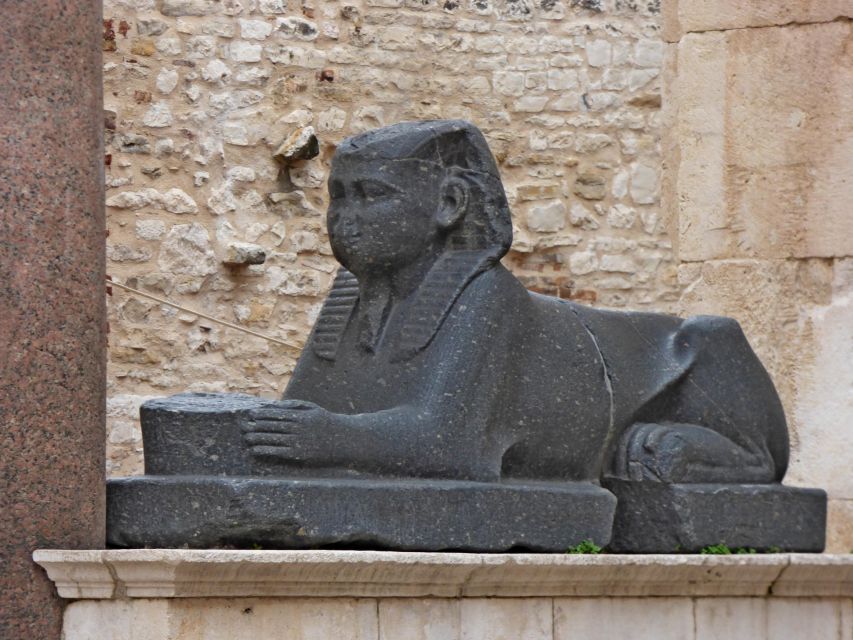
The Palace is the main event. Built in the 4th century for the Roman emperor Diocletian, it is the oldest part of Split. Yet you will not walk through a deserted imperial compound. The medieval town developed inside it, and later buildings were fitted into the Roman plan.
That mixture is what makes the visit worthwhile. You may see a Roman column beside a medieval house, or an ancient wall supporting a much newer building. Instead of treating each period as a separate chapter, Sanja explains how the town grew by reusing what was already there.
The Palace walls and four gates help you understand the original design. Each gate offered a route into the imperial complex, and the south side opens toward the water. The gates also give you useful orientation points when you return alone. Once you know which side of the Palace you are on, the maze becomes less intimidating.
The Golden Gate is one of the most memorable stops. It is a strong reminder that this was once a fortified imperial residence, not simply a collection of old buildings. The tour’s short visit here works well because you get the purpose and setting without spending too much of your limited time on one entrance.
Peristil and the Roman center of power
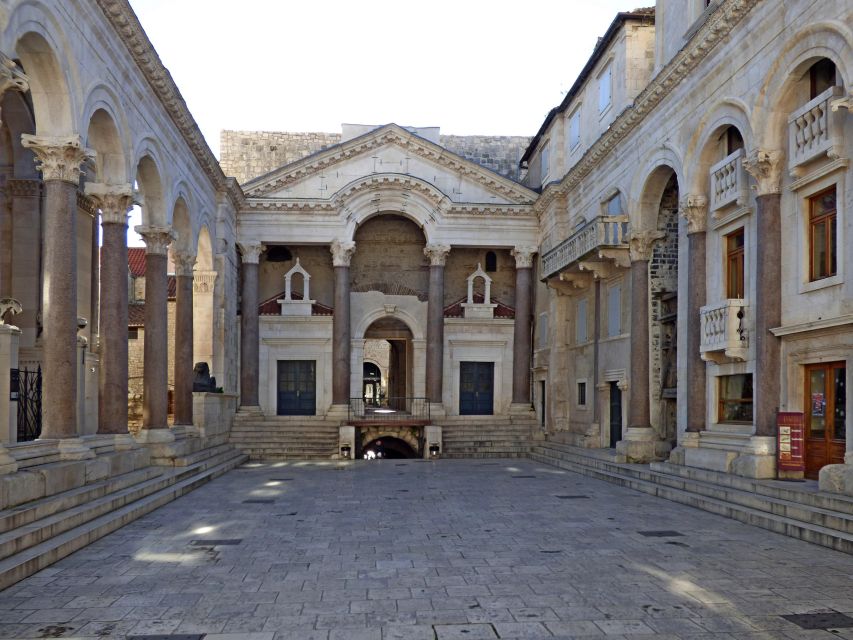
Peristil is the Palace’s main square and one of the places where the Roman plan is easiest to grasp. It has the scale and form of an imperial ceremonial space, but daily life now flows around it.
Sanja uses Peristil to explain the Palace as a working residence and political center. You are not just looking at columns and stone. You are seeing the place where imperial authority was displayed.
The stop is scheduled for about 10 minutes, which is enough for orientation and explanation but not a long pause. If you want detailed photographs or time to sit and watch the square, plan to return later. That is one reason the tour works best at the start of your stay. You learn what deserves a second look.
Same stretch of coast, a completely different day out:
- Split: Krka Waterfalls Trip with Boat Cruise and Swimming
★ 4.8 · 10,519 reviews - From Split: Krka Waterfalls, Food & Wine Tasting Tour
★ 5.0 · 9,326 reviews - Blue cave, Mamma Mia and Hvar, 5 islands speedboat tour
★ 5.0 · 7,150 reviews - From Split: Krka Waterfalls, Food & Wine Tasting Tour
★ 4.9 · 6,598 reviews
Cathedral of Saint Domnius and Jupiter’s Temple
The Cathedral of Saint Domnius occupies the former mausoleum of Diocletian. That change tells you a great deal about Split in one building: an imperial tomb was later adapted for Christian worship. Sanja guides you through the significance of the site and points out the connection between the Palace’s Roman purpose and its later religious life.
The visit is mainly a guided sight from outside, with the itinerary allowing time to pass by rather than including a cathedral entrance. If entering the cathedral is important to you, confirm the current arrangements separately and allow extra time after the walk.
Nearby, Jupiter’s Temple is now associated with the Palace Baptistery. The tour includes an exterior visit without an entrance fee. Again, the value is in seeing how Roman religious architecture was reused within the Christian town.
These stops are brief, but they add an important layer. You see that Split’s old center was not preserved in one untouched state. People kept adapting it to new beliefs and new needs.
The Substructures: the one extra-cost stop
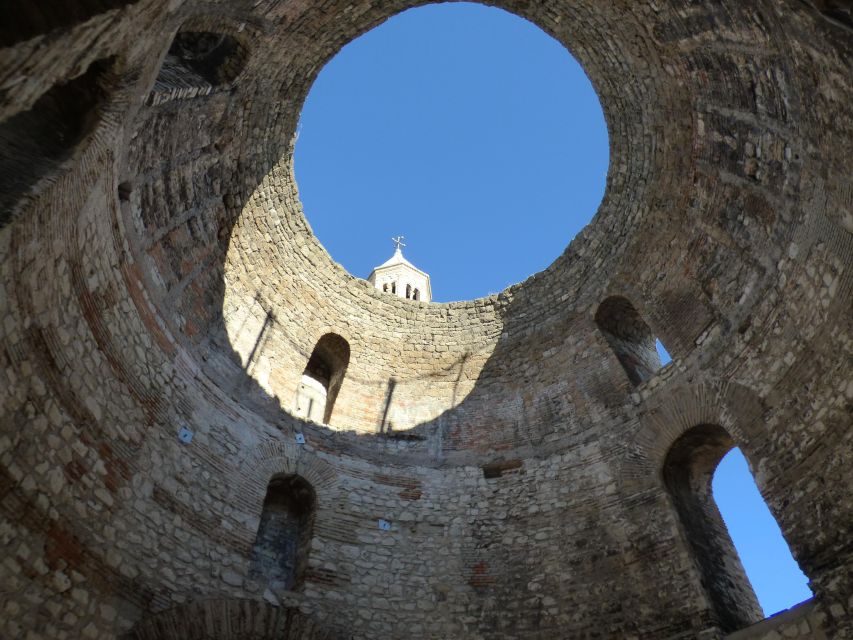
The Palace Substructures, also called the Basements, require an entrance fee that is not included in the tour price. This is the only specifically listed admission cost, so keep some money aside for it.
The Substructures are valuable because they reveal the Palace’s ground plan from below. They also help you understand why parts of the upper town have the shape they do. Sanja takes you through this level as part of the private walk, then continues above ground through the historic center.
The separate ticket is a small practical drawback, particularly if you assumed the $153 covered every stop. Still, I think this is the right admission to add if you want the Roman Palace to make sense. Without the lower level, you see fragments. With it, the structure becomes easier to picture.
Because the full tour lasts only 105 minutes, do not expect a slow archaeological study. The Substructures are one part of a broad introduction, not a stand-alone museum visit. If Roman construction is your main interest, you may want to spend more time there after the guided portion.
Beyond the Palace walls: Pjaca and Fruit Square
The second half leaves the imperial compound and enters the medieval neighborhood that grew outside it. This shift is important. You see how Split moved from a planned Roman residence to a functioning town with public squares, family homes, and changing political customs.
People’s Square, known as Pjaca, is one of the key stops. It gives you a sense of the town’s civic life beyond the Palace. The guide connects the square to the way Split developed under different rulers, rather than treating it as just another attractive open space.
Fruit Square offers another view of the medieval and later town. Its name comes from the market tradition associated with the area, and the setting helps show how commerce and daily life spread outward from the Palace. The short stop is useful for orientation, though you will not get a long pause at every building.
One of the tour’s strengths is the way it links architecture to government. Sanja discusses life under Venetian, French, Austro-Hungarian, and Yugoslav rule. You get a more useful explanation than a list of dates because the changes are tied to the streets and squares around you.
The walk also includes medieval houses of noble families and a small former Jewish ghetto with an active synagogue. These details broaden the picture of Split. The old town was not shaped only by emperors and grand churches. It was also a place of residents, religious communities, trade, and local power.
Prokurative and the waterfront finish
Prokurative is a later square with a different feel from the Roman spaces inside the Palace. Its name and design reflect Venetian influence, and its broad layout provides a sharp contrast to the narrow lanes nearby.
This is a good place to hear about the later political and social layers of Split. By the time you reach it, the tour has moved from imperial Rome through the medieval town and into the periods that shaped the modern city.
The walk ends back on the Riva promenade by the sea. That return is practical. You finish near a familiar reference point, with the old town behind you and the waterfront ahead. Sanja can also give you ideas for exploring after the tour, which is one of the strongest reasons to schedule this experience early in your stay.
Timing, walking conditions, and group size
At 105 minutes, this is long enough to cover the essential historic center without taking over your day. It is a good fit if you have limited time in Split, are visiting on a cruise stop, or want a strong introduction before independent sightseeing.
The route is on foot through old streets and squares. The description does not give a precise distance, so you should expect continuous walking rather than a seated history talk. Wear comfortable shoes and be ready for uneven historic surfaces. The experience is not suitable for wheelchair users.
The private group can include up to 15 people. That maximum is useful for a family group or a larger party, but the experience will feel more personal with a smaller number. One English-speaking group of four found it easy to hear and follow Sanja, which is the practical advantage of private guiding at its best.
The tour is offered in English, Italian, French, and Spanish. Sanja’s French was praised as especially clear, and her English was described as excellent. If language comfort matters to your group, select the language that lets everyone follow the political and architectural explanations without strain.
Is $153 a good value?
The price is $153 per group, not per person, for a private tour of up to 15 people. That makes the value depend heavily on your group size.
For 10 to 15 people, the cost per person is modest for a licensed local guide and nearly two hours of private attention. For four people, it works out to about $38 per person before the Substructures admission. For two people, the cost is much higher per person, though you still gain flexibility and a direct line to the guide.
I would compare it with the cost of losing time in the old town. Split’s center is compact, but its layers are not obvious. A good first walk can prevent you from seeing the Palace as a string of unrelated stones. It also gives you a list of places to revisit, including the Substructures, cathedral area, squares, and gates.
The main value is not the number of stops. It is the explanation tying them together. If you only want quick photographs, a private guide may be more than you need. If you want to understand why Roman, medieval, Venetian, French, Austro-Hungarian, and Yugoslav traces occupy the same few blocks, the price is easier to justify.
Remember to add the Substructures admission fee. The guide, private format, and commission tax are included, but that entrance is not.
Who should book this Split tour?
I would choose this walk if you are visiting Split for the first time and want your bearings quickly. It is also a strong choice for families, couples, or friends who prefer asking questions freely instead of joining a large group.
French-speaking visitors have a particularly good reason to consider Sanja, given the praise for her fluent and culturally aware explanations. English, Italian, and Spanish speakers also have language options.
This tour suits you if you care about history but do not want a long academic lecture. The route keeps moving, and each stop adds a piece to the town’s story. It also suits you if you plan to stay inside or near the old Palace walls and want to understand your surroundings from the first day.
I would think twice if you use a wheelchair, dislike walking on old streets, or want extensive interior visits. The cathedral and Jupiter’s Temple are exterior stops, and the tour gives you a broad introduction rather than long time inside each monument.
Should you book it?
Book this private walk early in your Split stay if you want a clear introduction, a multilingual guide, and useful ideas for independent exploring. Sanja’s strongest qualities are her clear explanations, strong language skills, and ability to connect architecture with the many governments that shaped the city.
The $153 price is easiest to justify for a group, and the extra Substructures fee should be part of your budget. For a small party on a tight budget, a shared walk may cost less. But if you value personal attention and want Split’s old center to make sense instead of simply looking old, this is a well-focused choice.
FAQ
Where does the tour meet?
You meet beside the bronze model of Split’s historical core on the Riva promenade by the sea. It is in front of the south entrance to Diocletian’s Palace.
How long does the walking tour last?
The tour lasts 105 minutes, or about 1 hour and 45 minutes.
What language can I choose?
The live tour guide is available in English, Italian, French, and Spanish.
Is the tour private?
Yes. It is a private group tour for up to 15 people.
Is entrance to the Palace Substructures included?
No. The Substructures, also called the Basements, require a separate entrance fee.
Does the tour visit Diocletian’s Palace?
Yes. The route includes Diocletian’s Palace, its walls and four gates, the Substructures, Peristil, the Cathedral of Saint Domnius, and Jupiter’s Temple.
Which squares are included outside the Palace?
The walk includes People’s Square, also called Pjaca, Fruit Square, and Prokurative.
Is the tour suitable for wheelchair users?
No. The activity is listed as not suitable for wheelchair users.
More Walking Tours in Split
- Split & Diocletian’s Palace Walking Tour
★ 5.0 · 1,125 reviews - Split: Diocletian Palace & Old Town Guided Walking Tour
★ 4.7 · 882 reviews - From Split: Krka Waterfalls Cruise & Trogir Walking Tour
★ 4.7 · 681 reviews - Diocletian’s Palace and Old Town SMALL GROUP Walking Tour
★ 5.0 · 502 reviews
More Historical Tours in Split
- Walking Tour of Split with a ‘Magister’ of History
★ 5.0 · 1,122 reviews - Split Walking Tour with Professor of History
★ 5.0 · 926 reviews - Split: History and Heritage Walking Tour
★ 4.9 · 650 reviews - Split History and Gastro Small-Group Tour with Food and Drinks
★ 5.0 · 375 reviews
Just added around Split
- Split Sunset Stand Up Paddle Tour★ 5.0 · 16 reviews
- Split: Sunset Guided Kayaking Tour★ 4.8 · 71 reviews
- Split&Sip: Educational wine tasting★ 4.9 · 52 reviews
- Stand Up Paddle Tour in Split★ 4.7 · 17 reviews
- Split: Guided Walking Tour in English★ 4.9 · 10 reviews
- Split – Walking in Khaleesi Footsteps in the City of Dragons★ 5.0 · 13 reviews
- Split Walking Tour with History Professor★ 5.0 · 23 reviews
- Split Walking Tour: History, Legends & Tales★ 5.0 · 9 reviews
Old Town Walking Tours, compared.



Walking Tour of Split and Diocletian’s Palace
Read our review →


Krka Waterfalls tour with Trogir Walking tour and Krka panoramic boat cruise
Read our review →
City Walls Early Morning or Sunset Walking Tour
Read our review →
Plitvice Lakes with Boat Ride and Zadar Old Town Tour
Read our review →Browse the lists this tour appears in