
Reviewed · OLD TOWN WALKING TOURS
Split: Palace & Old Town Private Walking Tour-Entrance incl.
Split’s old town is not a museum behind ropes. It is a living city built inside and around a Roman emperor’s retirement palace. This private 2.5-hour walk gives you the useful big picture, from the waterfront and palace cellars to the Peristyle, cathedral, ancient temple, medieval squares, and Venetian façades.
I like two things here. First, the entrance fees are included for the cathedral, baptistery, and palace cellars, so the guide can take you inside the most important sites without stopping to sort out tickets. Second, a private group of up to 10 people makes it easier to ask questions and adjust the pace. The main consideration is the price: at $192 per person, this makes the most sense for visitors who value personal attention and a well-organized introduction.
In This Review
- Key points at a glance
- Why Split’s palace works best on foot
- Palace cellars: the best opening lesson
- Peristyle and the imperial stage
- Cathedral of Saint Domnius: from mausoleum to church
- Jupiter’s Temple and the palace’s religious side
- Gates, Vestibul, and the Roman street plan
- Fruit Square and Pjaca: Split after Rome
- The fish market and Marmontova Street
- Prokurative: a Venetian-looking finish
- What $192 per person gets you
- Timing, language, and practical limits
- Who will get the most from this walk?
- Should you book the Split Palace and Old Town tour?
- FAQ
- How long does the Split Palace and Old Town tour last?
- What languages are available?
- What entrance fees are included?
- How many people can join the private tour?
- Where does the tour start and finish?
- Can the tour be changed for accessibility needs?
Key points at a glance
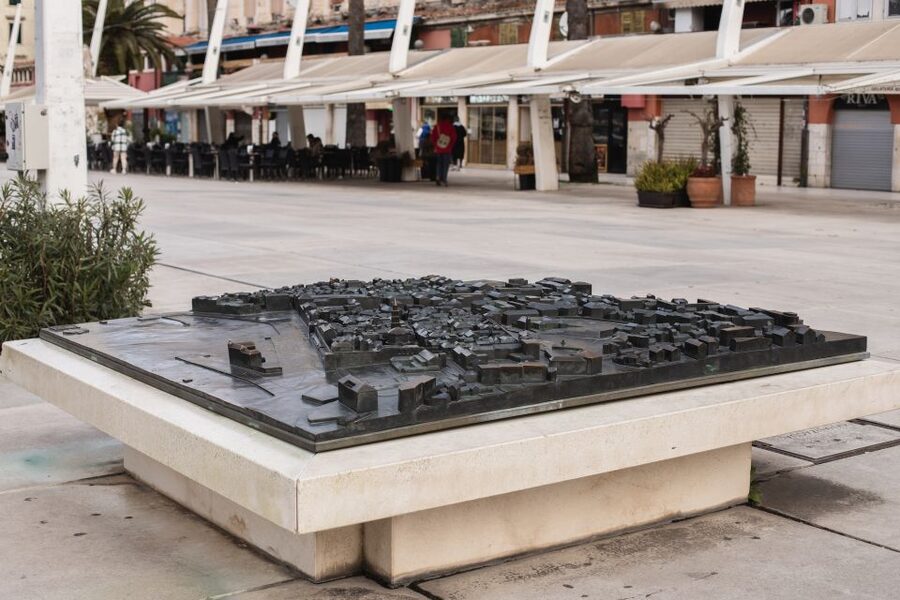
- Start beside Split’s bronze city model: Get your bearings on the Riva promenade before entering Diocletian’s Palace.
- See the palace below street level: The cellars offer a clear sense of the complex’s original scale and design.
- Visit the cathedral and Jupiter’s Temple: Two very different sacred spaces reveal the palace’s Roman and Christian past.
- Follow the old town beyond the palace: The route includes Pjaca, Fruit Square, Venetian palaces, the fish market, and Marmontova Street.
- Finish at Prokurative: End near cafés and restaurants on Split’s grandest 19th-century square.
- Use the private format to your advantage: Ask for more Roman history, more architecture, or a gentler pace if needed.
Why Split’s palace works best on foot
Diocletian’s Palace can confuse you at first. It is not one tidy building with a single entrance. Streets, homes, shops, courtyards, churches, and squares occupy the old Roman complex, so a guide helps you understand how the pieces fit together.
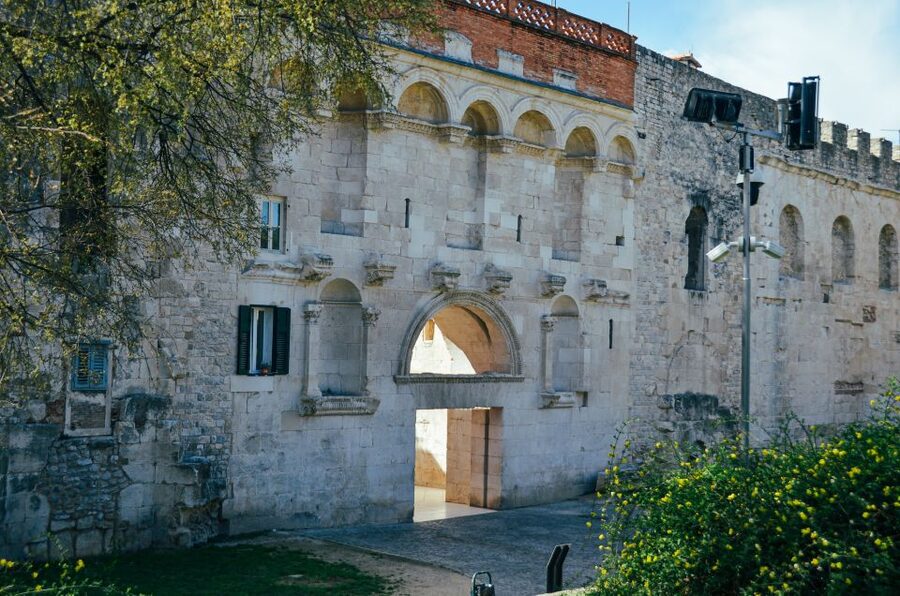
The walk begins at the bronze model of Split’s historic core on the Riva. This is a smart starting point because you can see the palace plan before entering it. From the waterfront, you head toward the southern gate, also called the Brass Gate, and into the palace cellars.
The route then climbs through the palace and continues across the old town. That matters because you are not seeing only Roman remains. You are following the way Split grew over many centuries, with Roman structures adapted for Christian worship and later surrounded by medieval and Venetian buildings.
The pace is fairly full. The listed stops add up to a busy sightseeing session, even though some are short guided looks rather than long visits. Wear shoes suited to uneven stone surfaces, and expect steps inside parts of the palace.
More Old Town Walking Tours in Split
- Split: Old Town and Diocletian Palace Walking Tour
★ 4.9 · 4,727 reviews - Walking Tour of Split and Diocletian’s Palace
★ 5.0 · 2,588 reviews - Krka Waterfalls tour with Trogir Walking tour and Krka panoramic boat cruise
★ 5.0 · 1,659 reviews
Palace cellars: the best opening lesson
The palace cellars are one of the strongest parts of this experience. You enter from the southern side, close to where Roman ships and visitors once approached the palace. Below the modern streets, the underground rooms preserve the shape of the emperor’s complex.
A 20-minute visit is enough to understand their purpose and scale. The cellars also show how much of the palace’s upper layout survives in the streets above. Once you know the underground plan, the Peristyle, gates, and palace lanes become easier to read.
The cellars are not just a quick photo stop. They give you a physical sense of the palace’s former size and help explain why Split’s old town feels so unusual. The modern city has grown through the Roman structure rather than simply around a separate ruin.
Included admission adds real value here. You do not have to decide on the spot whether to pay for entry, and the guide can explain what you are seeing as you move through the rooms.
Peristyle and the imperial stage
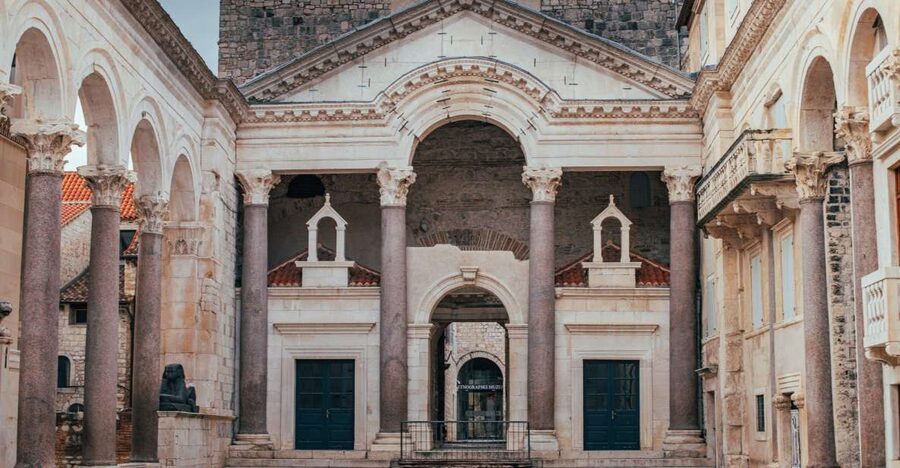
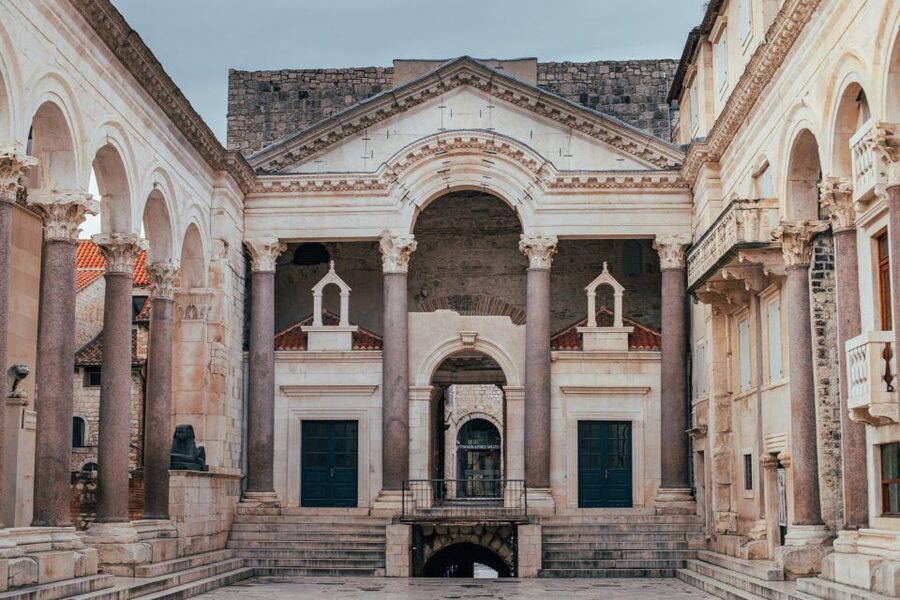
After the cellars, you climb toward the Peristyle, the palace’s grand central court. This is where Diocletian presented himself as the son of Jupiter and received worship from his subjects. The space was designed for ceremony and power, not casual public life.
Your guide will help you read the court as an imperial stage. Look for the contrast between the stern Roman setting and the later buildings that press around it. The Peristyle is one of those places where a short explanation changes what you see. Without context, it can look like a dramatic square. With context, it becomes the center of an emperor’s carefully planned world.
The tour allows about 10 minutes here, with another short look at nearby features such as the Vestibul and Triklinij. That is enough for orientation, though you may want to linger afterward if the square captures your attention.
The private format is useful in this part of the route. You can ask the guide to explain the palace’s original layout, Diocletian’s connection to Jupiter, or the way later residents reused the imperial setting.
Cathedral of Saint Domnius: from mausoleum to church
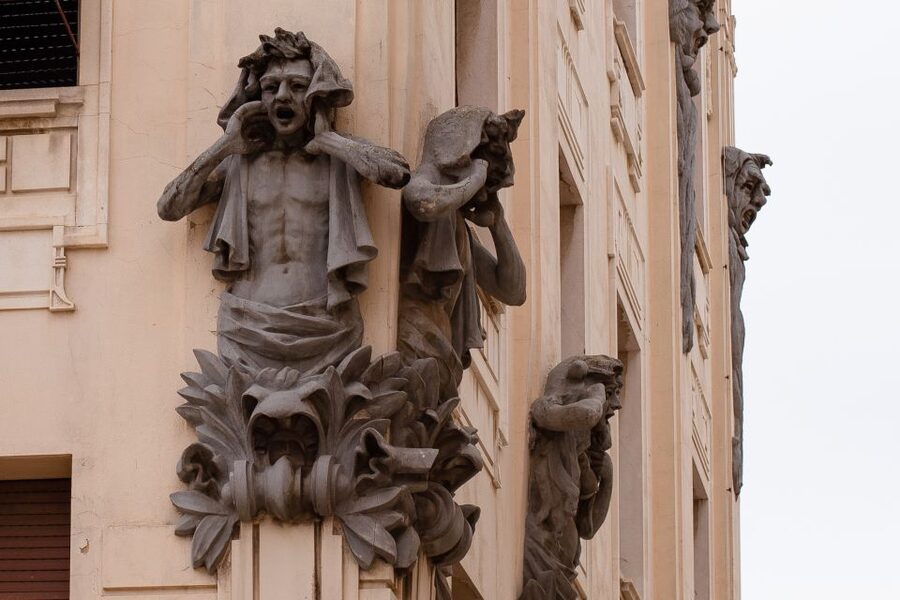
Split Cathedral occupies a building first planned as Diocletian’s mausoleum. During the Christianization of the Roman world, it became a place of Christian worship instead.
That change is the key to understanding the cathedral. You are not simply entering an old church. You are entering a Roman imperial burial structure that took on a completely different religious purpose. The building carries both identities at once.
The visit lasts about 20 minutes, and admission is included. The cathedral is one of the tour’s main interior stops, so this is a good place to ask questions about what belongs to Diocletian’s original plan and what reflects later Christian use.
The tour also includes the baptistery. The exact order of the interior visits can change, especially if a church service or special event affects access. If one of the included sites cannot be entered, the entrance fee for that place is refunded.
Same stretch of coast, a completely different day out:
- Split: Krka Waterfalls Trip with Boat Cruise and Swimming
★ 4.8 · 10,519 reviews - From Split: Krka Waterfalls, Food & Wine Tasting Tour
★ 5.0 · 9,326 reviews - Blue cave, Mamma Mia and Hvar, 5 islands speedboat tour
★ 5.0 · 7,150 reviews - From Split: Krka Waterfalls, Food & Wine Tasting Tour
★ 4.9 · 6,598 reviews
Jupiter’s Temple and the palace’s religious side
The Temple of Jupiter offers a sharp contrast with the cathedral. In Diocletian’s time, it was a pagan sacred space dedicated to Jupiter, the god with whom the emperor publicly associated himself.
The temple is a compact stop, listed at about 10 minutes, but its details reward attention. Look up at the coffered ceiling, one of the features specifically worth seeing inside. The ceiling pattern gives the small interior a sense of order and ceremony.
This is where the tour connects the palace’s politics and religion. Diocletian did not treat religious imagery as decoration alone. It helped define his authority. Seeing the temple after the Peristyle and cathedral creates a clear sequence: emperor, Roman gods, and later Christian worship, all within a short walk.
Gates, Vestibul, and the Roman street plan
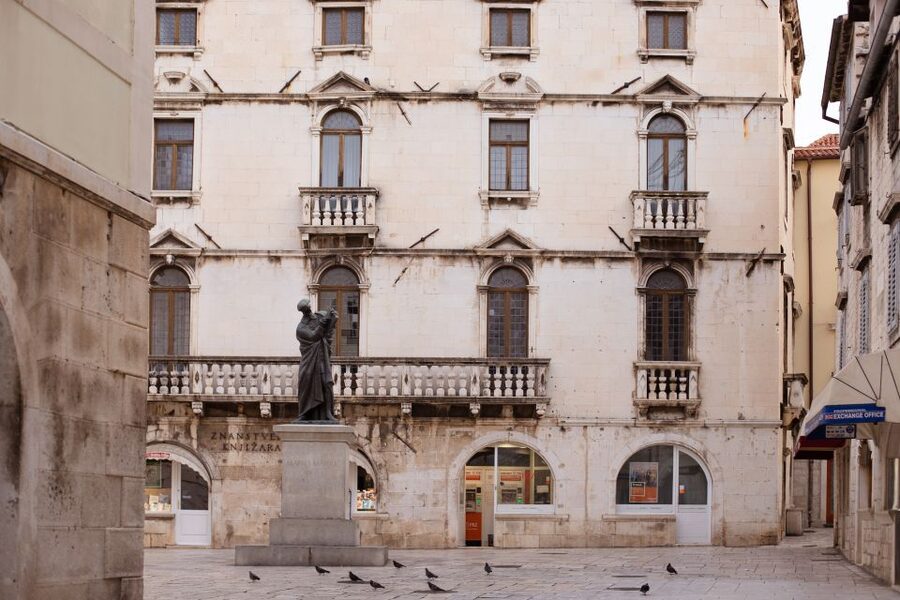
The route continues through several of the palace’s best-known points. At the Silver Gate, you get a short guided explanation of one of the original entrances. The Golden Gate receives a longer look, about 10 minutes, and leads toward the statue of Gregory of Nin.
The Vestibul is another important architectural stop. This circular entry space once formed part of the approach to the imperial apartments. The tour gives it about 10 minutes, enough to understand how visitors moved from the formal court toward the private section of the palace.
Triklinij receives a shorter explanation. Its name points to a Roman dining space, and the stop helps fill out the palace’s domestic side. Not every place on this walk is a major monument. That is part of the value. You see how the emperor’s residence worked as a complex of ceremonial, religious, and private spaces.
The Gregory of Nin statue is outside the original Roman world, but it helps mark the transition into later Split. The guide includes about five minutes here. You may hear about the statue and the local custom connected with touching its toe, though the provided tour details do not promise a specific demonstration or explanation, so ask if that interests you.
Fruit Square and Pjaca: Split after Rome
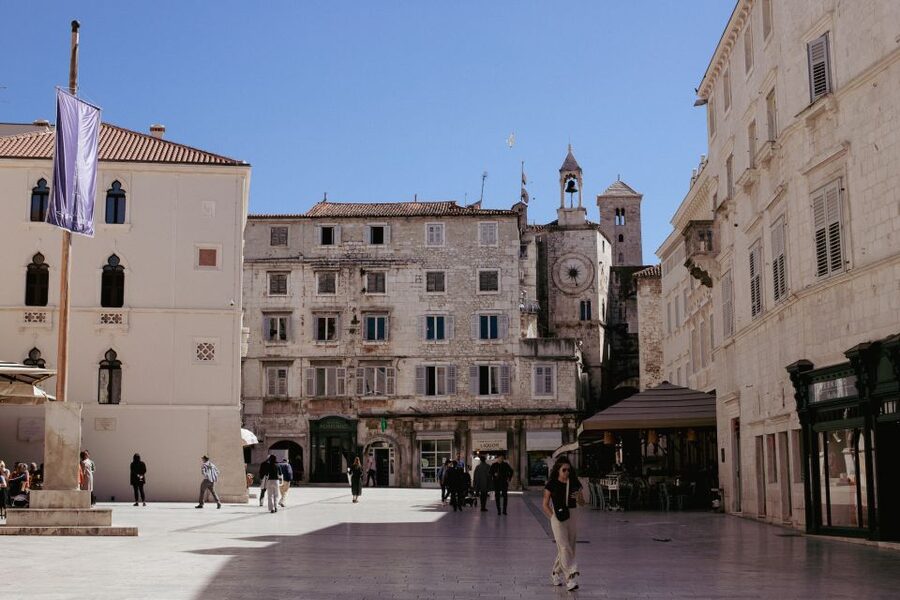
Fruit Square, or Voćni trg, is one of the old town’s attractive open spaces. The route gives it around 10 minutes. It is a good place to notice how the city’s later growth differs from the strict geometry of Diocletian’s original palace.
Then you reach Narodni trg, commonly called Pjaca. This has been a central meeting place since the Middle Ages. Venetian palaces surround the square, and the historic town hall adds another layer to the architectural mix.
Pjaca helps you understand Split as more than a Roman attraction. The city remained useful long after Diocletian’s time, and its public life shifted into medieval and Venetian settings. The square is still active, with cafés and daily movement, but its value on this tour comes from the buildings and the long change in how the space was used.
The City Lodge, or Loggia, is a short stop of about five minutes. It adds another civic detail to Pjaca and gives the guide a chance to explain how public business and urban life worked in the old town.
The fish market and Marmontova Street
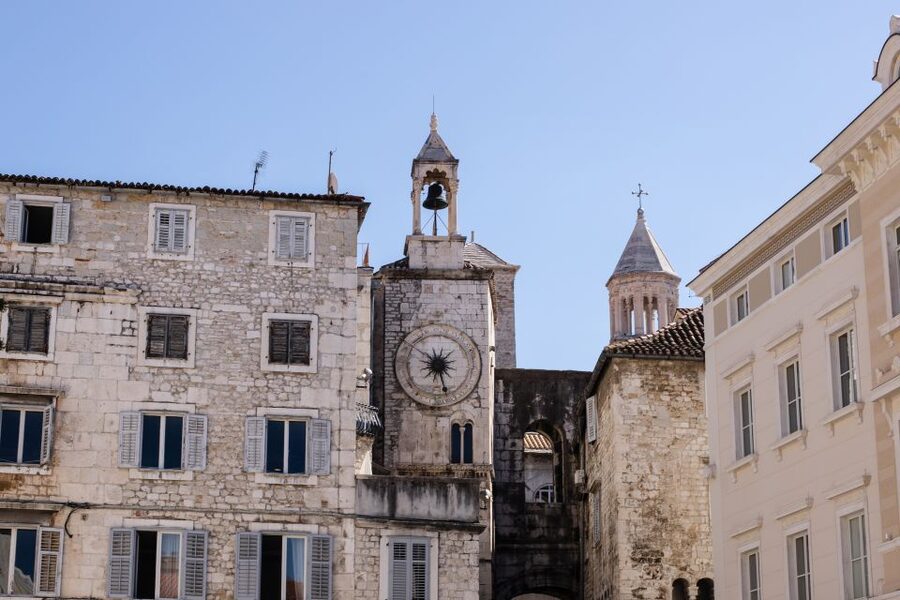
The later part of the walk leaves the most concentrated palace area. You pass the Split fish market and Marmontova ulica, each receiving about five minutes of guided attention.
These stops are useful because they show everyday Split rather than only monumental Split. The fish market connects the old town to local commerce and the city’s coastal setting. Marmontova Street offers a look at one of the main modern shopping and walking routes through the center.
Do not expect long indoor visits at these points. They are brief orientation stops, best used to connect the historic core with the city you see today. If your main goal is Roman architecture, these sections may feel less essential. If you want a broader introduction to central Split, they make the route more complete.
Prokurative: a Venetian-looking finish
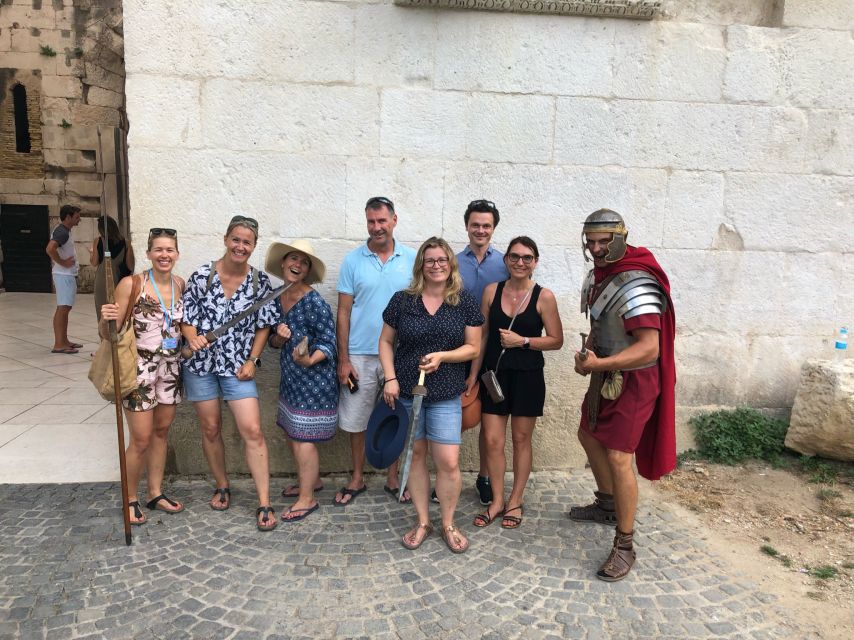
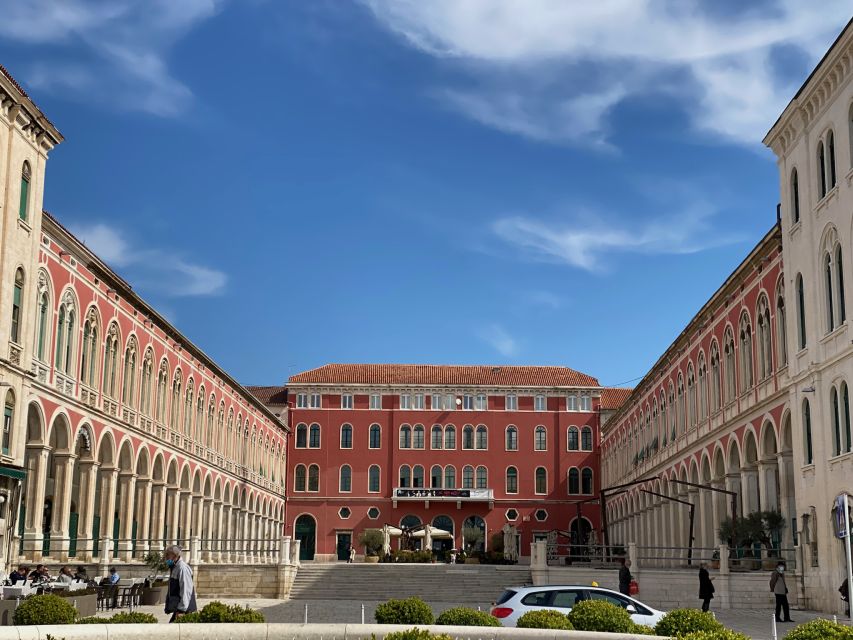
The walk ends at Trg Republike, better known as Prokurative. The square recalls St. Mark’s Square in Venice, with rows of cafés and restaurants around its open space.
This is a practical ending. You are not dropped beside an isolated monument. You finish in an area suited to a drink, meal, or quiet pause after the tour. The guide can also leave you with a clear sense of how Split’s Roman core connects to its later public squares and streets.
Prokurative is not Roman, and that is precisely why it works as the final stop. The tour has moved from imperial architecture to Christian buildings, medieval centers, Venetian façades, and a later urban square. You finish with a wider view of Split’s development.
What $192 per person gets you
At $192 per person, this is an expensive walking tour by ordinary sightseeing standards. The price needs to be judged against the private format, not only the 2.5-hour duration.
You are paying for a personal guide, a group capped at 10 participants, and entry to the palace cellars, cathedral, and baptistery. You also avoid arranging separate admissions and can ask for the tour to be customized. For a couple, family, or small group that wants private attention, the cost may be reasonable.
For a solo visitor or a pair watching every kuna or dollar, the value is harder to defend. A large part of Split’s old town can be walked independently, and several exterior sights do not require admission. The strongest reason to book is not the number of stops. It is the explanation that ties those stops together and the convenience of seeing the key interiors in one organized route.
The 4.8 rating from eight submitted ratings points to a very positive response, but the sample is small. I would treat it as encouraging rather than final proof. The only written comment provided is a brief positive note, so there is not enough detailed feedback to judge a particular guide’s style or personality.
Timing, language, and practical limits
The tour lasts 2.5 hours, with starting times varying by date. Confirm the meeting point when you book because the exact start can vary by option. The usual beginning is at the bronze model on the Riva, beside the southern approach to the palace.
Guiding is available in English, French, and German. The group is private and limited to a maximum of 10 people. The tour can be individually adjusted, which is useful if your group wants more time at the cathedral, needs a gentler pace, or prefers stronger emphasis on Roman architecture.
The route is partly not wheelchair accessible. It can be adapted to special needs, but you need to tell the provider in advance. Steps and old stone surfaces are part of the setting, especially around the palace’s interior areas.
Church services and events can restrict access to some sights. If that happens, the program changes slightly, and you receive a refund for an entrance fee when an included site cannot be visited inside.
Free cancellation is available up to 24 hours before the tour, and you can reserve now and pay later. Those terms are useful if your Split schedule depends on a cruise arrival, changing weather, or another timed activity.
Who will get the most from this walk?
I would choose this tour if you want Split explained rather than simply photographed. It suits first-time visitors, families who benefit from a private pace, and anyone curious about how Roman, Christian, medieval, and Venetian buildings share one compact center.
It is also a good choice for a short stay. In 2.5 hours, you cover the palace cellars, main court, cathedral, temple, gates, squares, fish market, and Prokurative without spending time finding each entrance yourself.
You may want another option if you prefer a slow architectural study, a food-focused walk, or long time inside every monument. The route includes many stops, but several receive only five or 10 minutes. This is a broad introduction, not a full archaeological seminar.
Should you book the Split Palace and Old Town tour?
Book it if the private guide and included interiors matter more to you than keeping the cost low. The palace cellars, Cathedral of Saint Domnius, baptistery, and Jupiter’s Temple give the walk substance, while Pjaca, Fruit Square, Marmontova Street, and Prokurative show how Split continued to grow beyond its Roman walls.
I would especially consider it for a small group sharing the cost. You get a focused route, no ticket-line fuss, several languages to choose from, and room to shape the experience around your interests. If you are comfortable exploring on your own and mainly want exterior views, $192 per person is likely more than you need to spend.
FAQ
How long does the Split Palace and Old Town tour last?
The tour lasts 2.5 hours. Starting times depend on availability.
What languages are available?
The live guide can conduct the tour in English, French, or German.
What entrance fees are included?
Admission to Split Cathedral, the baptistery, and Diocletian’s Palace cellars is included.
How many people can join the private tour?
The private group can include a maximum of 10 participants.
Where does the tour start and finish?
The tour generally starts at the bronze model of Split’s historic core on the Riva, but the exact meeting point may vary by the option booked. It finishes at Trg Republike, also called Prokurative.
Can the tour be changed for accessibility needs?
The site is partly not wheelchair accessible, but the tour can be adapted to special needs if you inform the provider in advance.
More Walking Tours in Split
- Split & Diocletian’s Palace Walking Tour
★ 5.0 · 1,125 reviews - Walking Tour of Split with a ‘Magister’ of History
★ 5.0 · 1,122 reviews - Split Walking Tour with Professor of History
★ 5.0 · 926 reviews - Split: Diocletian Palace & Old Town Guided Walking Tour
★ 4.7 · 882 reviews
Just added around Split
- Split Sunset Stand Up Paddle Tour★ 5.0 · 16 reviews
- Split: Sunset Guided Kayaking Tour★ 4.8 · 71 reviews
- Split&Sip: Educational wine tasting★ 4.9 · 52 reviews
- Stand Up Paddle Tour in Split★ 4.7 · 17 reviews
- Split: Guided Walking Tour in English★ 4.9 · 10 reviews
- Split Walking Tour with History Professor★ 5.0 · 23 reviews
- Split Walking Tour: History, Legends & Tales★ 5.0 · 9 reviews
- Split – Walking in Khaleesi Footsteps in the City of Dragons★ 5.0 · 13 reviews
Old Town Walking Tours, compared.



Walking Tour of Split and Diocletian’s Palace
Read our review →


Krka Waterfalls tour with Trogir Walking tour and Krka panoramic boat cruise
Read our review →
City Walls Early Morning or Sunset Walking Tour
Read our review →
Plitvice Lakes with Boat Ride and Zadar Old Town Tour
Read our review →Browse the lists this tour appears in