
Reviewed · OLD TOWN WALKING TOURS
Split: History Walking Tour of the Old Town
Split’s Roman palace is not a fenced-off ruin. It is the city center, with cafés, homes, shops, lanes, and church bells fitted into the bones of Emperor Diocletian’s 1,700-year-old retreat. This 90-minute walking tour helps you read that remarkable jumble, from the Golden Gate to the Riva.
I like the way the guides use riddles, jokes, old maps, and photos instead of giving you a dry list of dates. I also like the stop in the palace cellars, where Daenerys Targaryen’s dragons were chained in Game of Thrones. The main consideration is pace: 90 minutes gives you a strong first look, but not time for a slow visit inside every monument.
In This Review
- Key points at a glance
- Why Split makes sense with a guide
- Starting at the Golden Gate and Đardin Park
- Peristyle: the palace’s grand central stage
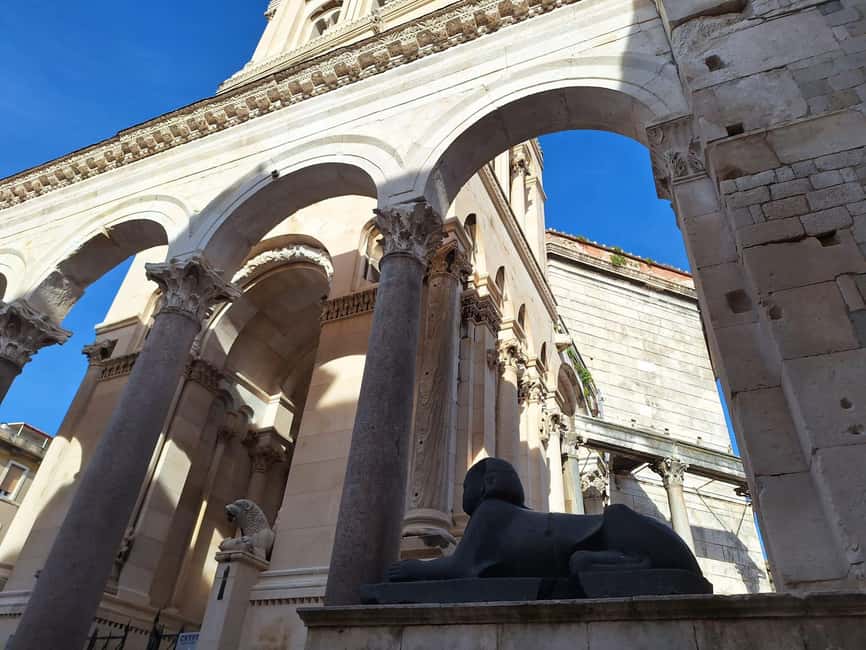
- Mausoleum and the headless Sphinx
- Jupiter’s Temple and the Vestibule
- The cellars and Split’s Game of Thrones connection
- From Pjaca to Fruit Square
- Ending on the Riva
- How much value do you get for $41?
- Language, guides, and the feel of the walk
- Who should book this Split walking tour?
- Should you book it?
- FAQ
- How long does the Split history walking tour last?
- What places are included on the route?
- Where does the tour finish?
- Is the tour available in English?
- Is a private tour option available?
- Can the guide pick me up from my hotel or cruise ship?
- What should I bring?
- Can I cancel for a full refund?
Key points at a glance
- Walk through a living Roman palace: See how modern Split grew inside Diocletian’s former imperial residence.
- Follow a lively route: The tour uses questions, riddles, jokes, maps, and stories to keep the history moving.
- Visit the famous palace cellars: See the filming location used for Daenerys’s dragons and the Unsullied.
- Meet guides with different strengths: Maya, Nina, Marc, and Marko are among the guides praised for clear explanations and local insight.
- Finish by the sea: The route ends on the palm-lined Riva, well placed for lunch, coffee, or onward plans.
- Get practical local advice: Ask about Dalmatian food, beaches, ice cream, fresh water, and islands for the rest of your stay.
Why Split makes sense with a guide
Split can look confusing at first. A Roman column may be built into a café wall, a medieval lane may pass through an imperial passage, and a busy square may once have served an entirely different purpose. Without context, you see attractive stone. With a guide, you begin to see the layers.
The tour focuses on the old town and Diocletian’s Palace, a UNESCO-protected area. You are not simply walking around a monument. You are moving through a city shaped by Roman rule, Christian worship, Venetian power, local customs, and modern tourism.
That is the main value of this outing. You get a framework for the city early in your stay, then recognize the places again when you return on your own. The guide also adds present-day details, including what people eat, where to look for Dalmatian specialties, and which islands may fit your plans.
The tone is meant to be light. Marko, Maya, Nina, and Marc are all named in the feedback connected with this experience, and the strongest pattern is clear: the guides explain seriously without acting solemn. Riddles and jokes help break up the history, while photos and maps can make the vanished Roman rooms easier to picture.
More Old Town Walking Tours in Split
- Split: Old Town and Diocletian Palace Walking Tour
★ 4.9 · 4,727 reviews - Walking Tour of Split and Diocletian’s Palace
★ 5.0 · 2,588 reviews - Krka Waterfalls tour with Trogir Walking tour and Krka panoramic boat cruise
★ 5.0 · 1,659 reviews
Starting at the Golden Gate and Đardin Park
The exact meeting point depends on the option you book, but the walk begins around the Golden Gate. This is a useful starting point because it introduces Diocletian’s Palace as a fortified imperial complex rather than just a pretty old town.
Look closely at the gate and you begin to understand the palace’s scale. The route then moves toward Đardin Park, giving you a brief change from tight stone lanes. The guide uses this early stretch to set up the story of Split and explain how the city developed around the Roman structure.
The tour’s playful side appears here. You may be asked to imagine replacing your head with the Sphinx’s and solving the Sphinx’s riddle. That sounds comic, but it gives you a memorable way to think about the palace’s Egyptian references and the fragments reused around the site.
If you arrive in summer, bring water, sunscreen, and a hat. The open portions of the route can be hot, while the narrow palace lanes and cellars offer shade. Comfortable shoes matter more than fashionable ones because the old town includes hard stone paving.
Peristyle: the palace’s grand central stage
Peristyle is the visual heart of the walk. This formal courtyard once helped announce the emperor’s power, and it still feels grand even though modern life presses in from every side.
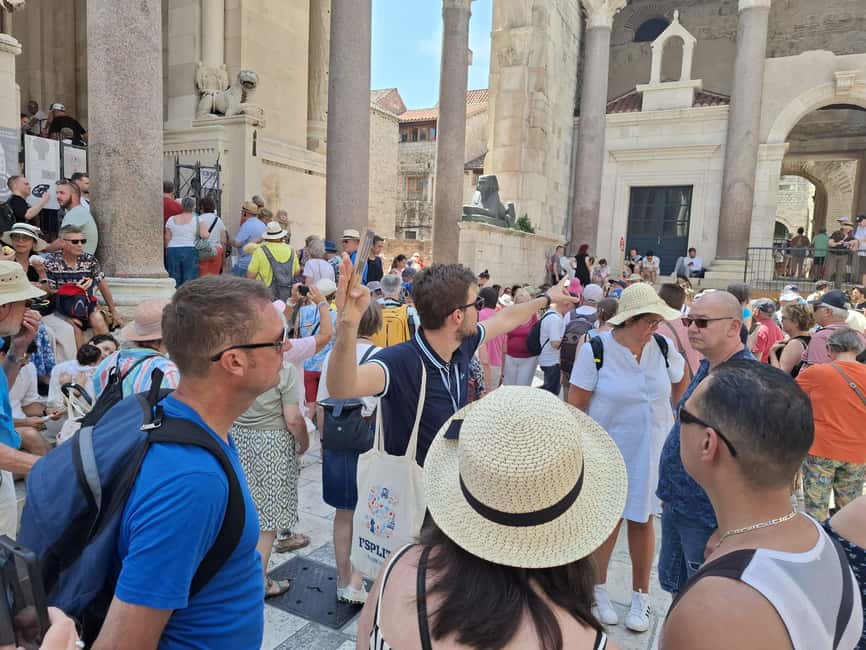
Your guide spends about 15 minutes here, explaining the columns, the approach to the mausoleum, and the role of the square in the palace plan. This is one of the places where a guide earns their fee. A quick photo does not tell you why the space was designed this way or how Diocletian wanted visitors to approach him.
The tour also introduces Diocletian’s reputation as one of the greatest persecutors of Christians. You hear about his habits and the stranger details attached to his story, including why he vomited after dinner. That kind of human detail helps prevent the emperor from becoming just another name on a timeline.
Peristyle can be crowded, especially at popular times. One useful strength noted in the feedback is the guides’ ability to manage groups, find shade, and position people so they can hear. Still, you should expect an active public square, not a quiet archaeological site.
Mausoleum and the headless Sphinx
The route continues to the mausoleum, now associated with Split Cathedral. The tour presents the remarkable contrast between Diocletian’s original imperial tomb and the later Christian use of the building.
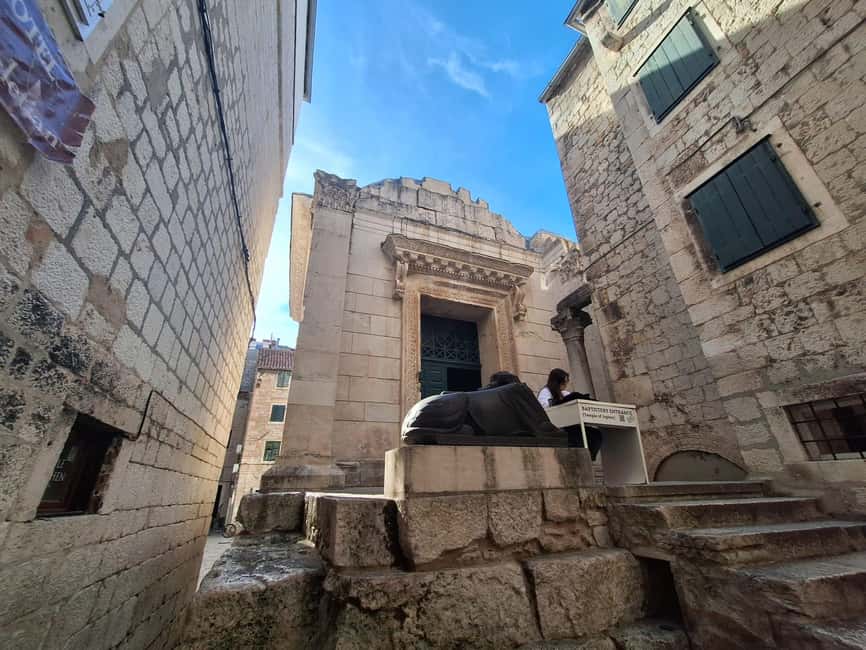
You will also hear about the Sphinx guarding the entrance to Jupiter’s Temple. Its headless form is one of the old town’s most memorable details. The guide explains why it is there and connects it to the emperor’s interest in Egypt.
The description of the cathedral as the oldest cathedral in the world is part of the tour’s storytelling. The point for you is less about winning a strict title and more about seeing how an ancient Roman mausoleum was transformed into a Christian place of worship. The bell tower adds a strong vertical marker to a city otherwise made of low stone walls and narrow passages.
The tour does not provide a full cathedral visit in the information supplied, so treat this stop as an exterior and historical introduction rather than a complete church tour. If you want to see every interior detail, you will need to return separately.
Same stretch of coast, a completely different day out:
- Split: Krka Waterfalls Trip with Boat Cruise and Swimming
★ 4.8 · 10,519 reviews - From Split: Krka Waterfalls, Food & Wine Tasting Tour
★ 5.0 · 9,326 reviews - Blue cave, Mamma Mia and Hvar, 5 islands speedboat tour
★ 5.0 · 7,150 reviews - From Split: Krka Waterfalls, Food & Wine Tasting Tour
★ 4.9 · 6,598 reviews
Jupiter’s Temple and the Vestibule
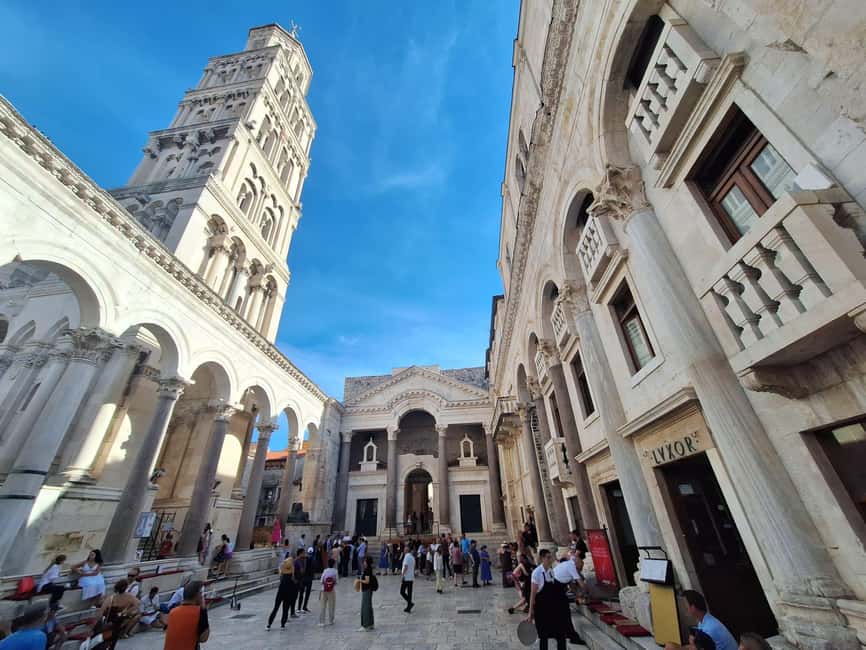
Jupiter’s Temple is a short stop, listed at about five minutes. It is small, but it helps you understand how religious buildings were fitted into the palace. The headless Sphinx at the entrance gives the site an immediately striking detail, and the guide explains the connection rather than leaving you to guess.
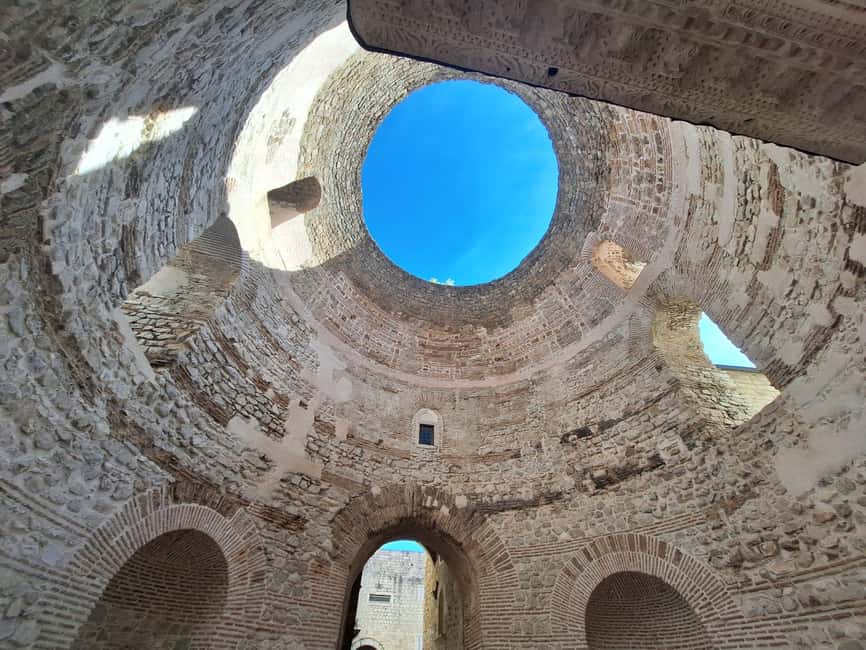
Next comes the Vestibule, with about 10 minutes for sightseeing and explanation. This round space once served as an approach to the emperor’s private apartments. Its shape and acoustics make it one of the more memorable rooms in the palace.
I like this portion of the walk because the buildings are close together, yet each one had a different job. The guide can show you the difference between ceremony, worship, burial, and private imperial space in a very small area.
The tradeoff is that the palace does not present itself like a modern museum. You may need to use your imagination. There are no long interpretive panels at every turn, so the guide’s storytelling does much of the work.
The cellars and Split’s Game of Thrones connection

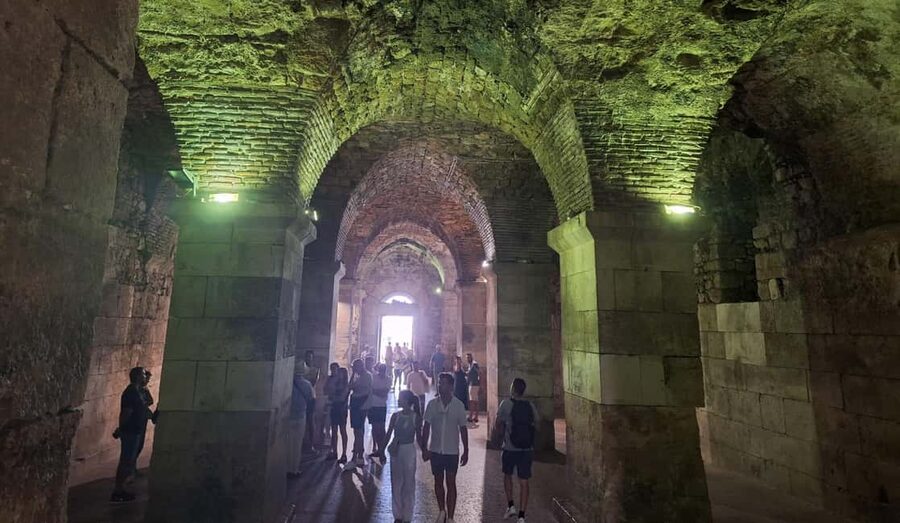
The cellars are the tour’s biggest pop-culture draw. This is where Daenerys’s dragons were chained in Game of Thrones, and where the Unsullied fought the Sons of the Harpy.
Even if you have no interest in the show, the cellars are worth your time. They reveal the solid engineering beneath the palace and help explain how the Roman complex was laid out. The lower level is also a welcome break from the summer heat.
The guide links the filming location to the real structure, rather than treating it only as a television set. You get a chance to see the dark spaces, hear how they were used on screen, and then return your attention to the much older Roman building.
The cellars are not the whole tour, and you should not book this experience expecting a dedicated television-location excursion. They are one section of a broader history walk. That balance works well for most people: you get the fun connection without losing the story of Split itself.
From Pjaca to Fruit Square
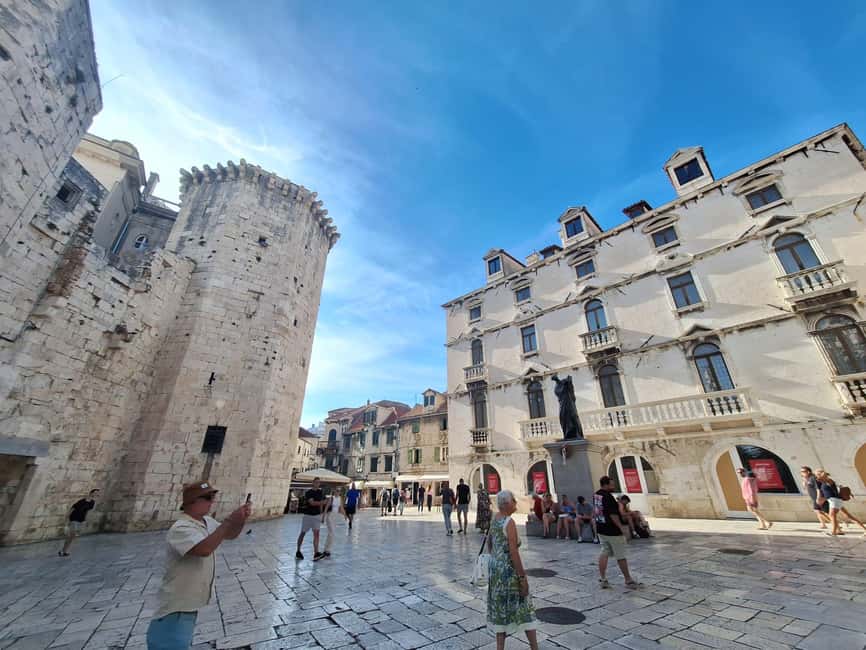
After the palace, the walk opens into Pjaca, or People’s Square. This change in space helps you see how Split grew beyond the Roman walls. The square connects the palace area with the later city and gives the guide a chance to explain local life beyond the emperor’s residence.
Fruit Square, known locally as Voćni trg, adds another useful layer. The name recalls the fruit sellers who once used the square, and the setting helps shift the tour from imperial history to everyday Split.
This is where the practical advice becomes especially useful. The guides can point you toward Dalmatian specialties, explain local eating habits, and suggest places for food or ice cream. You can ask about what to try later, rather than making your restaurant choices based only on the first menu you see.
The route is also a lesson in scale. The Roman palace may sound enormous in a history book, but the old town is compact enough to connect major stops on foot. That makes this a good orientation tour for a first day in Split.
Ending on the Riva
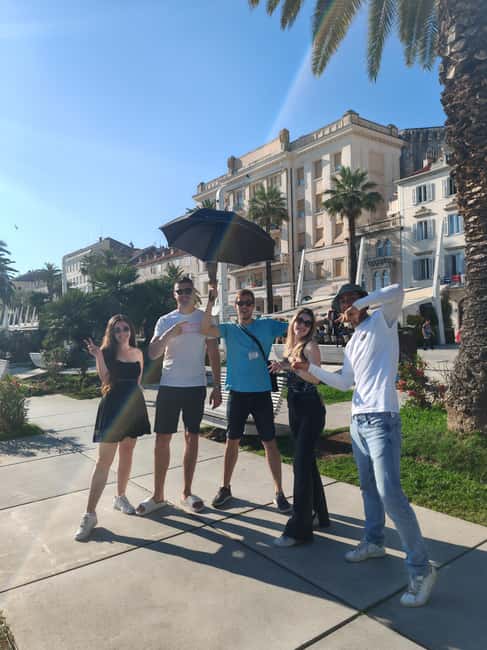
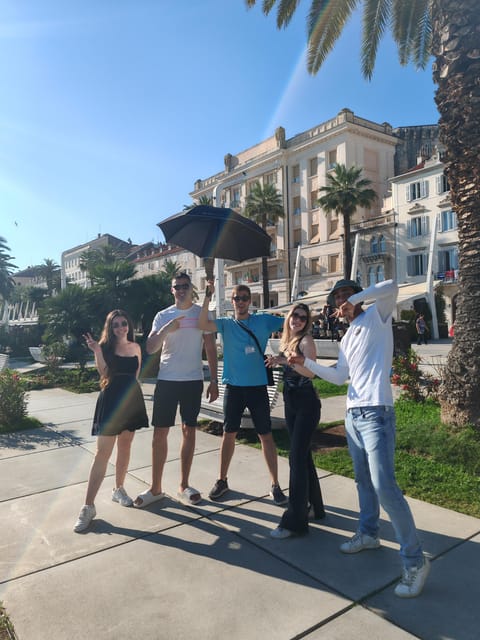
The walk finishes on the Riva, Split’s seafront promenade lined with tall palm trees. This is a natural ending because you leave the enclosed palace streets and arrive beside the water, with the city’s public life spread out in front of you.
The final location is practical. You can continue along the promenade, stop for a drink, or use the guide’s suggestions to plan the rest of your day. The experience also includes advice about beaches and islands, which is useful if Split is your base for several nights.
The stated drop-off options are the historical core of Split and Split Riva. There is no separate ride involved in the walking route. Optional pickup may be arranged depending on the booking choice, and you can provide a hotel address or note that you are arriving by cruise ship.
How much value do you get for $41?
At $41 per person, this is not the cheapest way to wander around Split. You can walk through much of the old town without paying anything. The question is what you want from the visit.
I think the price is reasonable if you want a local guide to connect the Roman palace, Christian monuments, Venetian history, food customs, and modern filming locations in one compact outing. The practical tips add value, especially if you are in Split for only a day or arriving from a cruise ship.
The price looks better when the group is small. The feedback includes a solo outing and a walk with only four people, both of which allowed plenty of questions. A private group is also available if you want a more personal pace or have a family or group with a clear set of interests.
The value is weaker if you prefer to study monuments at length. The tour spends about 15 minutes at the Golden Gate, 15 at Peristyle, 10 at the Vestibule, and 15 in the cellars, with shorter stops elsewhere. That schedule gives you breadth, not a detailed archaeological inspection.
Language, guides, and the feel of the walk
Tours are offered in English and Spanish. The Spanish delivery is a strong option here, particularly if you want more than basic translation. Maya is praised for clear explanations and for bringing a folder with photographs and maps. Another Spanish-language guide is described as warm, funny, and easy to understand.
The English guides named in the feedback include Nina, Marc, and Marko. Nina is associated with good food, beach, and ice cream suggestions. Marc is described as especially helpful with questions, while Marko used riddles and jokes and made good use of the cooler cellars.
Those details matter because a 90-minute history walk depends heavily on presentation. The route itself is fixed, but your guide shapes how much you take away. You want someone who can explain the big picture, handle questions, and keep the group together in busy squares.
The overall rating provided for the experience is 5 out of 5 from 12 reviews. That is a small sample, so I would not treat it as a guarantee. Still, the praise is consistent across several themes: clear history, humor, personal attention, local advice, and good management in heat and crowds.
Who should book this Split walking tour?
This is a good match for a first visit to Split, especially if you have one day to understand the old town before exploring on your own. It also suits cruise passengers who need a compact introduction close to the historic center and Riva.
Families may like the riddles, dragons, Sphinx story, and short stops. The tour gives children several memorable hooks without asking them to absorb a long lecture. Adults who enjoy architecture and political history will get more from the explanations of Diocletian and the palace plan.
Game of Thrones fans will appreciate the cellars, but I would not book the tour for that reason alone. The television connection is one stop within a Roman and local-history walk.
You should think twice if you need step-free movement, although the supplied information does not describe accessibility conditions. The old town has historic stone streets and interior spaces, so ask the provider before booking if this is important for you.
Plan to wear comfortable shoes and carry water. A hat and sunscreen are sensible for the open squares and Riva. If you can choose your time, a cooler period of the day may make the walk more comfortable, though the cellars provide relief from the heat.
Should you book it?
Book this tour if you want a lively orientation to Split rather than a silent walk from monument to monument. Its best features are the human stories, the cellars, the guide’s local food advice, and the way the route connects an imperial palace with a living Croatian city.
Skip it if you already know Diocletian’s Palace well or want extended time inside the cathedral and archaeological sites. For most first-time visitors, though, $41 buys a useful foundation, a few good laughs, and enough local advice to improve the rest of your stay.
FAQ
How long does the Split history walking tour last?
The tour lasts 90 minutes.
What places are included on the route?
The route includes the Golden Gate, Đardin Park, Peristyle, the Mausoleum, Jupiter’s Temple, the Vestibule, Pjaca or People’s Square, Fruit Square, Diocletian’s Cellars, and the Riva.
Where does the tour finish?
The walk finishes at the Riva, Split’s seafront promenade. Drop-off locations include the historical core of Split and Split Riva.
Is the tour available in English?
Yes. Live guiding is available in English and Spanish.
Is a private tour option available?
Yes. A private group option is available.
Can the guide pick me up from my hotel or cruise ship?
Pickup is optional depending on the booking choice. You can provide a hotel name and street or note that you are arriving by cruise ship.
What should I bring?
Bring comfortable shoes, a hat, sunscreen, and water.
Can I cancel for a full refund?
Yes. You can cancel up to 24 hours in advance for a full refund. Reserve now and pay later is also available.
More Walking Tours in Split
- Split & Diocletian’s Palace Walking Tour
★ 5.0 · 1,125 reviews - Split: Diocletian Palace & Old Town Guided Walking Tour
★ 4.7 · 882 reviews - From Split: Krka Waterfalls Cruise & Trogir Walking Tour
★ 4.7 · 681 reviews - Diocletian’s Palace and Old Town SMALL GROUP Walking Tour
★ 5.0 · 502 reviews
More Historical Tours in Split
- Walking Tour of Split with a ‘Magister’ of History
★ 5.0 · 1,122 reviews - Split Walking Tour with Professor of History
★ 5.0 · 926 reviews - Split: History and Heritage Walking Tour
★ 4.9 · 650 reviews - Split History and Gastro Small-Group Tour with Food and Drinks
★ 5.0 · 375 reviews
Just added around Split
- Split Sunset Stand Up Paddle Tour★ 5.0 · 16 reviews
- Split: Sunset Guided Kayaking Tour★ 4.8 · 71 reviews
- Split&Sip: Educational wine tasting★ 4.9 · 52 reviews
- Stand Up Paddle Tour in Split★ 4.7 · 17 reviews
- Split: Guided Walking Tour in English★ 4.9 · 10 reviews
- Split – Walking in Khaleesi Footsteps in the City of Dragons★ 5.0 · 13 reviews
- Split Walking Tour with History Professor★ 5.0 · 23 reviews
- Split Walking Tour: History, Legends & Tales★ 5.0 · 9 reviews
Old Town Walking Tours, compared.



Walking Tour of Split and Diocletian’s Palace
Read our review →


Krka Waterfalls tour with Trogir Walking tour and Krka panoramic boat cruise
Read our review →
City Walls Early Morning or Sunset Walking Tour
Read our review →
Plitvice Lakes with Boat Ride and Zadar Old Town Tour
Read our review →Browse the lists this tour appears in