
Reviewed · OLD TOWN WALKING TOURS
Split: Cultural Walking Tour with Anthropologist Guide
Split’s monuments are only half the story. This two-hour walking tour with cultural anthropologist Marin uses the old city as a map for discussing Croatian identity, religion, politics, demographics, sexuality, economics, and the difficult parts of modern history that standard sightseeing tours often skip.
I like two things right away: you still see Split’s major center sights, and the guide connects them to present-day life rather than treating them as isolated ruins. I also like the extra audio-visual material, which gives the discussion more shape. The main consideration is simple: this is not a light, joke-filled introduction. The frank treatment of disputed subjects may not suit anyone wanting only Roman stones and pretty views.
In This Review
- Key points at a glance
- Why this Split tour takes a different route
- Starting beside the fountain in Strossmayer Park
- The Golden Gate and the politics of first impressions
- Peristil, where ancient stone meets living identity
- Diocletian’s Cellars and the value of seeing below street level
- People’s Square and the city beyond the palace
- Jewish Passage and the parts of history that need care
- Fruit Square and the changing meaning of public space
- The Riva, seen in passing
- Republic Square and the final discussion
- What you will learn that standard tours often skip
- The guide’s teaching style matters here
- Is $33 a fair price for two hours?
- Who should book this experience?
- Useful booking details before you go
- My call: book it for context, not just monuments
- FAQ
- How long does the Split cultural walking tour last?
- What language is the tour conducted in?
- Who leads the tour?
- Where does the tour start?
- Which Split sights are included?
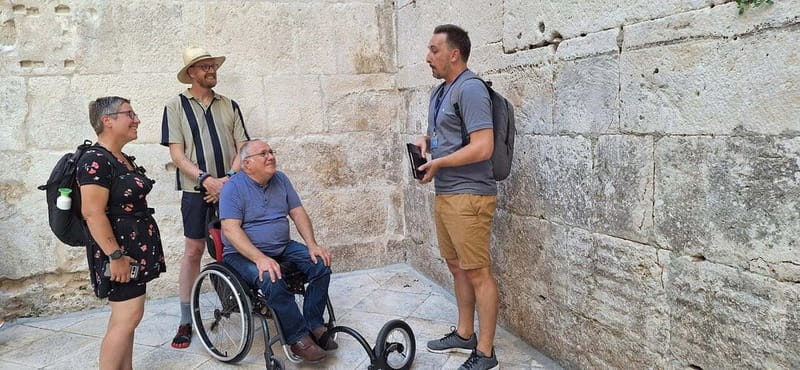
- Is the tour wheelchair accessible?
- Can I cancel the booking?
Key points at a glance
- Marin brings an anthropologist’s view: He also works as a school teacher, so expect ideas explained clearly rather than a lecture packed with academic terms.
- The route covers Split’s essential center: You visit the Golden Gate, Peristil, Diocletian’s Cellars, People’s Square, Jewish Passage, Fruit Square, Riva, and Republic Square.
- Contested subjects are central: Croatia’s identity, politics, religion, sexuality, demographics, economics, and historical memory all enter the conversation.
- The tour suits curious first-time visitors: You get the main sights while learning how past events still shape local society.
- It costs $33 per person: For two hours with a specialist guide and supporting material, that is a fair price if ideas matter as much to you as monuments.
- Practical details are friendly: The tour is in English, wheelchair accessible, and cancellable up to 24 hours before departure for a full refund.
Why this Split tour takes a different route
Many walking tours of Split follow a familiar pattern: Roman emperor, palace walls, medieval square, Venetian influence, quick photo stop. This experience covers much of that same ground, but it asks a harder question at each place: how has this site been used to explain, protect, or argue over Croatian identity?
That change in focus matters. A stone gate can tell you about architecture, but it can also lead into questions about power, belonging, religion, and the way a country remembers its past. A square can reveal more than its buildings when you consider who gathers there, who is represented, and which parts of history receive public attention.
Marin is the sort of guide this format needs. His background in cultural anthropology and teaching gives him two useful tools: he can place local events in a wider social setting, and he can make complicated material understandable. The tour is described as suitable for anyone over about 15, with no technical background required.
You should expect conversation and interpretation, not just dates. The subjects can be sensitive, and the approach is deliberately direct. That is the appeal, but it is also the reason to choose this tour carefully.
More Old Town Walking Tours in Split
- Split: Old Town and Diocletian Palace Walking Tour
★ 4.9 · 4,727 reviews - Walking Tour of Split and Diocletian’s Palace
★ 5.0 · 2,588 reviews - Krka Waterfalls tour with Trogir Walking tour and Krka panoramic boat cruise
★ 5.0 · 1,659 reviews
Starting beside the fountain in Strossmayer Park
The meeting point is at Ul. kralja Tomislava 12, in Park Josipa Jurja Strossmayera. Look for the fountain in the middle of the park. This is a useful starting place because you are not being asked to find a tiny doorway inside the old center.
The park gives Marin room to frame the tour before the streets become tight and crowded. I would arrive a little early so you can identify the fountain without rushing. Starting times vary, so you need to check availability when booking.
The entire experience lasts two hours. That is enough time for a focused introduction, but not enough for long museum visits or extended stops inside every building. The pace is best understood as a steady outdoor discussion with short explanations at important sites.
The Golden Gate and the politics of first impressions
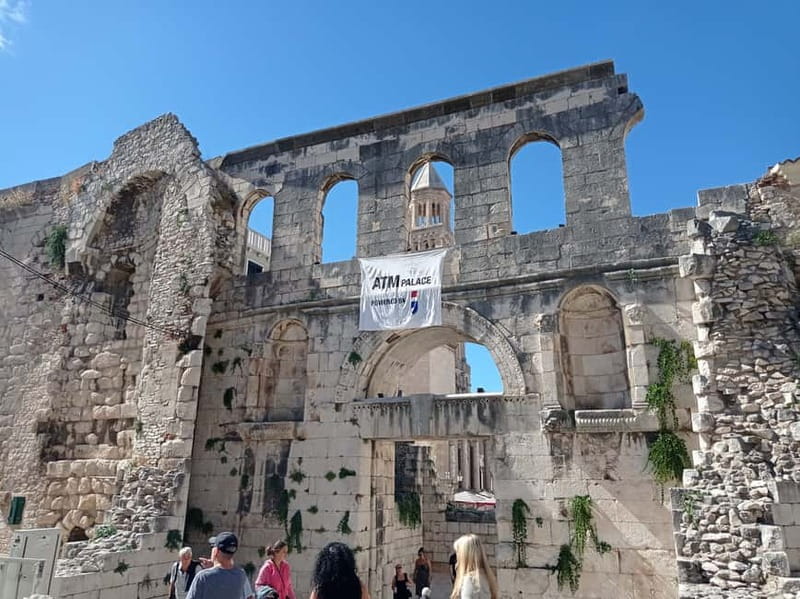
The first formal stop is the Golden Gate, with about 15 minutes of guided discussion. It is one of the clearest places to begin because the gate immediately announces the scale and authority of Diocletian’s palace.
Here, you can expect more than an explanation of construction. The gate becomes a way to discuss how imperial power is displayed and how later generations assign meaning to ancient remains. Marin’s method is to use the physical setting as evidence, then connect it to the wider story of Croatia.
This opening stop also helps first-time visitors get oriented. If this is your first walk through Split, the Golden Gate gives you a firm visual anchor before the tour moves into the palace interior.
Peristil, where ancient stone meets living identity
At Peristil, the tour spends about 15 minutes. This is likely the most instantly impressive part of the route, but the point is not simply to admire the columns and open space.
Peristil shows how a place can carry several identities at once. It began as part of an imperial complex, later became part of a Christian setting, and now functions as a public space within a modern city. That layered use gives Marin a natural place to discuss religion, cultural belonging, and how Croatians understand the relationship between ancient, medieval, and modern eras.
I like this stop because it prevents the past from becoming a sealed-off subject. You see the old stone, then consider the people and institutions that keep giving it new meaning. The short time allocation also keeps the tour moving, though anyone who wants detailed architectural study may find 15 minutes brief.
Same stretch of coast, a completely different day out:
- Split: Krka Waterfalls Trip with Boat Cruise and Swimming
★ 4.8 · 10,519 reviews - From Split: Krka Waterfalls, Food & Wine Tasting Tour
★ 5.0 · 9,326 reviews - Blue cave, Mamma Mia and Hvar, 5 islands speedboat tour
★ 5.0 · 7,150 reviews - From Split: Krka Waterfalls, Food & Wine Tasting Tour
★ 4.9 · 6,598 reviews
Diocletian’s Cellars and the value of seeing below street level

The visit to Diocletian’s Cellars lasts about 10 minutes. The cellars are a practical stop in a short tour because they show the palace’s structure from below, while also giving you a break from the open squares.
Marin uses the site as part of the broader story rather than treating it as a separate archaeological lesson. The cellars help explain how the palace has been preserved, reused, and woven into daily life. That connection between ancient construction and present-day society is one of the tour’s defining features.
Ten minutes is enough for a focused explanation and a look around. It is not enough for a detailed examination of every passage. If underground spaces are your main interest, you may want additional time in Split beyond this tour.
People’s Square and the city beyond the palace
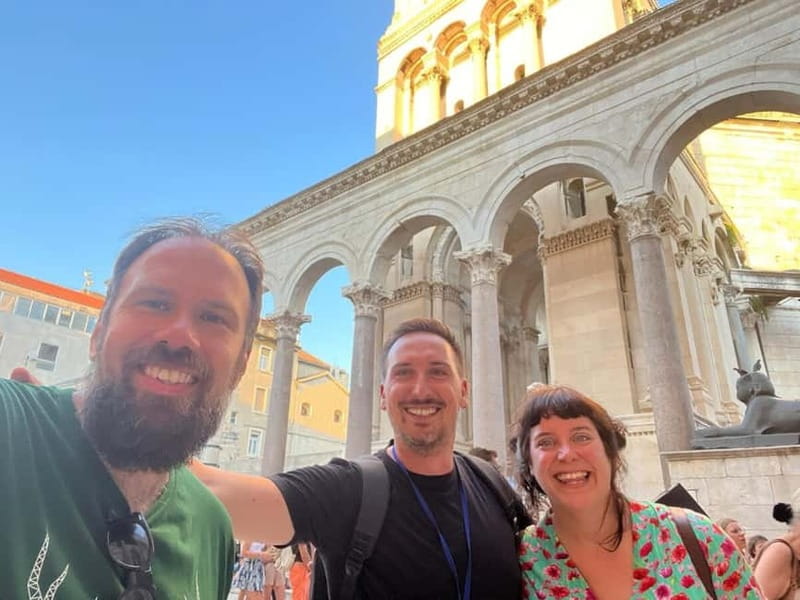
People’s Square receives roughly 15 minutes. This stop shifts the focus from imperial remains to a more recognizable civic setting, where questions about public life and social change can be brought closer to the present.
The tour’s subjects include economics, demographics, politics, and identity. A city square is a fitting place to connect those themes because it is not only an attractive urban space. It is also the kind of place where the character of a city becomes visible through commerce, public activity, and changing patterns of use.
You will not get a narrow monument-by-monument route here. Instead, Marin uses the square to show how Split’s story continues after the Roman period. That broader frame is useful if you want to understand Croatia as a country, not just Split as a historic center.
Jewish Passage and the parts of history that need care

The stop at Židovski prolaz, or Jewish Passage, lasts around 10 minutes. This is one of the more distinctive points on the route because it opens discussion of a community and a part of Split’s past that can easily receive less attention on a standard sightseeing walk.
The tour’s stated purpose is to address historical and present-day taboos directly. This passage is therefore not treated as a decorative shortcut. It provides space to consider religion, minority identity, memory, and the ways communities are represented in the city.
The subject may feel more serious than the grander palace stops. That is intentional. You should come ready to listen and think, rather than expecting each stop to be visually dramatic. The value here is the context Marin supplies.
Fruit Square and the changing meaning of public space
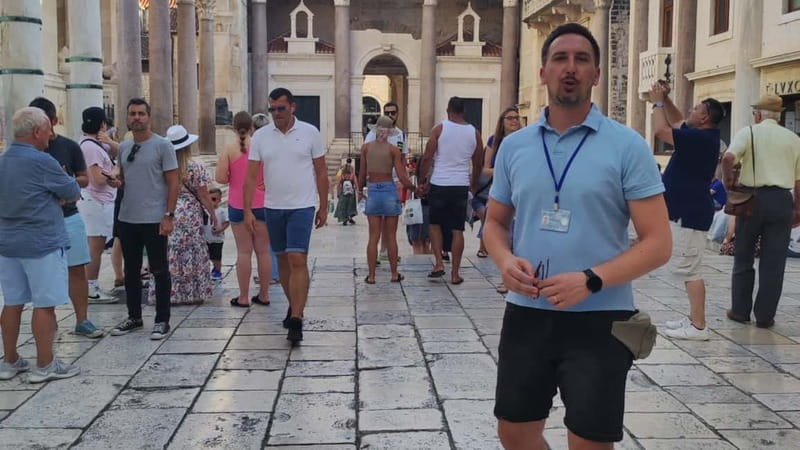
Fruit Square, or Voćni trg, gets about 15 minutes. The square offers another chance to shift from ancient history toward the social life of modern Split.
Marin’s approach links architecture with the people who use it. At Fruit Square, you can expect discussion that brings together economics, urban life, identity, and the long effects of political change. The exact details of the conversation can vary with the group, but the aim is clear: show how public places carry social meaning.
This is also a good point in the route to take stock of the tour’s style. You are not simply collecting facts about buildings. You are being asked to notice how history is selected, displayed, and understood.
The Riva, seen in passing
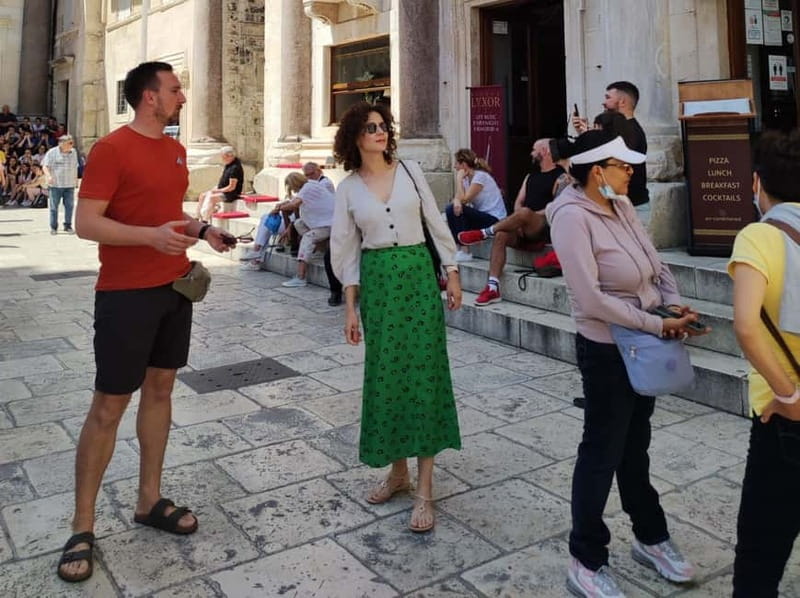
The tour passes along the Riva for about five minutes. There is no long guided stop here, so do not choose this experience expecting a full waterfront presentation.
Still, the Riva works as a useful link between the old center and the final squares. It places the palace and its arguments about identity beside one of Split’s most recognizable public spaces. You may want to return later for your own walk, a coffee, or a slower look at the waterfront.
Because this is a pass-by rather than a main lecture point, the tour keeps its attention on its central purpose: social and political interpretation.
Republic Square and the final discussion
Republic Square receives around 15 minutes and brings the guided portion toward its close. Its broad layout gives the group a little breathing room after the narrow streets and dense palace area.
This final major stop is well suited to pulling earlier themes together. By now, you have considered ancient authority, religious identity, public space, minority history, economics, and contemporary politics. Republic Square gives Marin a place to connect those subjects and show how they continue to influence Croatian society.
The route then finishes around Trumbićeva obala according to the stop sequence, while the meeting information also describes the activity as ending back at the meeting point. Since those details do not match perfectly, confirm the end point when you book, especially if you have a restaurant reservation or transport waiting.
What you will learn that standard tours often skip
The most praised feature of this experience is its willingness to discuss difficult subjects without smoothing them over. The tour deals with contested history and contemporary issues, including questions of Croatian identity, religion, politics, geopolitics, demographics, sexuality, and economics.
That does not mean every minute is grim. You still see the classic center and learn how Split developed across many periods. The difference is that the monuments are used to frame debate, not just admiration.
I especially like the way the tour links past and present. Ancient Roman power, medieval religious change, modern national identity, and current social pressures are not presented as separate boxes. You are encouraged to see how one period shapes the language and arguments of the next.
The extra audio-visual material supports this style. You receive more than spoken commentary at each subject point, although the supplied details do not specify the exact format or amount. Think of it as added support for the discussion, not a substitute for a museum visit.
The guide’s teaching style matters here
A tour about contested issues can easily become confusing or overly political. Marin’s work as both an anthropologist and a school teacher is important because the success of this experience depends on clear explanation.
The strongest descriptions of his guiding emphasize passion, careful structure, participant engagement, and the ability to relate ideas to architecture. That tells you what kind of experience to expect: Marin is not simply reciting prepared facts. He appears to build the discussion around the place you are standing in and make room for interpretation.
One particularly useful detail is that he made adjustments during rain and allowed time for a deaf participant to follow the tour through interpretation. The tour is also listed as wheelchair accessible. These points suggest a thoughtful approach to practical needs, though you should still contact the provider if you require specific accessibility arrangements.
Is $33 a fair price for two hours?
At $33 per person, this tour costs more than a basic orientation walk, but it offers a more specialized subject and a guide with an academic background. I consider it fair value if you want help understanding Croatian society as well as Split’s monuments.
The value is strongest when you take the tour early in your stay. You can use its context during later visits to museums, churches, neighborhoods, and other parts of Croatia. One person who took it on the first day found that it helped make the rest of the holiday more understandable. That is exactly when this kind of tour earns its keep.
If you want a long architectural lecture, many interior visits, or a low-cost introduction focused only on the palace, another tour may suit you better. The price pays for interpretation and discussion, not a large number of attractions.
Who should book this experience?
I would choose this tour if you enjoy asking why a place matters, not only when it was built. It suits intellectually curious adults, older teenagers, history students, teachers, and anyone interested in the forces behind modern Croatia.
It is also a strong choice for a first day in Split. You cover the center’s main sights while gaining a frame for later sightseeing. The walk is compact enough to fit into a morning or afternoon, and the English-language format makes it easy for international visitors.
I would hesitate if you prefer a cheerful, quick-moving tour with little discussion of conflict or national identity. The controversial subjects are not an occasional aside. They are the heart of the experience. You should be comfortable hearing different interpretations and considering topics that may not have tidy answers.
Useful booking details before you go
The tour runs for two hours, with starting times shown through availability. It is conducted in English and includes a live guide. No extra costs are listed, so the $33 price covers the activity as described.
You can reserve now and pay later, which helps if your Split plans are still shifting. Cancellation is free up to 24 hours before the tour for a full refund.
Meet next to the fountain in the center of Strossmayer Park at Ul. kralja Tomislava 12. The route stays in and around Split’s historic center, so comfortable walking shoes are sensible. The rain accommodation described for the experience is reassuring, but you should still dress for changing weather.
My call: book it for context, not just monuments
Book this tour if you want Split to make more sense. You will see the Golden Gate, Peristil, Diocletian’s Cellars, People’s Square, Jewish Passage, Fruit Square, Riva, and Republic Square, but the real purpose is to connect those places with the arguments shaping Croatia today.
Marin’s background, direct style, and use of supporting material give the tour a clear purpose. The $33 cost is worthwhile for a first-day orientation or for anyone who has already seen the standard palace highlights and wants a more searching account.
Skip it if you want only Roman architecture, easy entertainment, or a short list of dates. Choose it if you want the city’s beauty and its difficult questions in the same two-hour walk.
FAQ
How long does the Split cultural walking tour last?
The tour lasts two hours. Starting times vary, so check availability for the date you want.
What language is the tour conducted in?
The live tour is conducted in English.
Who leads the tour?
The guide is Marin, a cultural anthropologist who also works as a school teacher.
Where does the tour start?
Meet next to the fountain in the middle of Park Josipa Jurja Strossmayera, at Ul. kralja Tomislava 12, 21000 Split, Croatia.
Which Split sights are included?
The route includes the Golden Gate, Peristil, Diocletian’s Cellars, People’s Square, Židovski prolaz, Fruit Square, the Riva, and Republic Square.
Is the tour wheelchair accessible?
Yes. The activity is listed as wheelchair accessible.
Can I cancel the booking?
Yes. You can cancel up to 24 hours in advance for a full refund. You can also reserve now and pay later.
More Walking Tours in Split
- Split & Diocletian’s Palace Walking Tour
★ 5.0 · 1,125 reviews - Walking Tour of Split with a ‘Magister’ of History
★ 5.0 · 1,122 reviews - Split Walking Tour with Professor of History
★ 5.0 · 926 reviews - Split: Diocletian Palace & Old Town Guided Walking Tour
★ 4.7 · 882 reviews
Just added around Split
- Split Sunset Stand Up Paddle Tour★ 5.0 · 16 reviews
- Split: Sunset Guided Kayaking Tour★ 4.8 · 71 reviews
- Split&Sip: Educational wine tasting★ 4.9 · 52 reviews
- Stand Up Paddle Tour in Split★ 4.7 · 17 reviews
- Split: Guided Walking Tour in English★ 4.9 · 10 reviews
- Split Walking Tour with History Professor★ 5.0 · 23 reviews
- Split Walking Tour: History, Legends & Tales★ 5.0 · 9 reviews
- Split – Walking in Khaleesi Footsteps in the City of Dragons★ 5.0 · 13 reviews
Old Town Walking Tours, compared.



Walking Tour of Split and Diocletian’s Palace
Read our review →


Krka Waterfalls tour with Trogir Walking tour and Krka panoramic boat cruise
Read our review →
City Walls Early Morning or Sunset Walking Tour
Read our review →
Plitvice Lakes with Boat Ride and Zadar Old Town Tour
Read our review →Browse the lists this tour appears in