
Reviewed · OLD TOWN WALKING TOURS
Split: 1.5-Hour Walking Tour and Diocletian’s Palace
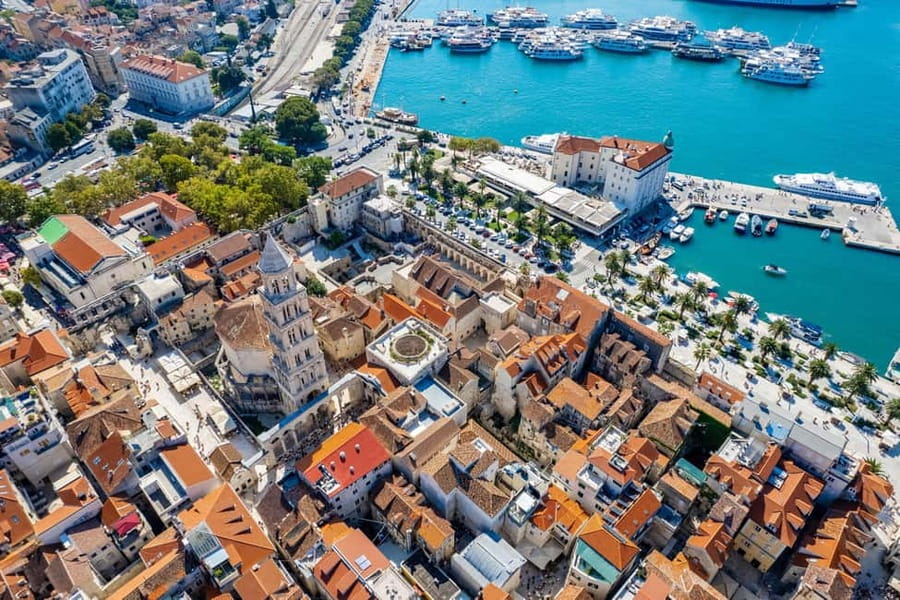
Split’s old town is not a museum behind ropes. It is a living city built inside and around a Roman emperor’s retirement palace. This 90-minute to two-hour walk takes you from the palace’s South Gate through its cellars, courtyards, medieval lanes, markets, cathedral, and waterfront.
I like the way the tour connects Roman ruins with everyday Split life, and I like the local advice about taverns, food, Marjan Hill, and places worth skipping. The main drawback is that entrance fees are not included, and the old town’s uneven streets and steps make this a poor choice for anyone with limited mobility.
In This Review
- Key points at a glance
- Why Diocletian’s Palace is the right place to begin
- From the South Gate to the palace cellars
- The Golden Gate and Split’s layered past
- People’s Square and Fruit Square
- The Riva waterfront and Marjan Hill views
- Peristyle, the palace’s grand center
- Saint Domnius Cathedral inside Diocletian’s mausoleum
- Vestibul and the Roman palace plan
- The guides make the difference
- Is $41 a fair price?
- Who should book this walking tour?
- My verdict on Split’s palace walk
- FAQ
- How long does the Split walking tour last?
- What languages are available?
- What sights are included in the route?
- Are entrance fees included?
- Where does the tour start?
- Is the tour suitable for people with limited mobility?
Key points at a glance
- Roman cellars beneath Diocletian’s Palace: See the preserved lower level and understand how the palace was built.
- A useful first walk through Split: The route covers the Golden Gate, Peristyle, cathedral, markets, old squares, and Riva.
- Local guides add personality: Sandra, Ana, Ivan, Jelena, and other guides have been praised for clear history, humor, and personal insight.
- The Cathedral of Saint Domnius: Visit the church formed from Diocletian’s mausoleum, presented here as the oldest Catholic cathedral in the world.
- A good short tour for a tight schedule: The walk gives you a city orientation without taking half a day.
- Plan for heat and uneven paving: Comfortable shoes matter, and an early or evening departure may be more pleasant.
Why Diocletian’s Palace is the right place to begin
The name can mislead you. Diocletian’s Palace is not one isolated building that you enter, walk through, and leave. It is the core of Split’s old town, with homes, cafés, shops, lanes, churches, squares, and modern life woven into the Roman plan.
The palace was built for Emperor Diocletian at the turn of the fourth century AD. He retired there after ruling the Roman Empire, and the remains now form the framework of central Split. A guided walk helps you see the old stones as parts of one large idea rather than as a series of unrelated ruins.
I find this especially useful on a first visit. Without some orientation, it is easy to wander through a narrow lane, admire a column, and miss the fact that you are walking through what was once an imperial residence and military complex.
The tour also gives you a quick lesson in how cities change. Roman walls were reused, medieval homes rose against ancient structures, later buildings filled old spaces, and 20th-century architecture joined the mix. You are not simply looking at antiquity. You are seeing centuries of practical reuse.
More Old Town Walking Tours in Split
- Split: Old Town and Diocletian Palace Walking Tour
★ 4.9 · 4,727 reviews - Walking Tour of Split and Diocletian’s Palace
★ 5.0 · 2,588 reviews - Krka Waterfalls tour with Trogir Walking tour and Krka panoramic boat cruise
★ 5.0 · 1,659 reviews
From the South Gate to the palace cellars
The walk begins at one of two possible meeting points, with South Tours Travel Agency listed as the starting option. Check your booking details carefully because the meeting point can vary with the option selected.
From there, the route heads toward the Golden Gate, one of the most important entrances to the palace. The guide explains the Roman layout and helps you picture how the main gates once controlled movement through the complex.
The cellars are one of the best parts of the experience. They preserve the lower structure of the palace and mirror much of the plan above. This is where the building’s scale begins to make sense. Rather than seeing a few scattered Roman fragments, you get a clearer picture of the palace as a planned imperial home.
The cellars are also a practical stop because they offer some shelter from the sun. Still, the route includes walking and may involve uneven surfaces, so comfortable shoes are essential.
Entrance fees are not included in the $41 price. That matters. The guide is included for roughly 90 minutes to two hours, but any paid admission along the way is an extra cost. Check exactly which areas your selected tour option enters before booking if you want a longer indoor visit.
The Golden Gate and Split’s layered past
The Golden Gate provides a strong introduction to the city. Its Roman construction is easy to connect with the palace’s original purpose, yet the surrounding streets show how much the area has changed.
The tour does not stop at Roman history. It points out architectural changes from later periods, including 20th-century buildings. I like this approach because Split is more interesting when you see the old and new together. The city is not trying to freeze itself in the fourth century.
A stop near the Game of Thrones Museum adds a modern pop-culture angle. The listed time is short, around five minutes, so do not expect a full museum visit. Instead, the guide can connect Split’s locations with the television series, an extra that some guides have included even when it was not central to the walk.
That part may appeal to fans, but it should not be your main reason for booking. The Roman palace and the living old town are the real attractions.
People’s Square and Fruit Square
People’s Square, or Pjaca, shifts the focus from imperial Rome to the later public life of Split. It is one of the places where the old city feels like a town rather than an archaeological site.
Your guide uses the square to explain how Split developed beyond the palace walls. This is where a good guide earns the fee, because the details help you read the buildings and street plan instead of merely photographing them.
Fruit Square, Voćni Trg, offers another useful pause. Its name recalls the old fruit market, and the square helps show how ordinary trade and daily routines fit into the historic center.
I would pay attention to local recommendations here. Several guides, including Ana and Ivan, have been praised for suggesting authentic places to eat and pointing out local taverns and produce. Those tips can be more useful than another list of dates, especially if you have only a day or two in Split.
The route’s short stops also keep the pace moving. You see a lot, but you do not spend long periods inside one monument. That is good for visitors who want a broad first look. If you prefer detailed architectural study, you may find the tour too brief.
Same stretch of coast, a completely different day out:
- Split: Krka Waterfalls Trip with Boat Cruise and Swimming
★ 4.8 · 10,519 reviews - From Split: Krka Waterfalls, Food & Wine Tasting Tour
★ 5.0 · 9,326 reviews - Blue cave, Mamma Mia and Hvar, 5 islands speedboat tour
★ 5.0 · 7,150 reviews - From Split: Krka Waterfalls, Food & Wine Tasting Tour
★ 4.9 · 6,598 reviews
The Riva waterfront and Marjan Hill views
The walk continues to the Riva, Split’s waterfront promenade. This changes the mood again. After the compressed streets and heavy stone of the old town, the open waterfront gives you room to understand Split’s position beside the sea.
From the Riva, you get panoramic views toward Marjan Hill. The guide may also explain the port and its place in the modern city. One guide was specifically praised for discussing both the port’s history and its present role, which is the kind of connection I value on a city walk.
The Riva stop lasts about ten minutes in the planned route. That is enough for orientation and photographs, but it is not a long waterfront stroll. If you enjoy the promenade, return later on your own.
The timing can matter here. A morning walk may help you get oriented before the day becomes hot and crowded. An evening departure, around 6 p.m. when available, can also be more comfortable. One past booking at 8 a.m. was considered especially useful for avoiding heat and crowds, though you should check the current start times before choosing.
Peristyle, the palace’s grand center
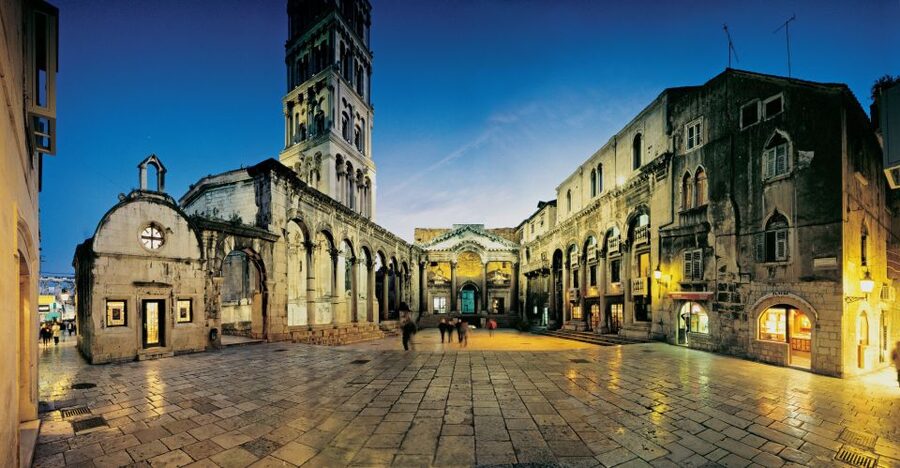
Peristyle is the visual heart of the palace. This formal square once served the imperial complex, and today it is one of Split’s most memorable open spaces.
Here you can see the black granite Egyptian sphinx, described as the last remaining Egyptian sphinx in the square. It is a striking detail because it shows the reach of Roman power and the way objects from far beyond Dalmatia became part of the emperor’s world.
The guide explains the relationship between the square, the palace buildings, and the streets leading away from it. This is a place where a short explanation can change what you see. Columns, stairs, stone walls, and later façades stop looking like random decoration.
Expect some crowds and interruptions, especially during the warmer months. The route is designed for sightseeing rather than quiet contemplation. Keep your camera ready, but give yourself time to look upward and around the edges of the square.
Saint Domnius Cathedral inside Diocletian’s mausoleum
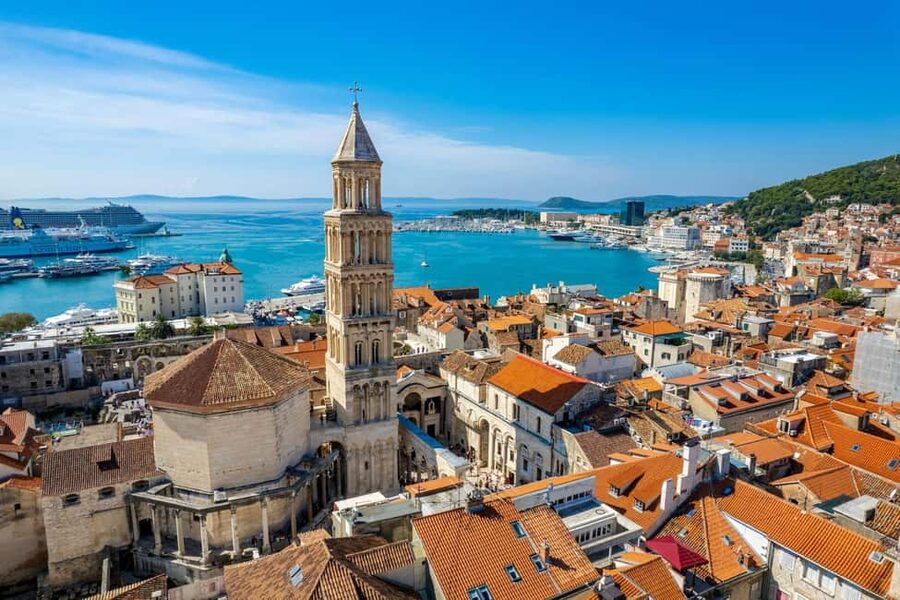
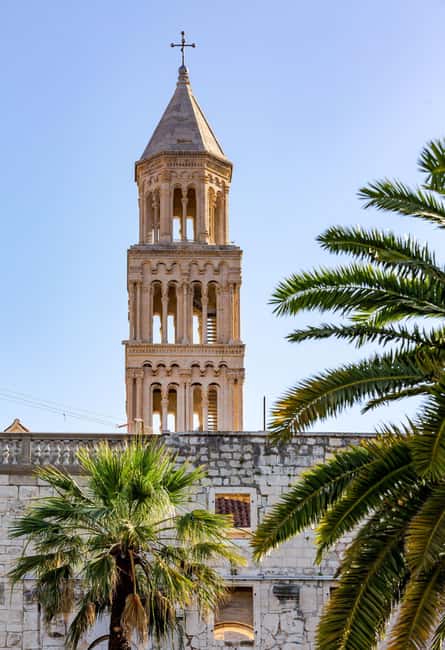
The Cathedral of Saint Domnius is one of the tour’s most powerful examples of reuse. It was formed from Diocletian’s Imperial Roman mausoleum, creating an unusual meeting of Roman imperial architecture and Catholic worship.
The experience presents it as the oldest Catholic cathedral in the world. The important point for you is not just the superlative. It is the physical story: a building made for a Roman emperor became a Christian cathedral, while the wider palace continued as the center of Split.
The route allows about ten minutes for this stop. That gives you a focused introduction, not an extended cathedral study. Entrance fees are not included, so check whether access to the interior is part of your chosen arrangement or requires separate payment.
If you want to study Saint Domnius in detail, return after the tour. The guided visit is best for understanding why the cathedral matters and how it fits into the palace.
Vestibul and the Roman palace plan
The Vestibul is another key Roman space and a planned photo stop. Its rounded form and position near Peristyle help you understand how the palace moved from public ceremonial areas toward the emperor’s private quarters.
The stop is brief, around ten minutes, but the guide’s explanation gives the architecture a purpose. I prefer this to rushing from monument to monument with only names and dates. Knowing how a space functioned makes the surviving walls far easier to remember.
The route then returns to the South Tours Travel Agency. Since the walk covers the main center, you should finish with a better sense of direction. Several guides have also pointed out shortcuts and places to return to later, which is useful because Split’s old town can feel confusing on your first day.
The guides make the difference
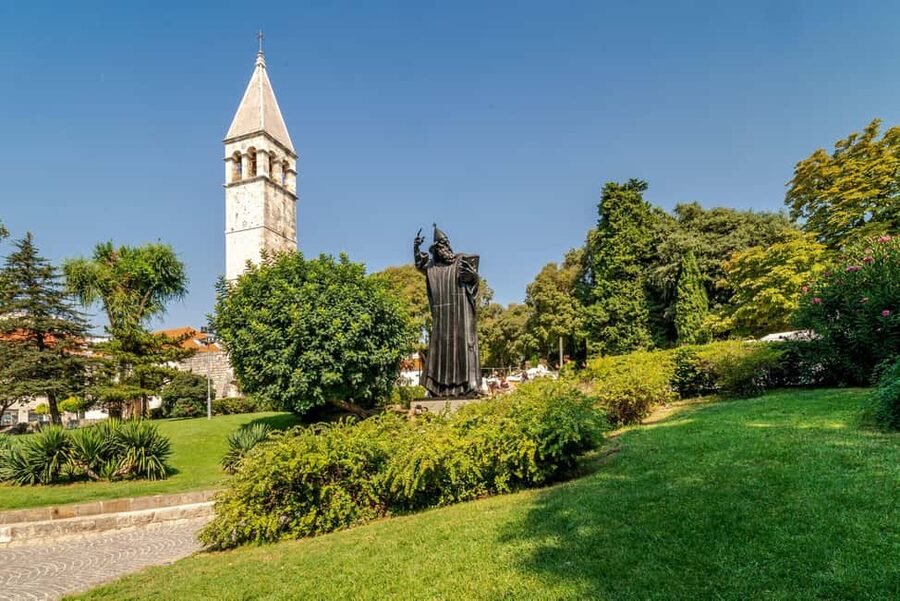
The strongest part of this experience is the guiding. Past guide names include Sandra, Ana, Ivan, Jelena, Iva, and Ina, with English and Spanish offered. You cannot assume a particular guide will lead your departure, but the guide style described for this experience is personal, lively, and focused on explanation rather than a dry recital.
Sandra has been praised for adding anecdotes and sharing a local view of Split. Ana has been noted for answering questions patiently, discussing current Croatian life, and giving practical food advice. Ivan’s warm, relaxed manner and broad understanding of Croatia made the walk comfortable for visitors who wanted both history and everyday context.
Jelena has been praised for presenting facts in a clear, entertaining way. Some guides have also added Game of Thrones filming information, local restaurant suggestions, and advice about other sights in Croatia.
There is one possible wrinkle: English and Spanish speakers may be combined in the same group. That has worked well for some people, but it can slow the pace and make the experience less smooth. If you want a fully focused English tour, check the language arrangement before you pay.
Group size can vary. Some past departures turned into very small or even private walks, while that cannot be promised. A small group makes it easier to ask questions and move through narrow lanes, but you should not book solely expecting private attention.
Is $41 a fair price?
At $41 per person, this is not the cheapest way to walk around Split, since the old town itself is open to independent exploration. You can see many exterior sights without paying for a guide.
The value comes from the structure and explanation. In under two hours, you cover the cellars, major palace gates, Peristyle, Vestibul, Saint Domnius Cathedral, People’s Square, Fruit Square, and Riva. You also get a local orientation and practical suggestions for the rest of your stay.
I consider the price reasonable if you are visiting Split for the first time, arriving from a cruise ship, or working with a tight schedule. It is less compelling if you already understand the palace, prefer to read at your own pace, or plan to pay for several separate monument entrances afterward.
Remember that food, drinks, and entrance fees are extra. The fee pays for the guided walk, not a full package of admissions.
Who should book this walking tour?
This tour suits you best if you want:
- A short first look at Split before exploring alone
- Roman history explained in plain language
- A mixture of major sights and ordinary city life
- Local advice about food and places to visit
- A guide who can connect ancient history with modern Croatia
- A manageable introduction during a short port call
It is less suitable if you have limited mobility. The tour is not recommended for people with mobility impairments, and the old town includes uneven paving, narrow lanes, and walking between several separate sites.
One past guide adapted a route for a wheelchair user, but that should not be treated as a standard guarantee. Ask the provider before booking if you need a specific route or access arrangement.
Heat is another consideration. Bring water, wear supportive shoes, and consider an early or evening departure when available. The walk is not long, but exposed stone streets can feel tiring in summer.
The free cancellation policy allows a full refund when you cancel at least 24 hours in advance. You can also reserve now and pay later, which helps if your Croatia plans are still shifting.
My verdict on Split’s palace walk
I would book this as an orientation tour, not as the final word on Diocletian’s Palace. Its strength is the combination of major Roman sites, medieval and modern streets, waterfront views, and personal local guidance in a compact time frame.
You should book if you want the story behind the stones and useful advice for the rest of your stay. Skip it if you prefer a slow, self-guided visit or need a fully accessible route. For most first-time visitors with comfortable shoes and limited time, $41 buys a helpful beginning to Split.
FAQ
How long does the Split walking tour last?
The tour lasts about 90 minutes to two hours, depending on the departure and pace.
What languages are available?
The tour is offered with a live guide in English or Spanish.
What sights are included in the route?
The route includes the Golden Gate, Game of Thrones Museum area, People’s Square, Fruit Square, Riva, Diocletian’s Palace, Peristyle, the Cathedral of Saint Domnius, and Vestibul.
Are entrance fees included?
No. Entrance fees are not included in the tour price. Food and beverages are also separate.
Where does the tour start?
There are two possible starting location options, and the meeting point may vary depending on the option booked. South Tours Travel Agency is listed as a starting point, with the walk returning there.
Is the tour suitable for people with limited mobility?
The tour is not recommended for people with limited mobility. Comfortable walking shoes are recommended because the route covers historic streets and several locations on foot.
More Walking Tours in Split
- Split & Diocletian’s Palace Walking Tour
★ 5.0 · 1,125 reviews - Walking Tour of Split with a ‘Magister’ of History
★ 5.0 · 1,122 reviews - Split Walking Tour with Professor of History
★ 5.0 · 926 reviews - Split: Diocletian Palace & Old Town Guided Walking Tour
★ 4.7 · 882 reviews
Just added around Split
- Split Sunset Stand Up Paddle Tour★ 5.0 · 16 reviews
- Split: Sunset Guided Kayaking Tour★ 4.8 · 71 reviews
- Split&Sip: Educational wine tasting★ 4.9 · 52 reviews
- Stand Up Paddle Tour in Split★ 4.7 · 17 reviews
- Split: Guided Walking Tour in English★ 4.9 · 10 reviews
- Split – Walking in Khaleesi Footsteps in the City of Dragons★ 5.0 · 13 reviews
- Split Walking Tour with History Professor★ 5.0 · 23 reviews
- Split Walking Tour: History, Legends & Tales★ 5.0 · 9 reviews
Old Town Walking Tours, compared.

Walking Tour of Split and Diocletian’s Palace
Read our review →

Krka Waterfalls tour with Trogir Walking tour and Krka panoramic boat cruise
Read our review →
City Walls Early Morning or Sunset Walking Tour
Read our review →
Plitvice Lakes with Boat Ride and Zadar Old Town Tour
Read our review →Browse the lists this tour appears in