
Reviewed · OLD TOWN WALKING TOURS
Pula Sightseeing Walking Tour
Pula’s best sights sit close together, but the city makes more sense when someone connects the Roman Arena, Venetian Forum, old gates, and Austro-Hungarian past. Saša Radost leads this walk as a relaxed conversation, with stories about the people who shaped Pula rather than a string of dry dates.
I like the small-group limit of 20, which should make it easier to ask questions, and I like the practical advice on restaurants, museums, and getting around. The main consideration is that the tour can last anywhere from 90 minutes to 2.5 hours, and entrance fees are extra. The optional climb to Kaštel also requires a bit of effort.
In This Review
- Key points at a glance
- Why this Pula walk works well
- The Arena: Pula’s Roman opening scene
- Tito’s Park and the city model
- Three small Roman-era stops
- Gate of Hercules
- Sergii Arch
- The Punishment of Dirce mosaic
- Roman and Venetian Pula at Forum
- The Twin Gates and the optional Kaštel climb
- What the personal guide style adds
- Time, group size, and practical value
- Is $34.91 a fair price?
- Who should book this walk?
- Cancellation and weather notes
- Should you book the Pula Sightseeing Walking Tour?
- FAQ
- How long does the Pula Sightseeing Walking Tour last?
- What is the price of the tour?
- Where does the tour begin?
- Where does the tour end?
- Is admission to the Pula Arena included?
- Is the Temple of Augustus included?
- Is the walk to Kaštel required?
- What is the maximum group size?
- Can I cancel for a full refund?
Key points at a glance
- Roman Arena first: Spend about 30 minutes learning how Pula’s most famous monument fits into the city’s past, from outside or inside.
- A local guide with a personal connection: Saša grew up in Pula, left for college, and returned because of her attachment to Istria.
- More than Roman ruins: The route includes the Gate of Hercules, Sergii Arch, Tito’s Park, a Roman floor mosaic, and Venetian-era Forum buildings.
- A lively human angle: Saša’s Badass People in Pula approach uses stories about notable people who lived in, visited, or shaped the city.
- Optional Kaštel viewpoint: The medieval fortress adds a climb, a museum option, and views toward the Arena and shipyard.
- Useful before sightseeing alone: The walk ends at Forum and gives you a better map of Pula for the rest of your stay.
Why this Pula walk works well
Pula is often introduced through its Roman Arena, yet the city is not simply an ancient Roman site. Histri, Romans, Venetians, Austrians, and people from more recent periods all left marks here. A walking tour is useful because these layers appear within a compact area, often only a few minutes apart.
You begin at Flavijevska ul. 2, near the Arena, and finish at Forum. That route is practical. You start with Pula’s largest landmark, then move through smaller remains and public spaces until the tour reaches the Temple of Augustus and the old city hall.
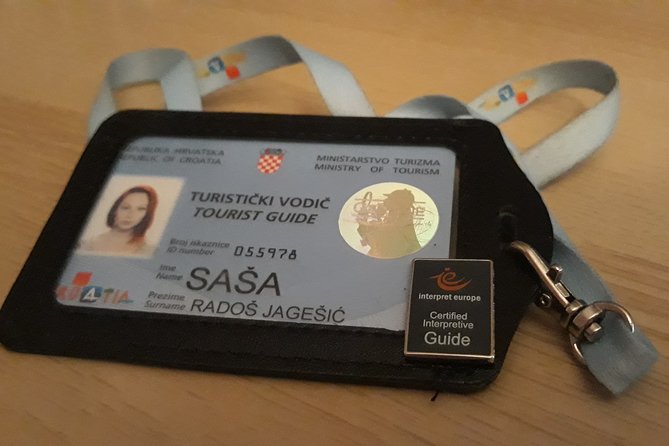
I especially like the guide’s local perspective. Saša grew up in Pula, went away for college, and came back because she loves life in Istria. That background gives the walk a personal center. You are not only hearing what a monument is. You are also getting suggestions for how to use your time in town.
The tour also has a distinct storytelling angle. Saša’s Badass People in Pula tour focuses on notable figures connected with the city. The approach is useful if conventional history lessons lose your attention. Instead of treating Pula as a list of dates, it puts people and their choices at the center.
More Old Town Walking Tours in Pula
- Pula: Historic Walking Tour with Local Guide & City Views
★ 4.8 · 143 reviews - Pula walking tour
★ 5.0 · 96 reviews - Pula: Historic Sites Guided Walking Tour
★ 4.8 · 78 reviews
The Arena: Pula’s Roman opening scene
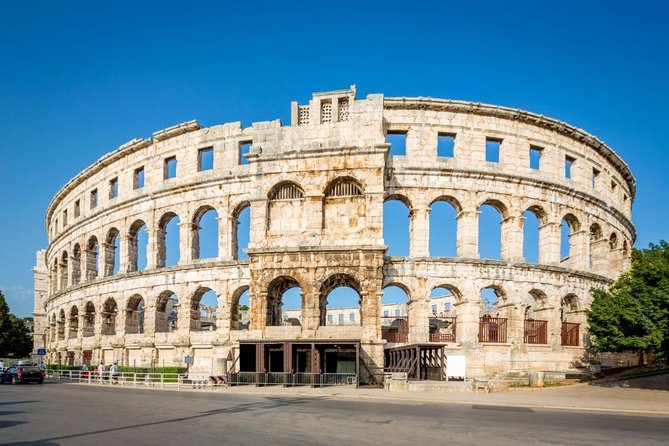
The Pula Amphitheatre is the major event at the start of the walk. Plan on roughly 30 minutes here. Saša can explain the building from the outside or take you inside, depending on what you prefer.
The exterior gives you an immediate sense of scale and lets you look at the Arena as part of modern Pula. Going inside offers a closer look at the Roman structure, but the admission fee is not included. The stated entrance price is 10 euros, so you should budget for that if you want more than the outside explanation.
This is a good place for the tour to begin because the Arena is easy to recognize and provides a clear entry into Pula’s Roman period. Saša’s goal is not just to identify the building. She tells the story of how the monument fits into the long, dramatic past of the city.
I would decide before meeting the guide if you want to pay for entry. If you are watching costs or have already visited inside, the outside option keeps the tour moving. If the Arena is your main reason for coming to Pula, the interior may be worth the extra fee.
Tito’s Park and the city model
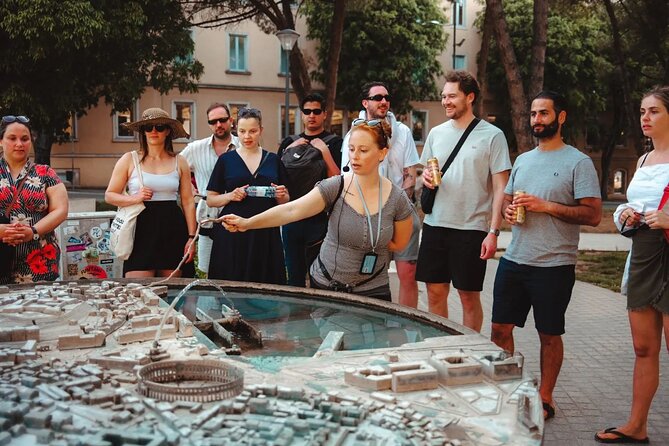
After the Arena, the route reaches Tito’s Park. In front of the park is a small model of Pula’s center. Saša uses it to explain the layout of the town and preview the rest of the walk.
This is a short stop, about 10 minutes, but it has real value. Pula’s streets and monuments can seem disconnected when you first arrive. A simple map model helps you understand where the Roman center sits in relation to the Arena, the old gates, Forum, and Kaštel.
The stop also introduces a more recent chapter in Pula’s story. The park is dedicated to fighters against fascism during World War II. You will not spend a long time here, but the location reminds you that Pula’s past does not end with the Romans.
Three small Roman-era stops
The next section shows why a guide helps in Pula. Some of the most interesting remains are not huge monuments. They are small features you could easily pass without knowing what you are seeing.
Same stretch of coast, a completely different day out:
- Medulin -Kamenjak 5h boat trip with lunch & drinks on Sandra Boat
★ 5.0 · 1,621 reviews - Full-Day Boat Tour of the Medulin Archipelago from Medulin
★ 5.0 · 1,389 reviews - 3hours all inclusive Sunset&Dolphin Tour from Medulin on Sandra
★ 5.0 · 1,130 reviews - Dolphin Watching & Sunset Boat Tour With Dinner and Drinks
★ 5.0 · 1,075 reviews
Gate of Hercules
The Gate of Hercules is described as the oldest of Pula’s town gates. The stop lasts about five minutes and costs nothing to visit.
Do not expect a large ceremonial entrance. Its value is in its age and position within the old town. Saša can point out what makes the gate important, then place it beside the other Roman entrances still visible in Pula.
Sergii Arch
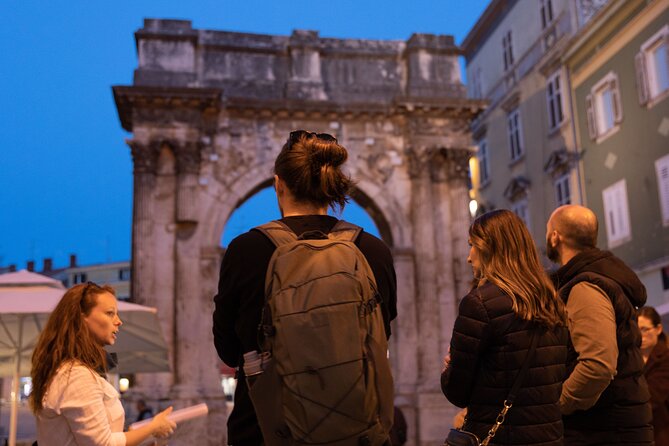
The Arco dei Sergi is a triumphal arch connected with the Sergii family. It sits at one end of one of Pula’s best-known streets, making it easy to combine with your own wandering after the tour.
The planned stop is about 10 minutes. This is a good example of a monument that benefits from explanation. On its own, it is an elegant arch. With context about the family and its public role, it becomes part of the city’s Roman civic story.
The Punishment of Dirce mosaic
The Roman floor mosaic showing the Punishment of Dirce is one of the route’s less obvious sights. It was found during World War II and indicates the location of a once wealthy Roman palace.
The mosaic is free to see and the stop takes around 10 minutes. Its setting makes it especially useful to visit with Saša. You may not notice it while walking through town, and there is no monumental building around it to announce its importance.
This stop also shows how archaeology in Pula works. Ancient remains are not limited to the Arena and Temple of Augustus. They can appear as a floor fragment within the modern city, quietly marking the location of an affluent Roman home.
Roman and Venetian Pula at Forum
The tour ends at Forum, Pula’s central square. Here you see the Temple of Augustus beside the medieval Venetian city hall, a pairing that neatly sums up the city’s changing rule and changing architecture.
The Temple of Augustus is dedicated to the goddess Roma and Emperor Augustus. Entry is not included, and the stated admission fee is 2 euros. The stop lasts about 10 minutes.
I like this ending because it brings several periods together in one view. The temple belongs to the Roman era, while the nearby city hall points to later Venetian influence. Instead of finishing at the first major monument, the route ends with a place that helps you compare the different chapters of Pula’s past.
Forum is also a useful place to finish independently. From here, you can continue exploring at your own pace, use Saša’s suggestions for museums and restaurants, or simply retrace part of the route with a clearer sense of direction.
The Twin Gates and the optional Kaštel climb
The Twin Gates are another brief stop, lasting about five minutes. They are described as the first and youngest of the three Roman town gates still standing in Pula.
The contrast with the Gate of Hercules is the point. One gate is the oldest, while the Twin Gates represent a later stage in the city’s Roman defenses and entrances. The free stop is quick, but it helps you see that Pula’s old boundary was made up of several entrances with different dates and roles.
The final stop is Kaštel, and this part is optional. The walk up is a little steep, so you should consider your energy and footwear before adding it. The medieval fortress now houses the Historic and Maritime Museum, although museum admission is not included.
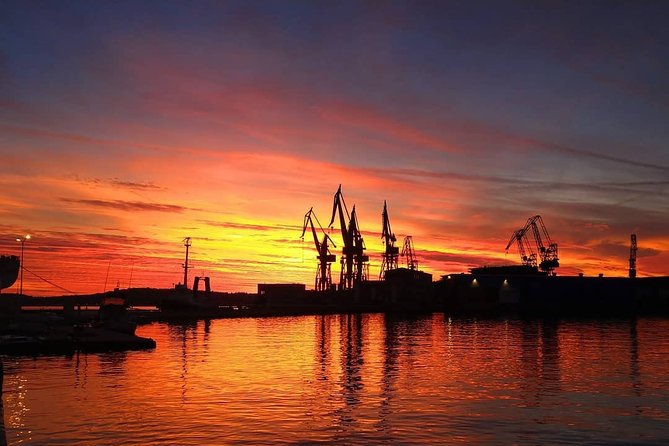
Kaštel offers a view toward the Arena and the shipyard side of town. That makes it a good choice if you want a broader look at Pula after seeing the monuments at street level. It also gives the tour another period to discuss, since the fortress belongs to the medieval story rather than the Roman one.
The climb is not essential to understand the main route. If you prefer a level walk or have limited time, you can skip it. If you enjoy viewpoints and do not mind a short uphill stretch, Kaštel adds a useful final perspective.
What the personal guide style adds
Saša’s strongest feature is the human approach. The tour is built around a chat with a local, not just a memorized lecture. That matters in Pula because the city’s major sights can otherwise feel like separate stops with no clear link.
The guide also brings a modern connection to the place. Saša left Pula for college and returned, which says something about how she sees the town today. You can ask about everyday matters, not only ancient dates. The experience specifically includes tips for getting around, choosing museums, and finding restaurants.
The Badass People in Pula angle adds another useful layer. Saša tells stories about well-known people who walked Pula’s streets, were born there, or lived there for a time. This perspective suits you if you want history with characters and personal stories.
The tone appears to be informal and lively. The published feedback repeatedly praises Saša’s ability to make history interesting, even for people who do not usually choose history-focused tours. One response calls the guide awesome and describes the experience as a different way to see Pula. That praise is worth noting because storytelling is the central product here.
Time, group size, and practical value
The advertised duration ranges from 1 hour 30 minutes to 2 hours 30 minutes. That is a wide spread. The shorter version likely works best if the route stays focused and Kaštel is skipped. The longer version gives more room for questions, the optional climb, or an inside visit if you choose it.
The maximum group size is 20 people. That is not a private tour, but it is still small enough to make a local conversation possible, especially compared with a large coach group. If you want a very personal experience, ask about the group size at booking, since the stated limit is a maximum rather than a guaranteed number.
The meeting point is Flavijevska ul. 2 in Pula, and the end point is Forum. Both are in the old center, and the tour is near public transportation. A mobile ticket makes the entry process simple.
Most people can take part, and service animals are allowed. The main physical point to keep in mind is the optional walk up to Kaštel. Poor weather can also affect the experience, since it requires good conditions.
Is $34.91 a fair price?
At $34.91 per person, the tour is not the cheapest way to look at Pula’s monuments. You are paying for a licensed guide, local interpretation, and a route that links major Roman remains with Venetian, medieval, and modern sites.
The price makes the most sense if you are new to Pula and want an efficient introduction. In roughly two hours, you can see the Arena, old gates, Sergii Arch, a Roman mosaic, the Temple of Augustus, Forum, and possibly Kaštel. You also receive practical suggestions for the rest of your stay.
You should add the cost of optional admissions. The Arena is listed at 10 euros, and the Temple of Augustus at 2 euros. Kaštel has the Historic and Maritime Museum, but its entrance cost is not provided, so check before you go if you plan to enter.
If you already know Pula well or prefer to read plaques at your own pace, the price may be harder to justify. The value comes from the guide’s stories and local advice, not from admission to a collection of attractions.
Who should book this walk?
I would recommend it for a first visit to Pula, especially if you want the main sights explained in one compact route. It also suits people who prefer stories about individuals and city life to a formal lecture on dates and architecture.
Families and mixed-age groups may appreciate the flexible pace and the choice between seeing the Arena from outside or paying to enter. The shorter stops also keep the walk from becoming a single long talk at one monument.
History fans will get the most from combining the Arena, gates, mosaic, temple, and fortress. You can see how Roman, medieval, Venetian, and more recent chapters overlap in a small area.
You may want a different plan if you need a fully accessible route, since Kaštel involves an uphill walk and no detailed accessibility information is provided. You should also skip the optional climb if you want a quick, level introduction.
Book at least a day ahead if your plans are firm. The experience is often reserved well in advance, with an average booking lead time of 107 days. Confirmation is sent within 48 hours, subject to availability.
Cancellation and weather notes
You can cancel for a full refund up to 24 hours before the start time. Cancellations or changes made less than 24 hours before the tour are not accepted for a refund.
The tour requires good weather. If poor weather causes cancellation, you are offered another date or a full refund. Since this is an outdoor walk, check the forecast and avoid scheduling it too tightly against another important activity.
Should you book the Pula Sightseeing Walking Tour?
Book it if you want Pula explained by someone with a personal connection to the city. The route covers the essential Roman sights, but the real strength is the way Saša links them to later periods, local life, restaurants, museums, and the people behind the city’s story.
The tour is particularly good value early in your visit. Take notes at Forum, ask for practical suggestions, and use the walk to plan the rest of your time. Pay for the Arena or Temple only if you want to enter, and treat Kaštel as an optional bonus rather than a requirement.
Skip it if you want a completely self-guided visit or already know Pula’s center. For most first-time visitors, though, this is a friendly and efficient way to get oriented without reducing the city to a checklist of ruins.
FAQ
How long does the Pula Sightseeing Walking Tour last?
The tour lasts approximately 1 hour 30 minutes to 2 hours 30 minutes.
What is the price of the tour?
The price is $34.91 per person.
Where does the tour begin?
The tour begins at Flavijevska ul. 2, 52100, Pula, Croatia.
Where does the tour end?
The tour ends at Forum, 52100, Pula, Croatia.
Is admission to the Pula Arena included?
No. Admission fees are not included. The stated entrance fee for the Amphitheatre de Pula is 10 euros.
Is the Temple of Augustus included?
No. Entrance is not included. The stated admission fee is 2 euros.
Is the walk to Kaštel required?
No. The walk to Kaštel is optional. It includes an uphill climb to the medieval fortress.
What is the maximum group size?
The tour can have a maximum of 20 participants.
Can I cancel for a full refund?
Yes. You can cancel at least 24 hours before the experience start time for a full refund. Poor-weather cancellations offer a different date or a full refund.
More Walking Tours in Pula
- Pula Essentials Walking Tour
★ 4.8 · 64 reviews - Pula Essentials Walking Tour
★ 5.0 · 62 reviews - Pula Food Walking Tour
★ 4.5 · 22 reviews - Pula: Old Town Walking Tour for Foodies with Dinner and Wine
★ 4.6 · 18 reviews
Just added around Pula
- 1-Hour Private E Foil Surfing Lessons in Istria★ 5.0 · 4 reviews
- Wine Tasting Experience at the organic winery in Šišan★ 3.5 · 13 reviews
- 3 Hours Private Wine and Sunset Tour★ 5.0 · 9 reviews
- Transfer Pula – Poreč★ 5.0 · 5 reviews
- Dolphin & Sunset tour with Brijuni panorama★ 5.0 · 119 reviews
- E-Bike swim & fortress tour Vodnjan★ 5.0 · 6 reviews
- Stop on Island & National Park Day Cruise with Lunch Drinks★ 5.0 · 10 reviews
- Waves & Watercolors: A Seaside Painting Workshop★ 5.0 · 21 reviews
Old Town Walking Tours, compared.



Walking Tour of Split and Diocletian’s Palace
Read our review →


Krka Waterfalls tour with Trogir Walking tour and Krka panoramic boat cruise
Read our review →
City Walls Early Morning or Sunset Walking Tour
Read our review →
Plitvice Lakes with Boat Ride and Zadar Old Town Tour
Read our review →Browse the lists this tour appears in