
Reviewed · CYCLING TOURS
Classic Zagreb Bike Tour
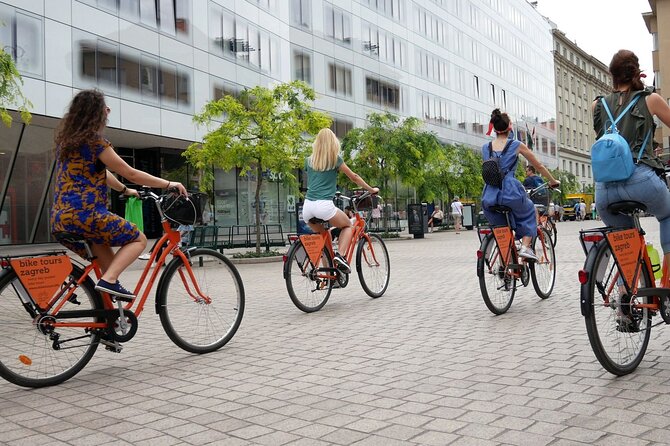
Zagreb makes good sense from a bicycle. In about three hours, you can cover the Upper and Lower Towns, pass the market and cathedral, pedal through old streets, and reach broad green squares that would take longer on foot. I especially like the easy pace and the included stop for coffee, a cold drink, or ice-cream. It gives the ride a friendly, social rhythm rather than turning it into a workout.
The guides are a major part of the experience. Filip, Iva, Zeljka, Sandro, and other local guides are praised for clear history, humor, restaurant tips, and their ability to adjust the pace. I also like the small-group limit of 12 people. The main caution is equipment and traffic: some riders have found bikes or helmets less than ideal, and the route includes cobblestones, pedestrians, public transport, and one or two hills.
In This Review
- Key points to know before you book
- Why a bicycle is a smart way to see Zagreb
- Starting near Jurišićeva Street
- Cathedral, Dolac Market, and Tkalciceva Street
- Bloody Bridge and the Stone Gate
- St. Mark’s Church and the Upper Town climb
- The National Theatre and Lower Town squares
- Guides, stories, and the refreshment break
- Price, group size, and what you get
- Bike quality and road-safety considerations
- Who will enjoy this Zagreb ride most
- Should you book the Classic Zagreb Bike Tour?
- FAQ
- How long does the Classic Zagreb Bike Tour last?
- Where does the tour start?
- Where does the tour end?
- What is included in the tour price?
- Is the funicular ticket included?
- How large is the group?
- Can I cancel for a full refund?
Key points to know before you book
- You see both sides of central Zagreb: The route links the medieval Upper Town with the planned squares and parks of the Lower Town.
- The ride is mostly gentle: It is largely flat, but cobblestones, busy pedestrian areas, and a short steeper section require confidence on a bicycle.
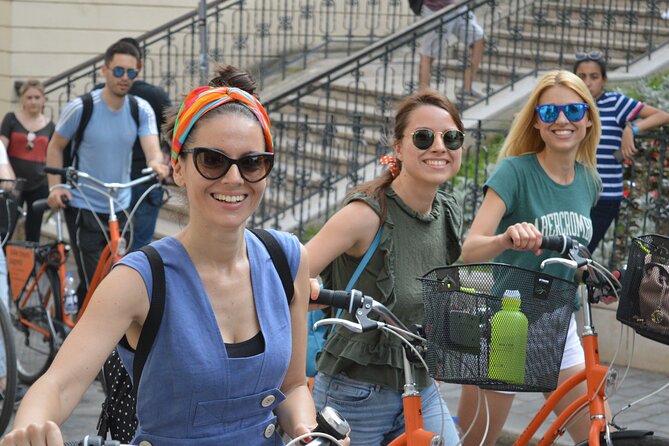
- Your guide adds local color: Filip, Iva, Zeljka, Sandro, and other guides bring history, humor, food suggestions, and practical city advice.
- A refreshment break is included: Choose coffee, a soft drink, or ice-cream during the stop.
- It is efficient for first-time visitors: You cover many central sights without spending the entire morning or afternoon walking.
- Check your bike before leaving: Confirm both brakes, saddle height, tires, and helmet fit before the group starts.
Why a bicycle is a smart way to see Zagreb
Zagreb’s center is compact, but its sights are spread across two distinct areas. The Upper Town has medieval lanes, stone gates, churches, and viewpoints. The Lower Town has long avenues, formal squares, museums, and parks laid out in a more orderly pattern.
A walking tour handles both areas well, but cycling saves time between them. You can move from Kaptol to Gradec, then down toward the National Theatre and Zrinjevac, without repeatedly retracing your steps. The bike also lets you sample more of the city than a short stroll around the main square.
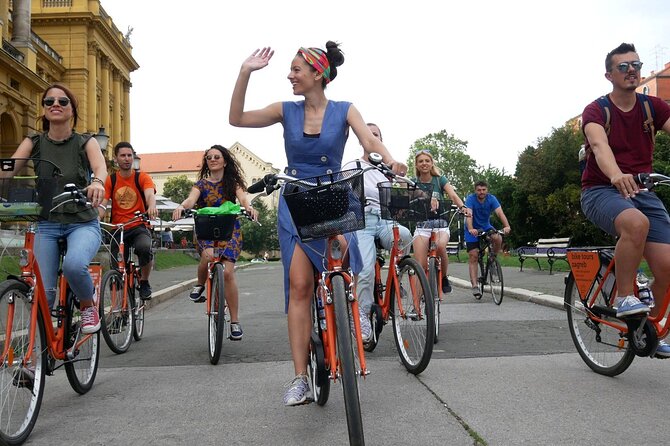
This is not presented as a sporting ride. The pace is relaxed, and several stops break up the cycling. One family completed it with three 10-year-olds, while another rider who was not especially athletic found it manageable by walking the bike up the steeper hills.
You should still be comfortable riding in an urban setting. The route can involve cobblestones, pedestrians, trams, buses, and tight maneuvering. One rider noted that the gears rarely moved beyond first gear because of the busy streets. That tells you what kind of ride this is: sightseeing first, cycling challenge second.
A few more Zagreb trips to weigh up
- Zagreb Highlights Bike Tour
★ 5.0 · 208 reviews - Zagreb: 2.5-Hour Highlights Bike Tour
★ 4.8 · 93 reviews - Best of Zagreb: 4-Hour Cycling Tour
★ 4.9 · 13 reviews
Starting near Jurišićeva Street
The tour begins at Jurišićeva ul. 19 in central Zagreb and returns there at the end. The location is near public transportation, which makes it practical if you are staying outside the old center.
Allow a little time at the start for fitting the bicycle and helmet. Before setting off, I would check that both brakes work, the saddle is comfortable, and the bike feels the right size. This is especially important for shorter riders, since one person found that small bicycles were not available.
The operator supplies the bicycle and helmet, and the group can include up to 12 people. That is small enough for a guide to answer questions and keep track of the group, though a full group will naturally feel less intimate than a ride with only two or four people.
Cathedral, Dolac Market, and Tkalciceva Street
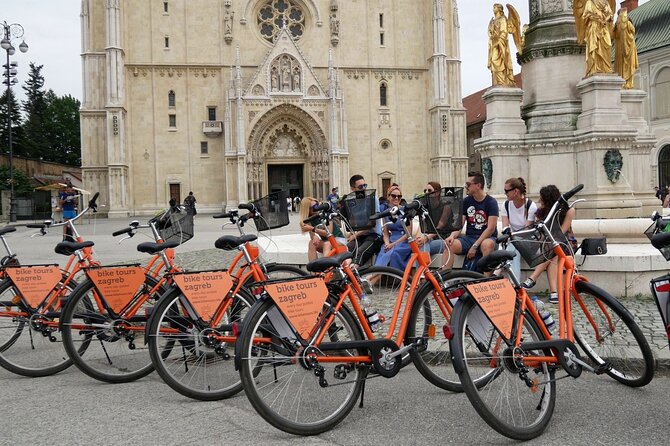
The first stop is Zagreb Cathedral in Kaptol, where the city’s story is closely tied to the founding of the Diocese of Zagreb in 1093. You have about 10 minutes here. The stop gives you an early sense of Zagreb’s religious and political roots, though the tour does not include an admission ticket.
From the cathedral, the route reaches Dolac Market, often called the belly of Zagreb. This is the city’s largest farmers market, and it offers a more everyday view of local life than a polished monument does. You have 10 minutes, enough to look around and understand why the market matters, though not enough for a long shopping visit.
Tkalciceva Street follows. Today it is packed with cafés, restaurants, and evening activity, but its past is far less respectable. From the late 19th century into the 1930s, it was Zagreb’s red-light district. The guide can connect that former reputation with the street you see now, making this a useful reminder that city neighborhoods change dramatically over time.
The route through this part of town is attractive, but it is not always effortless. Expect pedestrians and uneven surfaces. You will get more from the stop if you slow down, listen, and accept that the bike is being used as a way to connect sights rather than race between them.
Bloody Bridge and the Stone Gate
Krvavi Most, or Bloody Bridge, recalls the old divide between Gradec and Kaptol. The two settlements once faced each other across the Medveščak stream, and clashes between their residents gave the crossing its grim name.
The stream is no longer an open feature of the city in the way it once was, so the guide’s explanation matters here. This is one of the stops where a few minutes of context helps you picture the older city beneath modern Zagreb.
Next comes Petrini Pyli, better known in English as the Stone Gate. The passage has long housed a shrine to Our Lady of the Stone Gate, regarded as the patron saint of Zagreb. Even if you are not visiting churches, this is an important place to pause because it combines architecture, devotion, and civic identity in a very small space.
The Stone Gate also illustrates the advantage of a bicycle tour. You can reach it without spending much time navigating the Upper Town alone, then move on before the route begins to feel like a sequence of disconnected monuments.
Same stretch of coast, a completely different day out:
- From Zagreb: Plitvice & Rastoke Guided Day Trip with Ticket
★ 4.9 · 2,955 reviews - Zagreb: Rastoke & Plitvice Lakes Guided Tour with Ticket
★ 4.9 · 1,897 reviews - Communism & Croatian Homeland War Tour
★ 5.0 · 1,355 reviews - Best of Zagreb with the WW2 Tunnels
★ 5.0 · 973 reviews
St. Mark’s Church and the Upper Town climb
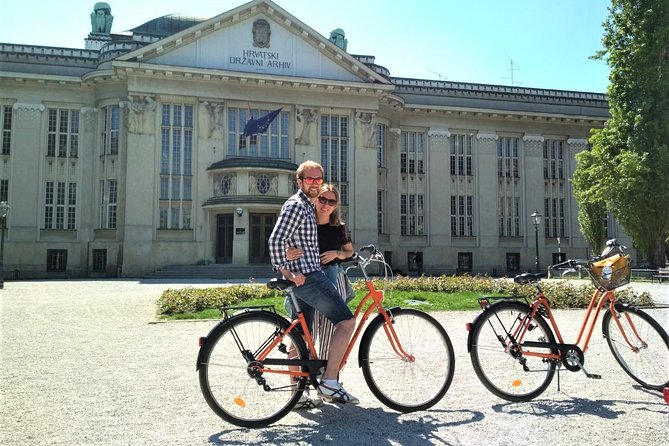
St. Mark’s Church is one of Zagreb’s oldest buildings and one of the city’s best-known symbols. Its history reaches back to at least the 14th century, when it appeared among the parish churches listed in the Kaptol Statute.
You have about 15 minutes at the church. This is a good point to pay attention to the guide’s explanation of Zagreb’s Upper Town, since the surrounding streets carry much of the city’s older character. The stop is primarily about the exterior and the setting, and admission is not included.
The route includes some uphill riding. Most of the course is described as easy, but several riders point to one steeper hill. You can walk the bicycle if needed, and there is no reason to treat that short section as a test of fitness.
After St. Mark’s, the tour reaches the funicular railway. Built in 1892, it is considered Zagreb’s oldest passenger public transport. The stop lasts about 15 minutes, but the funicular ticket is not included. If you want to ride it, plan to pay separately, and do not assume the tour price covers that extra.
The funicular is useful as a piece of city history even if you do not ride. It shows how Zagreb connected the Upper and Lower Towns as the city grew. The bicycle route gives you that same connection under your own power.
The National Theatre and Lower Town squares
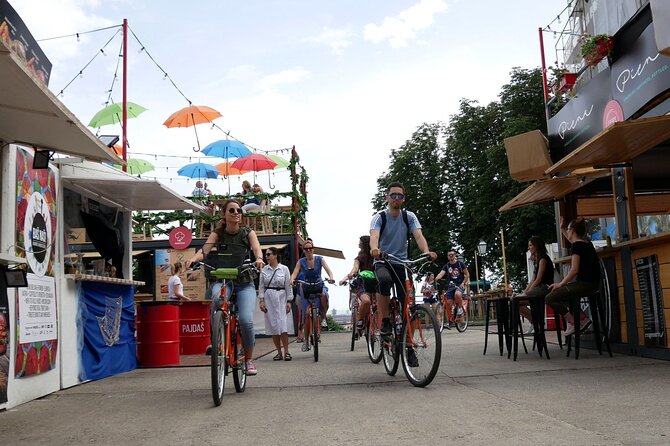
The Croatian National Theatre comes next, with about 20 minutes at the stop. Founded in 1860, it represented the long-held goal of creating a Croatian theater in the Croatian language. The building and its role in national culture give the Lower Town a different tone from the medieval lanes above.
From there, the ride continues to King Tomislav Square. Tomislav ruled Croatia in the early 10th century and is regarded as the first Croatian king. The square provides a broad open setting after the tighter streets of the Upper Town.
The final stop is Zrinjevac, one of the key pieces of Zagreb’s Lower Town plan. In 1876, the city adopted an urban design intended to link the Lower Town squares into one connected framework. Zrinjevac helps you see that plan rather than simply ticking off another park.
You will not have time to tour museums or enter every landmark during this outing. Think of the ride as a well-organized introduction. If the National Theatre, cathedral, or another sight catches your attention, return later for a slower visit.
Guides, stories, and the refreshment break
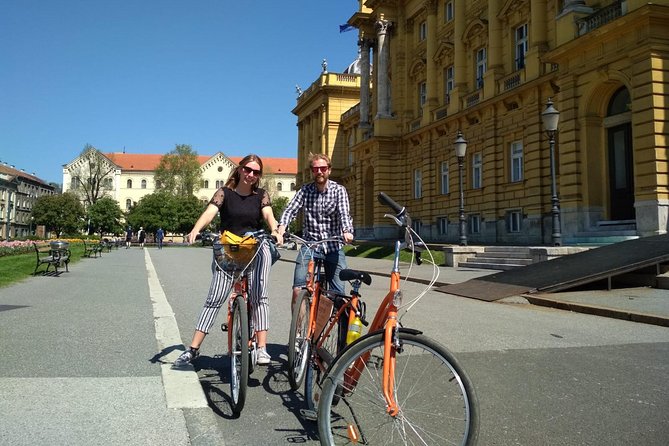
The most consistently praised part of this experience is the guiding. Filip is described as warm, funny, and especially good at mixing history with stories and questions. Iva and Eva are noted for engaging explanations and adapting the ride to the group. Zeljka receives praise for her friendly style and restaurant advice, while Sandro is appreciated for humor and clear accounts of Zagreb’s past.
That range matters because a bicycle tour can easily become a list of dates and names. The strongest guides make the stops feel connected. They explain why Kaptol and Gradec competed, how the Upper and Lower Towns developed, and what Zagreb’s food, sports, and daily life mean today.
You also receive recommendations for restaurants and local dishes. These suggestions are a useful bonus because they come at the end of an orientation ride, when you already know which parts of the center appeal to you.
The included break is another practical strength. You can choose coffee, a refreshing drink, or ice-cream. Alcoholic drinks are not included. The pause lets you rest, ask questions, and get to know the rest of the group. On a warm day, it also makes the ride much more comfortable.
Price, group size, and what you get
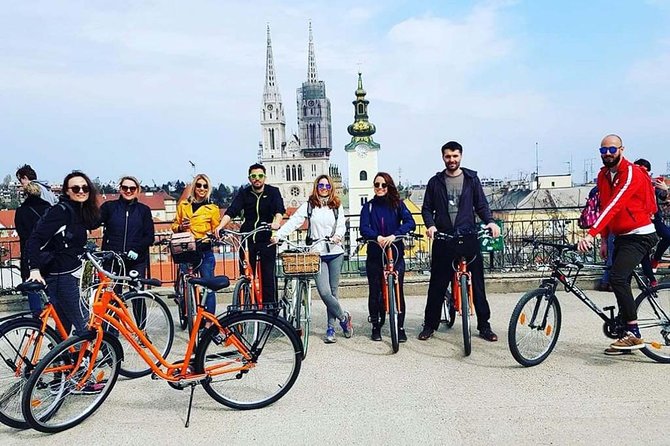
At $54.44 per person, this is not the cheapest way to see Zagreb’s center. It is a fair price if you value a bicycle, helmet, local guide, three hours of organized sightseeing, a refreshment, and a photo from the tour.
The value comes from coverage and orientation. You get the main Upper Town sights, the market, the central streets, the National Theatre, King Tomislav Square, and Zrinjevac in one outing. A self-guided version costs less, but you would need to work out the route, research the background, arrange a bicycle, and decide how to move between the two parts of the city.
The tour is booked an average of 38 days ahead, so it is sensible to reserve early, especially if your dates are fixed. Confirmation is provided at booking, and free cancellation is available until 24 hours before the start time.
The included photo is a small extra, not a reason to book by itself. The useful inclusions are the bike, helmet, guide, and drink or treat. If you want to enter museums or ride the funicular, budget separately.
Bike quality and road-safety considerations
Most of the equipment feedback is positive, with bicycles described as comfortable and equipped with multiple gears. One rider received a replacement bike quickly after hitting a bump, which suggests that asking for help during the ride is worthwhile.
Still, you should take the equipment concerns seriously. Some bicycles have been described as dated, and one rider found a bike without a kickstand and another reported a missing brake. The operator disputed that account and stated that bikes are checked before departure, but the practical lesson remains the same: inspect your bicycle before leaving the meeting point.
I would ask the guide to confirm the brakes and point out any problem immediately. Make sure the helmet fits securely. If the bike feels unstable, too large, or poorly adjusted, request a change before the group sets off.
Road safety is another consideration. One account described the tour as less focused on keeping the group together than other bike tours. That may not reflect every departure, but you should remain alert at crossings, follow the guide’s instructions, and avoid treating the ride as a casual bike path outing.
Who will enjoy this Zagreb ride most
I recommend this tour for a first visit to Zagreb, especially if you want a quick sense of how the city fits together. It works well early in your stay because the guide can point you toward restaurants, sights, and areas worth revisiting.
It also suits families with confident young riders. The route is not described as strenuous, and the guides can keep children interested with questions and stories. Parents should judge their children’s ability to handle cobblestones, crowds, and urban cycling rather than relying only on the gentle pace.
The tour is less suitable if you dislike bicycles, feel nervous around pedestrians and public transport, or want long indoor visits at museums and churches. It is also not the best match for someone seeking a quiet countryside ride. This is a city tour, with all the movement and interruptions that come with it.
If you are a strong cyclist, you may find the ride slow. That is intentional. The point is to stop often, hear the story, and look around.
Should you book the Classic Zagreb Bike Tour?
Yes, if you want an active introduction to central Zagreb and are comfortable riding over uneven streets. The route covers a lot without becoming exhausting, and the break, local advice, and relaxed pacing add real value to the $54.44 price.
Book it early if possible, and arrive ready to check the bicycle and helmet. If the equipment is sound and you accept that some sections require careful riding, this is an efficient way to get your bearings, hear the city’s stories, and decide where to return on foot.
FAQ
How long does the Classic Zagreb Bike Tour last?
The tour lasts approximately three hours and returns to the starting point.
Where does the tour start?
It starts at Jurišićeva ul. 19, 10000 Zagreb, Croatia.
Where does the tour end?
The activity ends back at the meeting point on Jurišićeva Street.
What is included in the tour price?
The price includes use of a bicycle and helmet, a local guide, coffee, a refreshing drink or ice-cream during the break, and a photo from the tour.
Is the funicular ticket included?
No. Admission to the funicular railway is not included.
How large is the group?
The tour has a maximum of 12 participants.
Can I cancel for a full refund?
Yes. You can cancel at least 24 hours before the experience start time for a full refund. Changes or cancellations made less than 24 hours before the start time are not accepted.
Just added around Zagreb
- Toast to the Morning After: Zagreb Museum of Hangovers Visit★ 4.0 · 39 reviews
- From Split: Transfer to Zagreb with Stop at Plitvice Lakes★ 4.6 · 44 reviews
- Private Walking Tour of Zagreb★ 4.9 · 5 reviews
- Jump into Zagreb: Walking Tour with local guide★ 4.8 · 3 reviews
- From Zagreb to Plitvice Lakes and Rastoke – Private day tour★ 5.0 · 4 reviews
- From Zagreb: Varazdin Baroque Town & Trakoscan Castle★ 4.9 · 38 reviews
- From Zagreb: Plitvice Lakes & Rastoke Private Tour★ 5.0 · 9 reviews
- From Zagreb: Prehistoric and Medieval Croatia Tour★ 4.9 · 3 reviews
Cycling Tours, compared.

E-Bike Tour + Gourmet Snack + Wine Tasting (Small Group)
Read our review →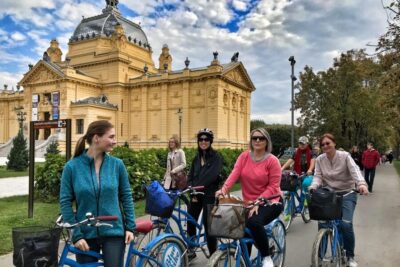
Browse the lists this tour appears in