
Reviewed · OLD TOWN WALKING TOURS
Trogir walking tour with a local guide
Trogir’s Old Town is small enough to cross on foot, yet its stone lanes pack in Romanesque churches, Venetian palaces, medieval courts, and a fortress by the sea. This walking tour gives you a useful first look, led by local guides such as Daniela, Kristina, Blanka, Michaela, and Michael, depending on the day.
I like the personal local angle, especially when guides connect old events with family stories and modern Croatian life. I also like the route’s variety: you move from Radovan’s remarkable medieval carving to a cafe-filled square, then out along the palm-lined Riva toward Kamerlengo Castle.
The main consideration is timing. The tour is advertised at about 1 hour 30 minutes, but one account describes a 60-minute finish. If you want a slow look inside every monument, this is not that kind of tour. It is a compact orientation walk.
In This Review
- Key points at a glance
- Why Trogir works so well on foot
- Starting at the city gate and Cathedral of St. Lawrence
- Radovan’s Portal in ten minutes
- John Paul II Square, Trogir’s outdoor living room
- Venetian civic life at Town Hall and the Loggia
- Cipiko Palace and Trogir’s noble families
- Smaller stories: Our Lady of Mount Carmel and Kairos
- The Riva and views toward Čiovo
- Finishing at Kamerlengo Castle
- What $18.14 buys you
- Who should book this walk?
- Should you book the Trogir walking tour?
- FAQ
- Where does the Trogir walking tour start?
- Where does the tour end?
- How long does the tour last?
- What language is the tour offered in?
- How much does the tour cost?
- How many people can join the tour?
- Are admission tickets included?
- What happens if bad weather cancels the tour?
Key points at a glance
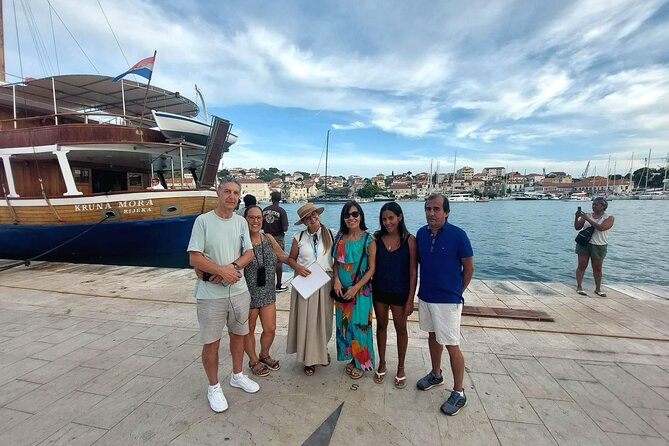
- A local introduction to Trogir: Guides such as Daniela and Kristina grew up in or near the town and add family memories to the historical account.
- A well-chosen route: You see the cathedral, main square, Town Hall, Clock Tower, Loggia, Cipiko Palace, Riva, and Kamerlengo Castle.
- Excellent value at $18.14: For less than the cost of many museum admissions, you get a guided overview of the Old Town.
- Small group size: The maximum is 15 people, which should make it easier to hear the guide in narrow streets.
- Useful early in your stay: The walk helps you decide where to return, eat, photograph, or explore at greater length.
- Outdoor sightseeing: Good weather matters, and summer heat can make the exposed sections tiring.
Why Trogir works so well on foot
Trogir sits on a tiny island between the mainland and Čiovo. Its historic center is compact, enclosed by old walls, and filled with buildings from several periods. You do not need a bus or a complicated transfer to reach the main sights. The value of a guide here comes from interpretation, not transportation.
Without context, the Old Town can feel like a beautiful maze of pale stone. With a guide, the carved portals, coats of arms, clock tower, and fortress begin to fit together. You get a basic timeline of Trogir, along with explanations of how civic life, faith, trade, plague, war, and Venetian rule shaped the place.
The local element is the strongest reason to book. Daniela is repeatedly described as someone who links Trogir’s past with her own life, including memories of growing up in town and experiences connected to the Croatian Homeland War. Kristina has also shared family history and details from her school days. These stories give the walk a human scale that a guidebook cannot quite match.
At the same time, the quality of any group tour depends on the individual guide and the pace of the day. The available guides include Daniela, Kristina, Blanka, Michaela, Mihaela, Christina, and Michael, so your experience may differ in tone. The consistent theme is a mix of historical facts, anecdotes, and local perspective.
More Old Town Walking Tours in Trogir
- Trogir: City Highlights Guided Walking Tour
★ 4.9 · 199 reviews - Trogir: Old Town Guided Walking Tour
★ 4.6 · 76 reviews - Split Old Town Walking Tour
★ 5.0 · 25 reviews
Starting at the city gate and Cathedral of St. Lawrence
The meeting point is at Ul. Gradska vrata 5, by the historic entrance to the Old Town. That is a sensible place to begin because Trogir’s gates immediately introduce the idea of a fortified island town. Bring your booking confirmation on your phone, since the activity uses a mobile ticket.
The first major sight is the Cathedral of St. Lawrence. Construction began in 1213 and continued for five centuries, which explains the building’s blend of Romanesque and Gothic forms. Its broad stone body has three naves, and its long building history mirrors Trogir’s changing fortunes.
The cathedral’s bell tower offers wide views over Trogir, Čiovo, the mainland, and the Adriatic Sea. The tour information identifies the tower as a highlight, but it does not say that tower admission is included or that the group climbs it during this walk. Ask your guide about access if the view is important to you. Do not assume the 90-minute schedule leaves time for a separate tower visit.
Radovan’s Portal in ten minutes
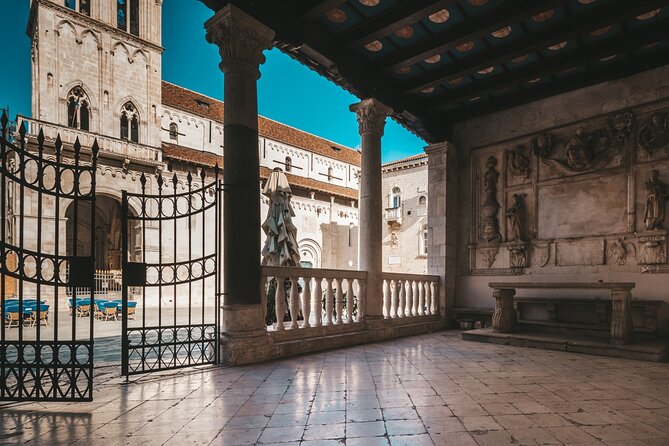
The cathedral’s main entrance is Radovan’s Portal, one of the most memorable pieces of medieval sculpture in Trogir. Master Radovan, a craftsman from medieval Trogir, carved it in the first half of the 13th century.
Look closely at the figures and the way the portal frames the doorway. This is not merely an entrance to admire from a distance. It is a rare chance to see local medieval craftsmanship presented in stone, with the sculptor’s work still forming the cathedral’s public face.
The stop is listed at about ten minutes and has no separate admission charge. That is enough for an explanation and a close look, but not for a long study of every carving. If you enjoy sculpture, make a mental note to return after the tour.
John Paul II Square, Trogir’s outdoor living room
From the cathedral, the route reaches John Paul II Square, or Trg Ivana Pavla II. This is the town’s central historic piazza, surrounded by major buildings and filled with cafe tables and umbrellas.
I like this stop because it shows Trogir as a living town, not just an open-air museum. You can sit with a coffee or ice cream and watch daily life unfold around Romanesque, Gothic, and Venetian architecture. The square is a natural place to return after the walk, especially if you want a rest in the shade.
The listed stop lasts about 15 minutes. That is enough to understand the layout and hear the guide explain the buildings around you. It is not really a cafe break, so save your order for later unless your group pauses longer than planned.
The square also gives you a useful sense of scale. Trogir’s historic core is not a huge city center. Its appeal lies in how much is gathered within a short walk, and this piazza is the best place to see that concentration at once.
Same stretch of coast, a completely different day out:
- Blue cave, Mama Mia and Hvar, 5 island speedboat tour from Trogir
★ 5.0 · 2,861 reviews - From Trogir: Three Islands Half-Day Speedboat Tour
★ 4.8 · 804 reviews - From Trogir or Split: Full-Day Blue Cave & Hvar Island Tour
★ 4.7 · 413 reviews - Half Day Speedboat Tour to Three Islands from Trogir
★ 5.0 · 401 reviews
Venetian civic life at Town Hall and the Loggia

The next section focuses on the buildings that once handled public business.
Trogir’s Town Hall dates from the 15th century. Its stone courtyard is decorated with coats of arms, while the exterior staircase is a fine example of Venetian architecture. The staircase is easy to miss if you are moving quickly through the streets, which is exactly why a guide helps here.
The stop is listed at ten minutes, with no separate admission fee. You may see the courtyard from outside, but the supplied details do not promise interior access. Treat the building as an architectural stop rather than a full museum visit.
Nearby, St. Sebastian’s Church and Clock Tower tell a different story. The church was built in 1476 after the people of Trogir were spared from the plague. Its architect was Niccolò di Giovanni Fiorentino, also known in English as Nicolas of Florence.
That detail links St. Sebastian’s Church with another building on the route, Cipiko Palace. The town’s artists and architects worked across several important projects, and a good guide can help you notice those connections instead of viewing each monument as an isolated stop.
The Town Loggia is a covered public space beside the Clock Tower. In earlier centuries, people gathered there to discuss local matters. The court also met there on certain days to proclaim laws and hear cases.
This is one of the most useful places for understanding how a medieval and Venetian town functioned. It was not just decoration. It was a meeting place, courthouse, and stage for public announcements. The stop lasts about ten minutes and is free to visit.
Cipiko Palace and Trogir’s noble families

The Great Cipiko Palace is a group of Romanesque buildings that were remodeled between the 15th and 17th centuries. The renovation gave the complex its Venetian Renaissance appearance.
Niccolò di Giovanni Fiorentino also worked here, including the palace’s south portal. After seeing his work at St. Sebastian’s Church, you have a clearer reason to pay attention to the palace entrance. This is a small but satisfying thread running through the walk.
The scheduled stop is only about five minutes. That tells you how the tour is designed: you receive the story and see the key exterior features, then keep moving. If you want detailed architectural study, you will need a return visit.
The route also includes the Garagnin-Fonfogna Museum, housed in a group of palaces once owned by the Venetian Garagnin-Fonfonja family. It is located near the North Gate, one of the two principal historic entrances through the old walls.
The museum is mentioned as part of the sightseeing route, but admission is not listed among the included tickets. The information also does not specify an interior visit. Ask the guide if the museum is open and if you have time to enter independently. Do not plan on a full museum tour during this short walk unless that is confirmed.
Smaller stories: Our Lady of Mount Carmel and Kairos
The Church of Our Lady of Mount Carmel sits near the waterfront in the western part of the Old Town. Founded in the Middle Ages, it was historically connected with Trogir’s fishermen, craftsmen, and laborers.
This stop adds social texture. The grand cathedral and palaces tell you about bishops, nobles, and civic power. Our Lady of Mount Carmel points toward the working people who made their lives by the sea and through local trades.
If you are in Trogir on July 16, the church has a traditional evening procession with a statue of Our Lady. The walking tour itself is not described as including that event, so you would need to return on your own.
Another brief story concerns Kairos, a young man shown in bas-relief standing on tiptoe with wings ready to carry him away. He holds scales, has a long lock of hair at his forehead, and is bald at the back of his head.
The lesson is simple: seize the right moment by the forelock, because once Kairos flies past, there is nothing to grab. It is a memorable bit of symbolism to encounter in a town filled with serious stone monuments, and it gives the walk a touch of humor and folklore.
The Riva and views toward Čiovo

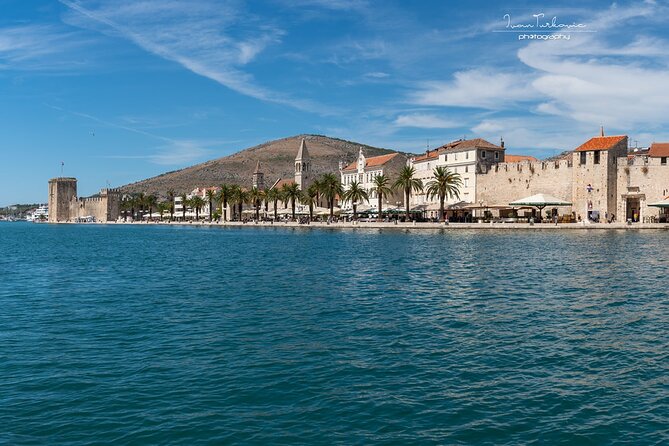
The route then opens onto the Riva, Trogir’s waterfront promenade. It is wide, flat, and straight, with palm trees and views across the channel to Čiovo.
After the close lanes of the Old Town, this change of space feels welcome. You can see how Trogir relates to the water, and you get a better impression of the town’s island setting. The stop is scheduled for about ten minutes and is free.
This is also the most exposed part of the route. One account describes the walk as very hot, so bring water, wear comfortable shoes, and consider booking a morning or later-day departure if you have a choice. The tour is offered in English, but the listing does not provide a specific start time.
The Riva works well for photographs, though you should keep the timing in mind. A short group stop gives you the view and the explanation. It does not guarantee a long pause for photography or sitting by the water.
Finishing at Kamerlengo Castle

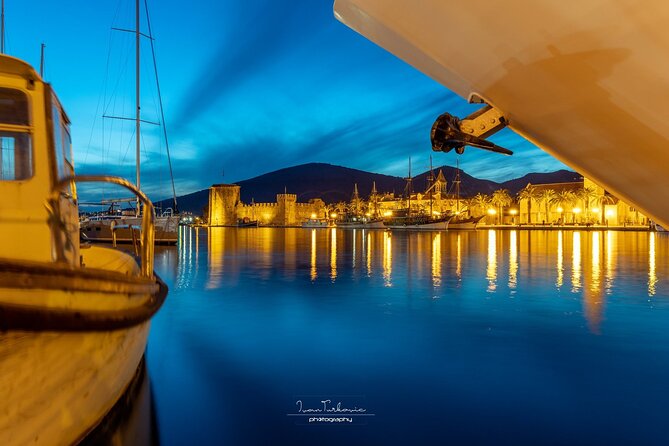
The walk ends near Obala bana Berislavića, at the waterfront, close to Kamerlengo Castle. The fortress dates from the early 15th century and occupies the end of Trogir’s promenade, on the corner of the small island holding the Old Town.
The area around the castle also includes a local football pitch, a small children’s playground, and stalls operated by local tour companies. That mix gives the ending a more ordinary feel. You are not leaving at a grand ceremonial gate, but near a part of town used for recreation and local business.
The information does not state that castle admission is included. The castle is therefore best treated as an exterior landmark during the guided walk unless your guide confirms otherwise. If you want to explore inside, ask about opening hours and extra cost before the tour finishes.
Ending here is practical. You can continue along the waterfront, return into the Old Town, or use the tour as a springboard for your own plans. The route does not loop back to the starting gate, so note the separate meeting and end points.
What $18.14 buys you
At $18.14 per person, this is a good-value orientation tour if you use it as an introduction rather than a complete historical visit. You get a local guide, an English-language walk, and a route through many of Trogir’s main sights. The listed stops do not carry separate admission charges, though interior visits to the cathedral tower, museum, or castle are not clearly included.
The small maximum of 15 people matters. Trogir’s lanes can be tight, and a large group would make it harder to stay together and hear the guide. Fifteen is still a group, but it is manageable.
The price also makes sense for a first morning or afternoon in town. You can learn the basic layout, hear which buildings deserve a second look, and then spend the rest of your time choosing your own pace.
I would not book this expecting a long lecture at every monument. The route covers a lot in about 90 minutes, and one reported experience lasted only an hour. That may be fine if you prefer a brisk introduction, but it is worth noting if your priority is detailed interior access.
Who should book this walk?
This tour suits you if you are visiting Trogir for the first time, have limited time, or want local context before exploring alone. It is also a good fit for families and mixed-age groups because the route is short and the guides use stories alongside dates and names.
The personal approach may appeal to you if you want more than a list of architectural facts. Guides have connected Trogir’s monuments with family roots, school memories, local culture, and Croatia’s recent past. That blend can make the town easier to understand.
It may be less suitable if you dislike group pacing or want to spend long periods inside churches and museums. You should also think carefully about heat, since much of the walk is outdoors and the Riva offers little protection from the sun.
The activity requires good weather. If poor weather causes cancellation, you are offered another date or a full refund. Otherwise, the booking is non-refundable and cannot be changed, so choose your date carefully.
Should you book the Trogir walking tour?
I would book it early in a Trogir stay, especially if you want a friendly local introduction before deciding how to spend the rest of your time. Daniela, Kristina, Blanka, Michaela, Mihaela, Christina, and Michael have each been praised for combining clear historical explanations with warmth and personal stories.
The strongest reason to choose this walk is not simply the number of sights. It is the chance to hear Trogir explained by someone connected to the town. At $18.14, that is a fair trade for a compact route through the cathedral, central square, civic buildings, Riva, and fortress.
Just keep your expectations realistic. Think of it as a well-priced orientation with local character, not a full museum tour. If that matches your plans, it is an easy recommendation.
FAQ
Where does the Trogir walking tour start?
The tour starts at Ul. Gradska vrata 5, 21220 Trogir, Croatia, near a historic entrance to the Old Town.
Where does the tour end?
The walk ends at Obala bana Berislavića, near Trogir’s waterfront.
How long does the tour last?
The listed duration is approximately 1 hour 30 minutes. One account describes the walk ending after 60 minutes, so the actual duration may vary.
What language is the tour offered in?
The tour is offered in English.
How much does the tour cost?
The listed price is $18.14 per person.
How many people can join the tour?
The maximum group size is 15 people.
Are admission tickets included?
The listed stops show no separate admission charge. However, the information does not confirm interior admission to the cathedral tower, Garagnin-Fonfogna Museum, or Kamerlengo Castle.
What happens if bad weather cancels the tour?
The activity requires good weather. If it is canceled because of poor weather, you are offered a different date or a full refund. Otherwise, the experience is non-refundable and cannot be changed.
More Walking Tours in Trogir
- Private Trogir walking tour with LOCAL guide
★ 4.8 · 23 reviews - Discover Trogir: Guided Walking Tour of a Medieval Gem
★ 5.0 · 13 reviews - Dubrovnik: Old Town Walking Tour
★ 4.8 · 5,174 reviews - Split: Old Town and Diocletian Palace Walking Tour
★ 4.9 · 4,727 reviews
Just added around Trogir
- Split: Private tour to Salona, Vitturi castle and Trogir★ 5.0 · 6 reviews
- Private Trogir walking tour with LOCAL guide★ 4.8 · 23 reviews
- Private tour from Split area: Trogir and Krka National Park★ 5.0 · 7 reviews
- From Trogir Day sailing (private tour)★ 5.0 · 4 reviews
- From Trogir, Seget & Okrug: Krka Waterfalls & Swimming★ 4.8 · 25 reviews
- From Trogir: 3 islands half day tour with Blue Lagoon★ 4.9 · 26 reviews
- From Split: Blue Lagoon & Trogir Boat Trip with Snorkeling★ 5.0 · 5 reviews
- From Split: 3 Islands Half-Day Boat Tour with Blue Lagoon★ 4.9 · 6 reviews
Old Town Walking Tours, compared.
Walking Tour of Split and Diocletian’s Palace
Read our review →
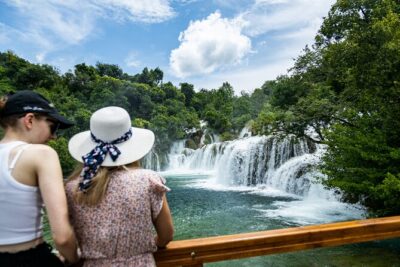
Krka Waterfalls tour with Trogir Walking tour and Krka panoramic boat cruise
Read our review →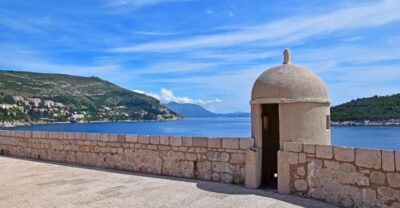
City Walls Early Morning or Sunset Walking Tour
Read our review →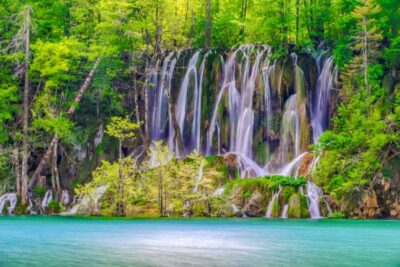
Plitvice Lakes with Boat Ride and Zadar Old Town Tour
Read our review →Browse the lists this tour appears in