
Reviewed · OLD TOWN WALKING TOURS
Old Town Secrets Walking Tour
Dubrovnik’s Old Town is easy to admire and surprisingly easy to misunderstand. This one-hour walk gets past the postcard views, using Pile Gate, the main street, palace buildings, and the cathedral to explain how a small fortified republic protected itself, governed itself, and survived war. The unusual details are the fun part: a pharmacy with centuries of working history, a cathedral filled with objects linked to Richard the Lionheart, and a political system with a rather odd beginning.
I like the private format, which gives your group room to ask questions instead of following a guide’s fixed speech. I also like the early 9 a.m. option mentioned in the tour information, especially during Dubrovnik’s hot months. Davor is described as well-versed in local history and happy to explain details, which suits this walk’s story-heavy design.
The main drawback is its short length. One hour goes quickly, and this tour gives you an introduction rather than a full exploration of Dubrovnik’s walls, museums, or churches. The price is also much better for a group of several people than for one or two.
In This Review
- Key points to know before booking
- What this Dubrovnik walk is really designed to do
- Pile Gate: Dubrovnik’s defensive first impression
- Stradun: the main street with stories in the stone
- Luza Square: politics, ceremony, and city rivalry
- Rector’s Palace: power with an odd beginning
- The cathedral: relics, Richard the Lionheart, and surprising details
- Davor’s guiding style and the value of a private group
- Is $239.65 a fair price?
- Who will get the most from this walk?
- Should you book Old Town Secrets?
- FAQ
- Where does the Old Town Secrets Walking Tour start?
- Where does the tour end?
- How long does the tour last?
- What language is the tour offered in?
- How many people can join the private tour?
- Who guides the tour?
- What places are included on the route?
- Are admission tickets included?
- Can I cancel for a refund?
Key points to know before booking
- A private walk for up to 10 people: Your group has the guide to itself, with no larger tour crowd mixed in.
- Five central Old Town stops: The route covers Pile Gate, Stradun, Luza Square, Rector’s Palace, and the Cathedral of the Assumption.
- History beyond medieval scenery: Expect discussion of the Croatian Independence War, damage to the Old Town, political rivalries, customs, and local legends.
- A useful one-hour introduction: The compact route helps you get oriented before exploring Dubrovnik on your own.
- English-language guiding by Davor: The guide’s strength is explaining both major events and small local stories.
- A group price, not a per-person fare: At $239.65 for as many as 10 people, the value depends heavily on your group size.
What this Dubrovnik walk is really designed to do
This is an orientation walk, not a museum tour or an extended history course. You move through the heart of the Old Town while the guide links buildings and public spaces to the city’s past.
That approach works well in Dubrovnik because the streets themselves are the exhibit. A fountain can explain medieval engineering. A church can lead to a story about local customs. A palace can reveal how the republic handled power, money, imprisonment, and public life.
The route lasts about one hour and covers five stops. The listed time at each stop adds up to the full tour: ten minutes at Pile Gate, fifteen on Stradun, fifteen at Luza Square, ten at Rector’s Palace, and ten at the cathedral.
You should expect a brisk but manageable walk through the central Old Town. The tour does not promise a climb onto the city walls, a cable-car ride, or extended interior visits. The focus is on seeing key sites and hearing the stories that make them easier to understand.
More Old Town Walking Tours in Dubrovnik
- Dubrovnik: Old Town Walking Tour
★ 4.8 · 5,174 reviews - Dubrovnik Discovery Old Town Walking Tour
★ 5.0 · 4,458 reviews - Dubrovnik: Game of Thrones Walking Tour
★ 5.0 · 1,732 reviews
Pile Gate: Dubrovnik’s defensive first impression
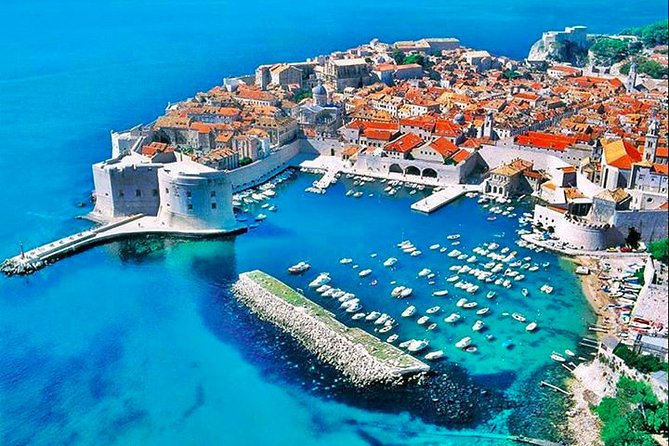
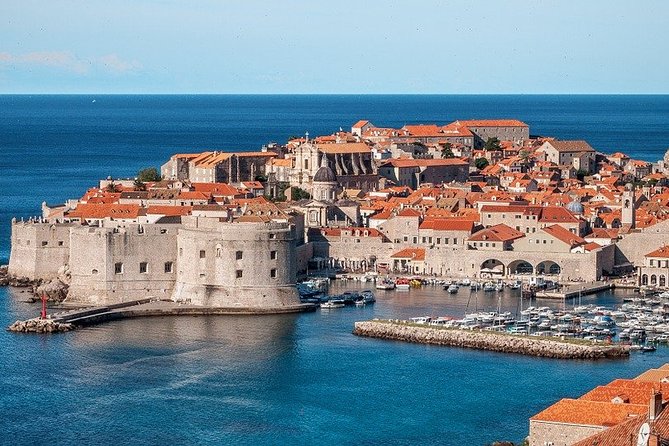
The walk begins at the Amerling Fountain on Ul. Svetog Đurđa, close to the Pile Gate area. From there, the guide explains the space between the outer and inner gates and the defensive system that helped make Dubrovnik one of Europe’s most heavily fortified cities.
This is a smart starting point. Before you look at palaces and churches, you learn why the city was built to control movement. Gates, walls, and narrow entrances were not decoration. They were the practical tools of a small maritime republic surrounded by larger powers.
The stop also brings the city’s modern past into view. A map shows damage suffered by the Old Town during the siege in the 1990s, followed by a short account of the Croatian Independence War.
That subject gives the tour useful balance. Dubrovnik can sometimes look like a perfectly preserved medieval stage set, but its buildings were not untouched by recent events. Seeing the damage marked on a map helps you understand that restoration is part of the city’s present story.
You spend about ten minutes here. That is enough for context, but not enough for a detailed military history. If you want a full account of the war or Dubrovnik’s fortifications, you will need more time elsewhere.
Stradun: the main street with stories in the stone
The route continues along Stradun, Dubrovnik’s main street. This is the longest stop, at about fifteen minutes, and it packs several landmarks into a short stretch.
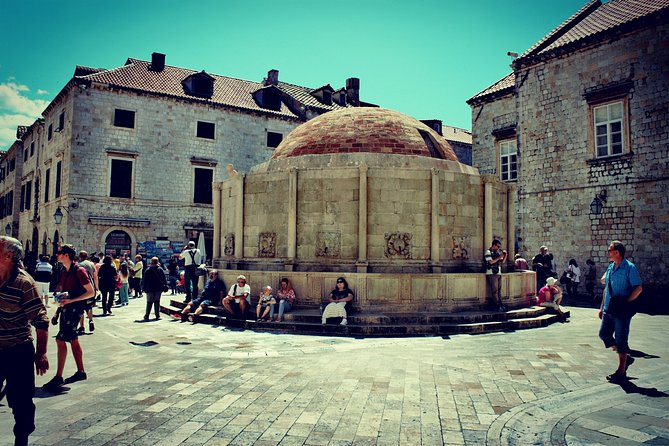
You hear about St. Saviour’s Church, the Franciscan Monastery, and Onofrio’s Fountain. Each site offers a different way into the city’s past.
The Franciscan Monastery is especially useful for understanding how daily life and religious life overlapped. Its pharmacy is described as one of the oldest still working in the world. That detail gives the building a practical connection to the people who lived here, rather than leaving it as another handsome church facade.
Onofrio’s Fountain offers a look at medieval engineering. In a city where water supply mattered greatly, a fountain was an essential public service as well as an architectural feature. The guide connects the fountain with old customs and stories, so you get both the public function and the human side of the place.
St. Saviour’s Church adds another architectural marker along the street. The guide’s role here is not simply to name the building, but to explain what you are looking at and attach it to local stories and legends.
Stradun is also the busiest-feeling part of the central route. The tour is private, but the street itself is public and can be active. Stay close enough to hear Davor, particularly if your group is spread out while looking at the buildings.
Luza Square: politics, ceremony, and city rivalry
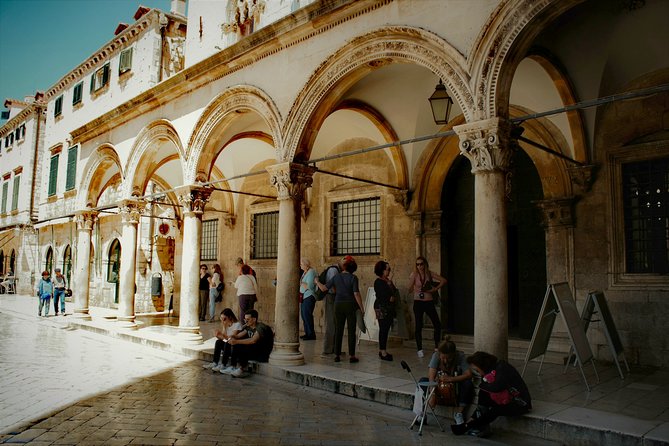
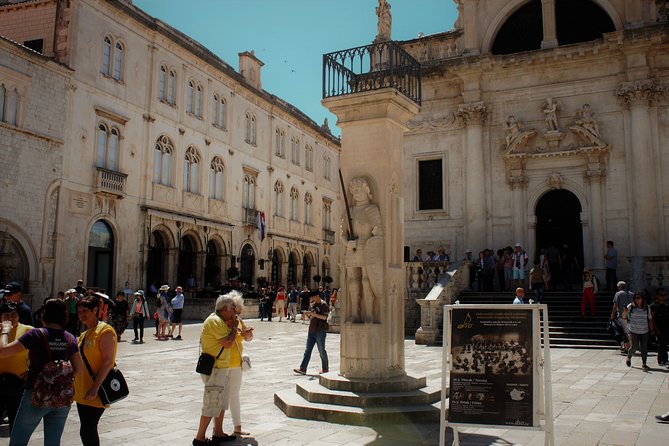
Luza Square is the center of Dubrovnik’s Old Town and the longest stop on the route, also lasting about fifteen minutes. It gathers several major buildings in one place: Sponza Palace, the Clock Tower, St. Blaise’s Church, and the Old Parliament Building.
This is where the tour shifts from defense and daily life to government. The square witnessed major events in Dubrovnik’s past and remains connected with the city’s administration. The surrounding buildings date from the fifteenth through the eighteenth centuries, so the square also gives you a quick lesson in changing architectural styles.
The more unusual material here concerns rivalry, bribery, and the mechanics of public life. That is valuable because political history is often reduced to dates and rulers. Stories of competition and corruption make the old republic feel like a place run by actual people, with ambition, compromise, and the occasional questionable payment.
Sponza Palace is a particularly good anchor for the discussion. Its presence beside other civic and religious buildings shows how closely trade, government, faith, and ceremony were tied together in the Old Town.
The Clock Tower and St. Blaise’s Church help you read the square as a public stage. The buildings were not placed together by accident. They framed the place where the city marked time, expressed devotion, handled administration, and gathered for important events.
If you enjoy political stories, this may be the strongest section of the walk. If architecture is your main interest, it is also a useful stop because the guide points out several significant buildings without sending you across the city.
Same stretch of coast, a completely different day out:
- Blue Cave Small-Group Boat Tour from Dubrovnik
★ 5.0 · 9,360 reviews - Full-Day Dubrovnik Elaphite Islands Cruise with Lunch and Drinks
★ 5.0 · 8,823 reviews - Dubrovnik: Epic Game of Thrones Tour + Lokrum & Saver Option
★ 4.9 · 5,995 reviews - Dubrovnik: Elaphiti Islands Full-Day Cruise with Lunch
★ 5.0 · 5,938 reviews
Rector’s Palace: power with an odd beginning
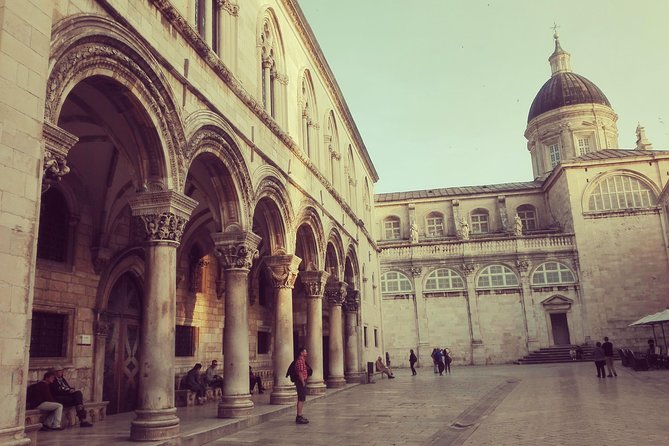
Rector’s Palace receives about ten minutes, but its subject is large. This was a center of power, a prison, a treasury, and an architectural statement all at once.
The guide explains the palace’s unusual origin story and the unlikely system used to govern Dubrovnik. That combination gives the stop its appeal. You are not only looking at an elegant building. You are learning how the city tried to limit individual power while still placing authority in the hands of a rector.
The palace’s several roles also show how compact the republic was. Government offices, money, confinement, and ceremony existed within a concentrated civic center. The building was practical, political, and symbolic at the same time.
The phrase ridiculous inception story in the tour description hints at a lighter presentation. That matters in a short walk. Davor’s style, based on the available information, includes anecdotes and humor alongside serious history, so the palace should not feel like a dry lecture.
Ten minutes is enough to understand the building’s importance and hear its central story. It is not enough for a full palace visit, detailed art discussion, or careful tour of every room. Treat this as a preview that may help you decide if you want to return for more.
The cathedral: relics, Richard the Lionheart, and surprising details
The final stop is the Cathedral of the Assumption of the Virgin Mary. It receives about ten minutes and closes the walk with a mix of faith, treasure, legend, and civic identity.
One memorable detail is that the cathedral is adorned with many statues, but none of them is Mary. That is the kind of observation you might miss while taking photographs. It gives you a specific detail to look for and a reason to pay closer attention to the facade and interior features visible during the stop.
The cathedral also holds priceless objects, kept within its walls for purposes that may not be obvious at first glance. The guide explains those uses along with stories about Richard the Lionheart and theories concerning Dubrovnik’s origins.
This is a good final stop because it gathers several themes from the walk. Dubrovnik’s religious buildings were places of worship, but they also held wealth, preserved memory, and carried stories about the city’s place in the wider world.
As with the other stops, the itinerary lists no admission charge for the stop itself. Still, the experience is presented as a guided look at the cathedral rather than a long, independent visit. If you want to study every object or spend quiet time inside, plan to return separately.
Davor’s guiding style and the value of a private group
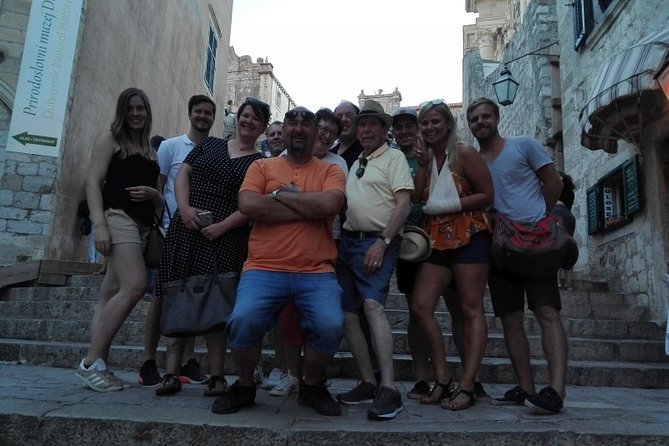
Davor is the named guide associated with the tour, and the strongest praise centers on his ability to explain Dubrovnik’s complex past, answer questions, and add local anecdotes. You should expect a guide who is comfortable discussing details rather than sticking only to a memorized list of dates.
That matters on a private walk. If your group wants to ask about the Croatian Independence War, the Old Parliament Building, an old custom, or the city’s government, you have a better chance to shape the conversation around your interests.
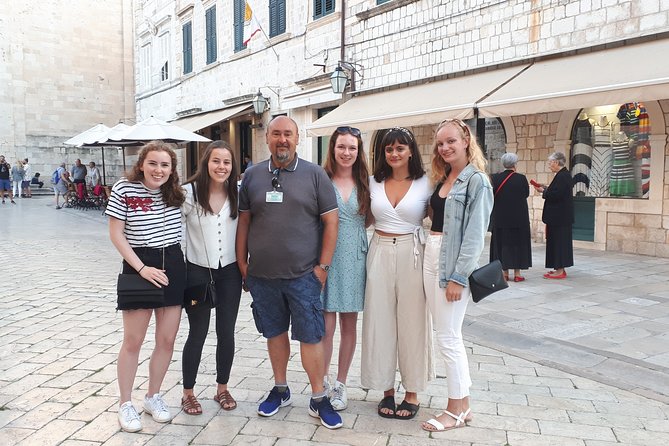
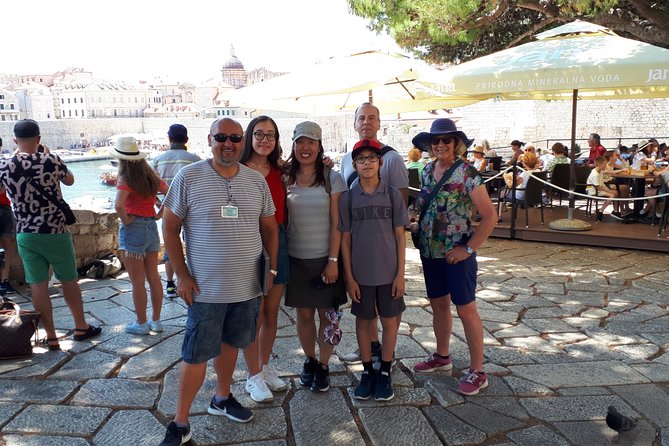
The booking limit is ten people, and only your group participates. For a family, a group of friends, or a small cruise-party outing, that can make the hour feel more personal and less hurried than a large public tour.
The private setup does not guarantee unlimited time at each stop. The route still lasts about one hour, and the guide has five main places to cover. You will get the most from it if you ask questions as you go and decide in advance which subjects matter most to your group.
One useful detail from the tour’s customer feedback is the mention of a 9 a.m. start. That early time can help you avoid the strongest heat of the day. It also lets you use the rest of your morning for a museum, the walls, or independent wandering.
Is $239.65 a fair price?
The listed price is $239.65 per group of up to 10 people. That makes the cost about $23.97 per person if ten people join, or about $119.83 each for a pair.
Those numbers show why group size matters. For a full group, the price is reasonable for a private English-language introduction with a named guide and a central route. For two people, it becomes a much bigger purchase for only one hour.
I would consider it better value if you are traveling with several relatives or friends who want the same guide and schedule. It is also useful when your group values questions and a private setting more than the lowest possible price.
The short duration is the main limit on value. You are paying for focused orientation and local explanation, not a long tour with multiple admissions. The listed stops have free admission, so the price goes toward the guide and the private format rather than entry tickets.
Who will get the most from this walk?
I would choose this tour if you want a fast introduction to Dubrovnik before exploring on your own. The route covers the places most people encounter first, while adding political and wartime context that you might not pick up from a casual stroll.
It suits people who enjoy stories about government, defense, religion, architecture, and local customs. It also works for groups that prefer to ask questions instead of listening silently in a large crowd.
The tour may be less suitable if you want to spend most of your time inside buildings, climb the city walls, or examine art in detail. Those activities are not part of the stated route.
It is also worth thinking about the price if you are only two people. A public walking tour may cost less, though this private option gives you control over the group and the conversation.
The tour is offered in English, and confirmation is provided when you book. It is near public transportation, service animals are allowed, and most people can participate. The meeting point is the Amerling Fountain, and the walk ends on Stradun, which is convenient for continuing your day in the Old Town.
Free cancellation is available up to 24 hours before the start time for a full refund. Changes or cancellations inside that 24-hour window are not accepted, and the local start time controls the cut-off.
Should you book Old Town Secrets?
Book it if you want a private, story-led introduction to Dubrovnik and your group has enough people to make the price work. Davor’s focus on anecdotes, questions, and complicated local history gives the hour more substance than a simple building-by-building walk.
The best plan is to book the 9 a.m. departure if it suits your schedule, then use the rest of the day to revisit the cathedral, Rector’s Palace, or another site that caught your attention. Skip it if you want a longer tour, wall access, or extensive interior visits.
For a full group of friends or family, this is a sensible way to get your bearings and understand what you are seeing. For a couple on a tight budget, the one-hour private format may be harder to justify.
FAQ
Where does the Old Town Secrets Walking Tour start?
It starts at the Amerling Fountain on Ul. Svetog Đurđa in Dubrovnik, near Pile Gate.
Where does the tour end?
The walk ends on Stradun in Dubrovnik’s Old Town.
How long does the tour last?
The tour lasts approximately one hour.
What language is the tour offered in?
The tour is offered in English.
How many people can join the private tour?
A booking can include up to 10 people, and only your group participates.
Who guides the tour?
Davor is the guide named in the tour information. He leads the walk through Dubrovnik’s history, landmarks, anecdotes, and local customs.
What places are included on the route?
The route includes Pile Gate, Stradun, Luza Square, Rector’s Palace, and the Cathedral of the Assumption of the Virgin Mary.
Are admission tickets included?
The listed stops show free admission. The experience is a guided walk through the Old Town, and no separate paid admission is identified in the tour details.
Can I cancel for a refund?
Yes. You can cancel at least 24 hours before the experience starts for a full refund. Cancellations or changes made less than 24 hours before the start time are not accepted for a refund.
More Walking Tours in Dubrovnik
- Dubrovnik Old Town History Walking Tour
★ 5.0 · 1,684 reviews - Dubrovnik: City Walls Early Morning or Sunset Walking Tour
★ 4.8 · 1,523 reviews - Dubrovnik: Ancient City Walls & Wars Walking Tour
★ 5.0 · 1,270 reviews - Dubrovnik: Game of Thrones Walking Tour
★ 4.9 · 981 reviews
Just added around Dubrovnik
- Elaphiti Islands Private Dubrovnik Boat Unique Experience★ 5.0 · 10 reviews
- Full- Day Private Speedboat Tour in Dubrovnik on Elaphiti Islands★ 5.0 · 21 reviews
- PRIVATE Wine Tour to Konavle country side★ 5.0 · 11 reviews
- Parasailing in Cavtat★ 5.0 · 62 reviews
- Wine tour peninsula Pelješac★ 5.0 · 3 reviews
- Wine Lover’s Tour of Peljesac Peninsula★ 5.0 · 150 reviews
- Welcome to Dubrovnik Walking Tour★ 5.0 · 36 reviews
- Dubrovnik at War 1991-1992 Private Walking Tour★ 5.0 · 4 reviews
Old Town Walking Tours, compared.



Walking Tour of Split and Diocletian’s Palace
Read our review →


Krka Waterfalls tour with Trogir Walking tour and Krka panoramic boat cruise
Read our review →
City Walls Early Morning or Sunset Walking Tour
Read our review →
Plitvice Lakes with Boat Ride and Zadar Old Town Tour
Read our review →Browse the lists this tour appears in