
Reviewed · OLD TOWN WALKING TOURS
Dubrovnik Old Town Walking Tour
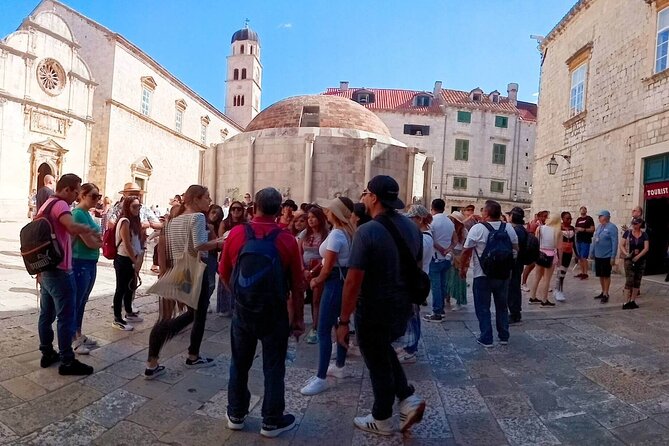
Dubrovnik’s story begins before you pass through its famous walls. This 90-minute walk starts near Pile Gate, with views toward Fort Lovrijenac and Bokar, then follows the old city’s water system, pharmacy, churches, harbor, and grand civic buildings. You get the city’s basic map and story in one compact outing.
I like the focus on local details, especially Onofrio’s Fountain and the Franciscan monastery pharmacy, rather than only the usual postcard views. I also like the small maximum group of 16, plus the choice of morning or afternoon departures. The main drawback is sound: several people found the guide hard to hear in crowded streets, and no listening devices are provided.
In This Review
- Key points to know before booking
- Starting outside the walls at Pile Gate
- Understanding life in the Republic of Ragusa
- Onofrio’s Fountain and Dubrovnik’s water supply
- The Franciscan pharmacy and the city’s medical past
- Stradun, St. Ignatius, and the Cathedral
- Film locations without letting them take over
- The Old Town harbor and the city’s changing fleet
- Luža Square, the Rector’s Palace, and St. Blaise
- How the 90-minute pace feels
- Group size, sound, and guide style
- What the $30.04 price buys you
- Who should book this Dubrovnik walk?
- Should you book it?
- FAQ
- Where does the Dubrovnik Old Town Walking Tour begin?
- Where does the tour finish?
- How long does the walking tour last?
- What language is the tour offered in?
- Is entry to the City Walls included?
- Do the tour stops include church or museum interiors?
- What is included in the price?
- What is the maximum group size?
- Can I cancel for a full refund?
Key points to know before booking
- Enter through Pile Gate with views of two fortresses: The walk begins outside the walls, giving you useful bearings before the narrow streets begin.
- See major sights without paying separate entrance fees: The tour passes the fountain, churches, Cathedral, harbor, palaces, bell tower, and Stradun, but does not include entry inside museums or the City Walls.
- Expect a history-heavy walk: You’ll hear about the Republic of Ragusa, daily life, medicine, trade, and Dubrovnik’s changing fleet.
- Guides are the heart of the experience: Dorotea and Enis have been singled out for warmth, humor, clear storytelling, and practical recommendations.
- Plan for heat and crowd noise: Morning may be more comfortable, while a smaller group makes it easier to hear.
- Finish at Luža Square: You can continue along Stradun independently after the formal tour ends.
Starting outside the walls at Pile Gate

The meeting point is the Amerling Fountain on Ul. Svetog Đurđa, near the Pile area. This is a sensible place to start because Dubrovnik’s main western entrance is not just a gateway. It is the point where the modern city gives way to the old fortified town.
Before entering, your guide introduces the view outside the walls. Fort Lovrijenac rises on its rocky position near the sea, while Bokar helps protect the western approach. You get a quick sense of why Dubrovnik was difficult to attack before you begin walking through its streets.
This opening also helps you avoid a common problem in Dubrovnik: entering the Old Town without knowing which direction to take. The city can feel like a maze at first, especially when cruise crowds fill the main route. A short explanation outside the walls gives you a mental map before the tour moves indoors, so to speak, into the stone lanes.
The first stop is brief, listed at about five minutes. Do not expect a long fortress visit. The value is the setting and orientation, not admission to the fortifications.
More Old Town Walking Tours in Dubrovnik
- Dubrovnik: Old Town Walking Tour
★ 4.8 · 5,174 reviews - Dubrovnik Discovery Old Town Walking Tour
★ 5.0 · 4,458 reviews - Dubrovnik: Game of Thrones Walking Tour
★ 5.0 · 1,732 reviews
Understanding life in the Republic of Ragusa
Once inside Pile Gate, the tour shifts from views to the way Dubrovnik functioned as a small maritime republic. The Republic of Ragusa controlled its affairs through diplomacy, trade, laws, and careful use of its position on the Adriatic.
You’ll hear about ordinary life as well as grand politics. That balance matters. Dubrovnik is easy to admire as a polished medieval city, but a guide can explain how water, medicine, shipping, religion, and government shaped daily routines behind the walls.
The walk uses side streets on the way toward the Cathedral. These lanes offer a break from Stradun, the broad central street, and let you see how the Old Town is arranged away from its most photographed route. The group remains on foot throughout, so comfortable shoes are important. The supplied information calls for a moderate level of physical fitness, and the streets can be tiring in summer heat.
Onofrio’s Fountain and Dubrovnik’s water supply

Onofrio’s Fountain is one of the best early stops because it connects architecture with a practical need. It served as Dubrovnik’s main source of drinking water until the beginning of the 20th century.
The fountain is not simply a decorative landmark. It points to the challenge of supporting a dense settlement inside fortified walls. Water had to be brought into the city and distributed reliably, making the fountain part of Dubrovnik’s civic infrastructure.
Your guide stops here for about five minutes. That is enough to explain its purpose and place in city life, though not enough for a detailed architectural study. If this is the part of Dubrovnik that catches your interest, note the location so you can return later at your own pace.
This stop also shows why a guided walk can be worth more than a quick self-guided circuit. Without context, a fountain may be just a fountain. With the story, you see it as a piece of the city’s survival system.
The Franciscan pharmacy and the city’s medical past
The route passes the Franciscan monastery and its old pharmacy, described as the oldest functioning pharmacy in the world. The guide explains how the Franciscans developed medicine and how the monastery became linked with care and treatment.
You should know that the tour does not plan visits inside churches or museums. The pharmacy is part of the exterior walking route rather than a guaranteed interior visit. That keeps the tour moving, but it also means you will not get a museum-style look at objects or rooms.
Still, this is an unusually human detail in the itinerary. Dubrovnik’s walls, palaces, and churches can make the city feel like a collection of monuments. The pharmacy brings the focus back to health, religious institutions, and the practical needs of people living in a crowded port town.
Same stretch of coast, a completely different day out:
- Blue Cave Small-Group Boat Tour from Dubrovnik
★ 5.0 · 9,360 reviews - Full-Day Dubrovnik Elaphite Islands Cruise with Lunch and Drinks
★ 5.0 · 8,823 reviews - Dubrovnik: Epic Game of Thrones Tour + Lokrum & Saver Option
★ 4.9 · 5,995 reviews - Dubrovnik: Elaphiti Islands Full-Day Cruise with Lunch
★ 5.0 · 5,938 reviews
Stradun, St. Ignatius, and the Cathedral

The route includes Stradun, Dubrovnik’s main street, although the formal tour does not end there. Stradun is the place to understand the city’s grand public face. Its broad, straight line contrasts with the smaller side streets you have just used.
The stop at Stradun is short, about five minutes. That is enough for orientation and photographs, but you should save time to walk it again after the tour. The guide finishes at Luža Square, from which you can continue along Stradun independently.
The Church of St. Ignatius is another brief exterior stop. The same is true of the Cathedral of the Assumption of the Virgin Mary. These buildings add religious and artistic context to the walk, but you should not book this experience expecting interior visits or extended art commentary.
That limitation is clear and useful. If you want to examine church interiors, attend services, or spend time with paintings and relics, plan separate visits after the walk. This tour is designed to connect the main sights, not replace every museum or monument visit.
Film locations without letting them take over
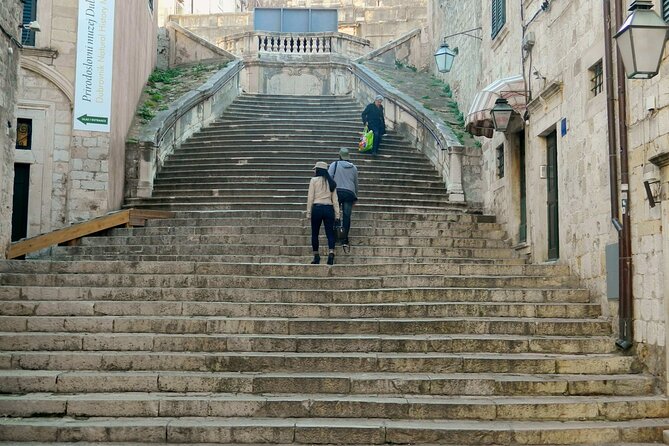
Dubrovnik has served as a filming location for Game of Thrones, Robin Hood, and Star Wars. Your guide points out some of these places along the way.
This is a useful extra, especially if you recognize the settings. Yet the tour does not appear to be built only for film fans. The main focus remains Dubrovnik’s own past, with filming locations added as a modern layer.
That balance makes the activity suitable for mixed groups. One person can enjoy the Republic of Ragusa and the fortifications, while another gets a kick out of recognizing a screen location. You’ll get the most from this section if you treat the film references as landmarks that help you remember the route, not as the main subject.
The Old Town harbor and the city’s changing fleet
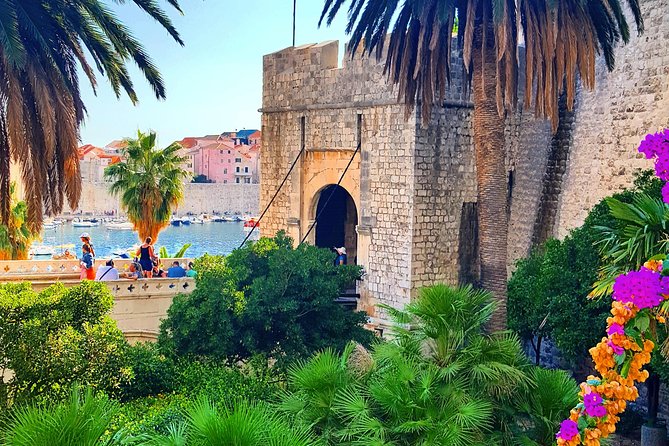
The walk continues toward the Old Town harbor, where your guide explains how modern ships took over from the traditional wooden galley.
This is a strong stop because it links Dubrovnik’s past with its present. The harbor was not only a pretty view. It was part of the city’s working life, tied to trade, defense, and travel across the Adriatic.
The stop lasts about ten minutes, longer than several of the church and palace views. You’ll have more time here to understand the change from sailing vessels to the modern fleet. The contrast also helps explain why Dubrovnik can feel both historic and active at the same time.
The harbor is an open area, so conditions may affect comfort. On hot days, shade becomes important. One account of the walk praised Dorothea for keeping the group in the shade when possible during temperatures of 36 degrees Celsius. That kind of practical care can make a real difference, though shade is not guaranteed.
Luža Square, the Rector’s Palace, and St. Blaise

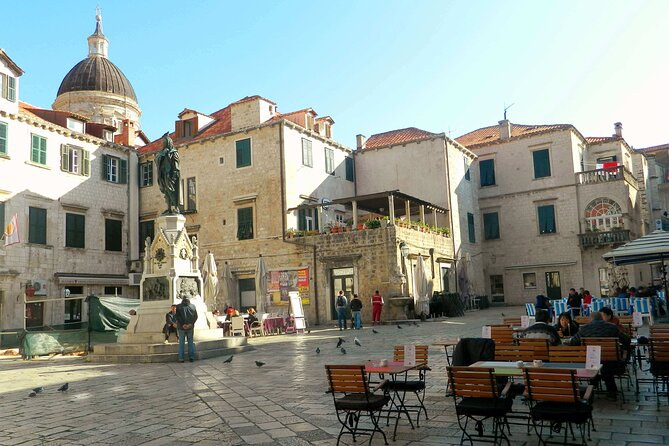
The formal walk finishes on Luža Square, a useful central point surrounded by some of Dubrovnik’s most recognizable buildings. Here you’ll learn about the Rector’s Palace, St. Blaise’s Church, and Sponza Palace.
The Rector’s Palace represents the old political center of the city. You walk by it rather than go inside, so the guide’s explanation gives you the building’s role and setting without turning the tour into a museum visit.
St. Blaise’s Church is dedicated to Dubrovnik’s patron saint and gives the square a strong civic and religious focus. Sponza Palace adds another side of public life, tied to administration, commerce, and the city’s institutions.
The bell tower is also included as a brief exterior stop. These final sights come quickly, so listen for the connections between them. The point is not to spend fifteen minutes at each building. It is to show how government, religion, trade, and public ceremony were gathered around one square.
Because the meeting point and ending point are different, you should pay attention to the finish. The end is at Saint Blaise’s Church, Rkt. crkva sv. Vlaha, Luža ul. 2. From there, you can walk along Stradun on your own, continue sightseeing, or stop for food and a drink nearby.
How the 90-minute pace feels
The advertised duration is approximately one hour and 30 minutes. The listed stop times add up to a compact route, and the experience is intended to keep moving through the Old Town.
One account describes the walk lasting closer to two hours, so allow some flexibility if the guide is answering questions or the group moves slowly. That is not necessarily a problem, but it matters if you have a timed museum visit, a restaurant reservation, or a ship departure.
The pace should suit you if you want a strong first look at Dubrovnik without giving up half a day. It may feel rushed if you want long photo stops, detailed architecture, or interior visits. I would use it as an introduction, then return to the places that interest you most.
Morning and afternoon departure choices make it easier to fit the walk around your day. In warm weather, an earlier time is likely the more comfortable choice. In a crowded port city, it may also help you hear the guide more clearly before the streets become packed, though crowd levels can change.
Group size, sound, and guide style
The group maximum is 16 people. That is smaller than a large city tour, but it is not a private walk. The difference between 16 people and four people can be noticeable on narrow streets, especially when other groups gather around the same landmarks.
The strongest part of this experience is the guide. Dorotea, also spelled Dorothea in tour feedback, has been praised for humor, enthusiasm, warmth, and the ability to make local history feel personal. She has also offered useful recommendations for the rest of a stay. Enis has been praised for interacting well with groups and giving a broad account of Dubrovnik’s past.
You are not guaranteed a particular guide, but these names give you a sense of the style to expect: an energetic local presentation rather than a silent march from building to building. One particularly positive account came from a family of four who had the guide almost to themselves, making it easier to ask questions and hear every detail.
The weak point is the lack of headphones or listening devices. In a crowded area, you may need to stay close to the guide. If you have hearing concerns, position yourself near the front and tell the guide at the start. The small group limit helps, but it cannot remove all street noise.
What the $30.04 price buys you
At $30.04 per person, this is a moderate price for a guided city introduction. The cost covers a professional English-speaking guide, while admission to the walking sights is free because the route views them from public areas.
The value depends on how you use the walk. If you want to learn the basic story, identify the main buildings, and get a route for later exploration, the price is reasonable. A guide can save you time by explaining why the fountain matters, how the harbor fits into the city’s past, and where to find the main civic buildings.
The value is weaker if you expect entry to the City Walls, museums, churches, or the pharmacy. None of those admissions is included, and no food or drinks are provided. Think of the fee as payment for interpretation and orientation, not a package of tickets.
Group discounts may be available, which can improve the price for families or larger parties. Children must be accompanied by an adult. Service animals are allowed, and the route is near public transportation.
Who should book this Dubrovnik walk?
I would choose this tour for a first visit, a short stay, or a day when you want to understand Dubrovnik before exploring alone. It is especially useful if the city’s layered story feels hard to sort out, since the route brings together fortifications, water, medicine, religion, trade, film locations, and government.
It also suits families and mixed-interest groups. The film sites give younger visitors an extra hook, while the harbor, pharmacy, and Republic of Ragusa discussion offer more substance than a photo walk.
You may want another type of experience if your priority is the City Walls, interior art, or a slow architectural study. Those are not part of this route. You should also consider a private tour if you need guaranteed personal attention or have difficulty hearing in noisy streets.
Book the morning if heat is a concern, and wear shoes suited to stone streets. Arrive at the Amerling Fountain with the full confirmation document, not only the ticket, since the instructions specifically ask you to print all booking details.
Should you book it?
Book this walk if you want a compact, affordable introduction to Dubrovnik led by an engaging English-speaking guide. The route covers a lot in 90 minutes, and the best moments come from the links between everyday life and famous buildings: water at Onofrio’s Fountain, medicine at the Franciscan pharmacy, shipping at the harbor, and civic power around Luža Square.
Skip it if you want interior admissions, City Wall access, or a private, slow-paced tour. Also keep the sound issue in mind. With a maximum of 16 people and no headphones, you’ll need to stay close to the guide.
For most first-time visitors, I’d book it early in the stay, then use the finish at Luža Square as a starting point for your own walk along Stradun and beyond.
FAQ
Where does the Dubrovnik Old Town Walking Tour begin?
The tour begins at the Amerling Fountain, Ul. Svetog Đurđa, 20000 Dubrovnik, Croatia.
Where does the tour finish?
The walk finishes at Saint Blaise’s Church on Luža Square, Rkt. crkva sv. Vlaha, Luža ul. 2. From there, you can continue along Stradun independently.
How long does the walking tour last?
The advertised duration is approximately one hour and 30 minutes. One account describes a walk closer to two hours, so allow some extra time.
What language is the tour offered in?
The tour is offered in English.
Is entry to the City Walls included?
No. Entrance to the City Walls is not included, and a visit to the walls is not planned.
Do the tour stops include church or museum interiors?
No. The tour does not plan visits inside churches or museums. The sights are viewed from the walking route.
What is included in the price?
A professional guide is included. Food, drinks, museum admission, and other items not specifically stated are not included.
What is the maximum group size?
The tour has a maximum of 16 travelers.
Can I cancel for a full refund?
Yes. You can cancel at least 24 hours before the experience start time for a full refund. Cancellations or changes made less than 24 hours in advance are not accepted for a refund.
More Walking Tours in Dubrovnik
- Dubrovnik Old Town History Walking Tour
★ 5.0 · 1,684 reviews - Dubrovnik: City Walls Early Morning or Sunset Walking Tour
★ 4.8 · 1,523 reviews - Dubrovnik: Ancient City Walls & Wars Walking Tour
★ 5.0 · 1,270 reviews - Dubrovnik: Game of Thrones Walking Tour
★ 4.9 · 981 reviews
Just added around Dubrovnik
- Full- Day Private Speedboat Tour in Dubrovnik on Elaphiti Islands★ 5.0 · 21 reviews
- Elaphiti Islands Private Dubrovnik Boat Unique Experience★ 5.0 · 10 reviews
- PRIVATE Wine Tour to Konavle country side★ 5.0 · 11 reviews
- Parasailing in Cavtat★ 5.0 · 62 reviews
- Wine tour peninsula Pelješac★ 5.0 · 3 reviews
- Wine Lover’s Tour of Peljesac Peninsula★ 5.0 · 150 reviews
- Welcome to Dubrovnik Walking Tour★ 5.0 · 36 reviews
- City Walls of Dubrovnik★ 5.0 · 70 reviews
Old Town Walking Tours, compared.



Walking Tour of Split and Diocletian’s Palace
Read our review →


Krka Waterfalls tour with Trogir Walking tour and Krka panoramic boat cruise
Read our review →
City Walls Early Morning or Sunset Walking Tour
Read our review →
Plitvice Lakes with Boat Ride and Zadar Old Town Tour
Read our review →Browse the lists this tour appears in