
Reviewed · CITY TOURS
Pula city tour in German
Pula’s past comes in layers, and this German-language walking tour puts those layers into a compact 90-minute route. You begin at the Roman Arena, then pass through old gates, the market, the Forum area, and smaller remains that are easy to miss when you explore alone.
I like two things here: Marina’s conversational style, which leaves room for questions, and the route’s attention to overlooked sights such as the Punishment of Dirce mosaic and the Roman mausoleum. The main consideration is time. At $28.66 per person, the value is good for a focused introduction, but the pace and fixed duration may leave you wishing for another half-hour.
In This Review
- Key points at a glance
- Why Pula works so well on foot
- The Arena: 30 minutes with Pula’s Roman centerpiece
- The market: Pula’s daily life in ten minutes
- The Arch of the Sergii and Pula’s Roman gateways
- The Temple of Augustus and the Forum area
- The Punishment of Dirce: a five-minute discovery
- The Twin Gate and Gate of Hercules
- The Roman mausoleum near the city wall
- What Marina adds to the experience
- Is $28.66 a fair price?
- How the timing shapes your morning
- Who should book this German-language Pula walk?
- Should you book it?
- FAQ
- What language is the Pula city tour conducted in?
- How long does the walking tour last?
- Where does the tour begin?
- Where does the tour finish?
- What time does the tour start?
- Is admission to the Pula Arena included?
- Is admission to the Temple of Augustus included?
- Is the market stop included on every tour?
- How many people can join the tour?
- Can I cancel for a full refund?
Key points at a glance
- Start with Pula’s Roman Arena: Spend about 30 minutes learning how the amphitheater worked and why bread and games mattered to Roman rulers.
- Hear German from a local guide: Marina explains Pula in fluent German and adds everyday comparisons between Croatia and Germany.
- See details many people miss: The route includes the Punishment of Dirce mosaic and the remains of a first-century octagonal mausoleum.
- Enjoy a small, personal format: The experience is described as private and capped at 15 people, so it avoids the feel of a large coach tour.
- Choose your market timing carefully: The market stop is included only on the morning version, which begins at 10:30 a.m.
- Plan for extra entrance costs: The Arena and Temple of Augustus list admission as not included, so budget separately if you want to go inside.
Why Pula works so well on foot
Pula is compact enough for a walking introduction, but its story is not simple. Roman builders left an amphitheater, temples, gates, mosaics, and tombs. Later Venetian and Austrian rule added new layers to the city’s character. A good guide helps you connect those periods instead of treating each monument as a separate photo stop.
This tour is aimed at that connection. Marina talks about the Romans, Austrians, and Venetians, but she also explains modern life and the differences you may notice between Croatia and Germany. That mix gives the walk a local feel. You are not only hearing dates and architectural labels. You are getting a sense of how Pula became the city you see today.
The route begins at 10:30 a.m. beside the Pula Arena on Flavijevska ulica and finishes at the market on Flanatička ulica. Since the end point is near the city center, you can continue sightseeing or stop for food after the walk. Marina has also given useful restaurant advice to some groups, so it is worth asking questions before you part ways.
A few more Pula trips to weigh up
- Pula: Historic Walking Tour with Local Guide & City Views
★ 4.8 · 143 reviews - Pula E-Bike Tour: From Verudela to Pula City Center
★ 5.0 · 7 reviews - Dubrovnik: City Walls Early Morning or Sunset Walking Tour
★ 4.8 · 1,523 reviews
The Arena: 30 minutes with Pula’s Roman centerpiece

The Pula Arena is the main event at the start of the walk. You spend roughly 30 minutes here, learning about its construction, purpose, and role in Roman public life. The familiar phrase bread and games provides the opening idea: rulers used food and spectacles to keep the population content.
That explanation matters because the Arena is more than a photogenic stone shell. It was a working public building tied to power, entertainment, and social order. With Marina, you can expect background on how the amphitheater functioned and the historical events linked to the ancient world.
The Arena admission fee is not included. That is not a flaw if you only want an exterior introduction, but many people will want to enter after hearing the explanation. If you plan to see the interior, add the ticket cost to the tour price and allow extra time beyond the scheduled 90 minutes.
The Arena is also the clearest reason to book a guide rather than simply walk up with a camera. You can easily understand its size on your own. It is harder to grasp why it was built, how it served Pula’s population, and what details deserve your attention without some context.
The market: Pula’s daily life in ten minutes
The next useful contrast comes at Gradska Tržnica Pula, the city market. The stop lasts about 10 minutes and covers both the green market, with local products, and the fish market. This gives the tour a welcome break from ancient stone and brings you into a place still tied to daily life.
There is one timing point to watch. The market stop is included only on the morning tour, which starts at 10:30 a.m. If market life is important to you, confirm that you are booking the morning departure rather than assuming every departure follows the same route.
I like this stop because it gives Pula a human scale. Roman monuments tell you about empire. A market tells you about shopping, food, and ordinary routines. It also helps explain the idea of Pula as a colorful city, one of the themes woven into the tour.
Ten minutes is enough for orientation, not a full market visit. You will not have much time to browse at leisure, so return later if you want to look closely at local products or the fish stalls. The tour’s purpose here is to point out the market’s role in the city, not replace an independent visit.
The Arch of the Sergii and Pula’s Roman gateways
The Arco dei Sergi is one of three Roman city gates in Pula. The stop lasts about 10 minutes and adds a different view of Roman power. The Arena shows public spectacle. The arch points toward civic identity and the importance of entering and moving through the city.
This is a good place to listen for the small details that can get lost on a self-guided walk. An arch can look like a quick photo stop, but its position and design help you understand how the old city was organized.
The route later includes the Twin Gate and the Gate of Hercules, so the Arco dei Sergi is part of a wider look at Pula’s entrances. You see that the Roman past is not confined to one large monument. It survives in fragments spread through the center.
Same stretch of coast, a completely different day out:
- Medulin -Kamenjak 5h boat trip with lunch & drinks on Sandra Boat
★ 5.0 · 1,621 reviews - Full-Day Boat Tour of the Medulin Archipelago from Medulin
★ 5.0 · 1,389 reviews - 3hours all inclusive Sunset&Dolphin Tour from Medulin on Sandra
★ 5.0 · 1,130 reviews - Dolphin Watching & Sunset Boat Tour With Dinner and Drinks
★ 5.0 · 1,075 reviews
The Temple of Augustus and the Forum area
The Temple of Augustus receives about 15 minutes. It is presented as one of Croatia’s oldest and most beautiful Roman temples, and its location near the Forum makes it a natural point for discussing Pula’s civic center.
The temple is another stop where you should separate the guided explanation from entrance plans. Admission is not included. The available information does not specify the current ticket cost or how long an interior visit takes, so check locally if entering is important to you.
Even from outside, the temple helps show how Roman religion and public life shaped the center of town. The short stop is enough for the guide to explain why the building matters and for you to place it within the larger route.
I would not book this walk expecting a long archaeological lecture at every monument. The tour keeps moving, and that is part of its appeal. Marina’s explanations are designed to stay clear and lively, with stories, legends, and questions rather than a heavy stream of technical terms.
The Punishment of Dirce: a five-minute discovery
The mosaic known as the Punishment of Dirce receives only about five minutes, but it may be one of the most useful stops for first-time visitors. It is easy to overlook while walking through Pula, which is exactly why a local guide adds value here.
A small, less obvious sight can change how you explore the rest of the city. Once you learn that Pula contains details hidden beside its major monuments, you are more likely to slow down and look at the pavement, walls, and side streets.
Do not expect a long explanation at this stop. Five minutes is a quick introduction. The benefit is knowing where the mosaic is and why it deserves attention, so you can return for a closer look if your schedule allows.
The Twin Gate and Gate of Hercules
The Twin Gate gets about 10 minutes. Its name points to its paired openings, but the stop also hints that it hides more than a Roman past. That makes it useful for understanding how Pula’s old structures have been reused or interpreted across different periods.
The Gate of Hercules follows for about five minutes. Here, Hercules is presented as a protector of the city across the centuries. The stop is brief, but it adds one more piece to the story of Pula’s defensive and civic entrances.
Together, these gates make the walk feel more complete. Without them, you might leave Pula thinking the Arena and Temple of Augustus are isolated Roman leftovers. With them, you see a city shaped by walls, access points, movement, and changing rulers.
The Roman mausoleum near the city wall

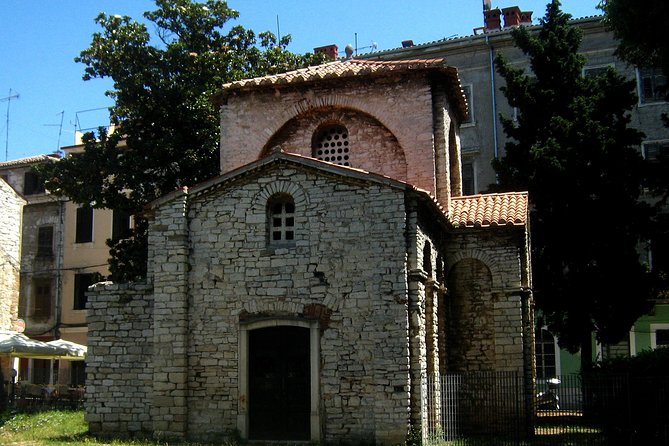
The last listed stop is the Roman mausoleum, an octagonal structure near the Twin Gate, the Archaeological Museum, and the city wall. It dates from the first century, but only the remains of the lower section are visible.
This is not a grand monument. That is the point. You get a look at the remains rather than a polished reconstruction, and Marina can help you picture what once occupied the site. The five-minute stop fits the tour’s pattern of showing both famous landmarks and modest fragments.
Because the mausoleum is near other sights, it also gives you practical ideas for later independent exploring. You can return to this part of town and combine it with the Archaeological Museum or a closer look at the city wall. The guided walk does not try to cover everything. It gives you a useful map in your head.
What Marina adds to the experience
The strongest feature is the guide’s manner. Marina is described as speaking very good German and leading in a friendly, open way. The walk is built as a dialogue, so you can ask questions instead of waiting for a fixed speech to end.
That helps families. Children have responded well to the storytelling, and the route includes enough variety to avoid nine straight stops that look alike. The Arena offers scale, the market offers daily life, and the gates and mosaic provide small discoveries.
You can also expect practical advice for the rest of your time in Istria. A restaurant recommendation has been especially useful, and Marina may offer suggestions based on your questions. Treat this as an added benefit rather than a promised separate service, since the core booking is the city tour.
A day-before WhatsApp message has also been part of the meeting process for some bookings, with clear arrangements made in advance. Since the stated meeting time is 10:30 a.m. at the Arena, keep your phone available around the booking date and make sure you know the exact meeting point.
Is $28.66 a fair price?
At $28.66 per person, this is a reasonable price for a local German-language introduction, especially if you value the ability to ask questions. The tour lasts about 90 minutes, includes a licensed guide, and avoids the impersonal feel of a very large group.
The value depends on your goals. If you want a quick orientation before exploring Pula on your own, the price makes sense. You will see the major Roman sights, learn where the overlooked pieces are, and finish near the market.
If you want interior visits, the price is not the full cost of your morning. Arena and Temple of Augustus admission are not included. You may also feel that 90 minutes is short, particularly if you like museums, photography, or detailed archaeology.
The group limit is 15 people, while the tour is presented as a private walking experience. That means you should not picture a crowded coach excursion, but you should check your booking details if you require a fully exclusive guide for only your own party. The practical advantage is still clear: the format allows more personal interaction than a large city tour.
How the timing shapes your morning
The route is tightly planned. The listed stops add up to roughly 90 minutes, with the Arena taking the largest share and the remaining sights receiving between five and 15 minutes each.
That structure works well for a first look. You get the main story without spending half a day on one archaeological site. It also leaves you free to return to the Arena, visit the museum, eat at the market, or continue through Pula independently.
The drawback is that the tour cannot linger everywhere. One 4-star assessment found the walk informative and pleasantly presented but wished it were longer and included more nearby sights. That is a fair expectation to manage. Read the route as a selected introduction, not a complete survey of every monument in central Pula.
Wear comfortable shoes and bring water, especially in warm weather. The experience is a walking tour through the city, and the information provided does not include transport between stops. Most people can participate, and the route is near public transportation if you need to reach or leave the center.
Who should book this German-language Pula walk?
I would choose this tour if you:
- Want to understand Pula’s Roman sights before exploring them alone
- Prefer German-language guiding from a local person
- Like asking questions and having a conversation
- Are traveling with children who need stories and variety
- Have only a short time in Pula
- Want suggestions for food and the rest of your Istrian visit
- Tend to miss small details such as mosaics and minor Roman remains
I would look for a longer tour if you want extended time inside the Arena, a museum visit, or a full treatment of every nearby sight. I would also avoid booking it at the last minute if your schedule is tight, since the experience is booked on average 16 days ahead.
The 4.9 rating from 34 ratings and 100 percent recommendation point to a consistently strong experience, with the clearest praise focused on Marina’s German, warmth, detail, and ability to keep the walk interesting for children. The one recurring limitation is not poor guiding. It is simply the short length.
Should you book it?
Book this Pula city tour in German if you want a friendly, focused start to your visit and value local explanation over a long formal lecture. Marina’s route gives you the Arena, market, Forum area, Roman gates, mosaic, and mausoleum in a sensible order, with enough historical context to make later independent sightseeing easier.
Before paying, decide if you want to enter the Arena or Temple of Augustus, then budget for those admissions separately. Also confirm the morning departure if the market matters to you. If you accept the 90-minute limit, this is a well-priced way to get your bearings and notice parts of Pula you might otherwise walk past.
FAQ
What language is the Pula city tour conducted in?
The tour is conducted in German by a local German-speaking guide from Pula. Marina is identified as the guide in the supplied tour information and is described as speaking very good German.
How long does the walking tour last?
The tour lasts approximately 1 hour and 30 minutes.
Where does the tour begin?
The meeting point is Pula Arena on Flavijevska ulica, 52100 Pula, Croatia.
Where does the tour finish?
The tour ends at the market on Flaniatička ulica 21, 52100 Pula, Croatia.
What time does the tour start?
The stated start time is 10:30 a.m.
Is admission to the Pula Arena included?
No. Admission to the Arena is not included in the tour price.
Is admission to the Temple of Augustus included?
No. Admission to the Temple of Augustus is listed as not included.
Is the market stop included on every tour?
No. The market stop is included only in the guided tour in the morning.
How many people can join the tour?
The activity has a maximum of 15 people. It is also presented as a private walking tour.
Can I cancel for a full refund?
Yes, if you cancel at least 24 hours before the local start time. Cancellations made less than 24 hours before the start time are not refunded, and changes within that period are not accepted.
Just added around Pula
- 1-Hour Private E Foil Surfing Lessons in Istria★ 5.0 · 4 reviews
- Wine Tasting Experience at the organic winery in Šišan★ 3.5 · 13 reviews
- Transfer Pula – Poreč★ 5.0 · 5 reviews
- 3 Hours Private Wine and Sunset Tour★ 5.0 · 9 reviews
- Dolphin & Sunset tour with Brijuni panorama★ 5.0 · 119 reviews
- E-Bike swim & fortress tour Vodnjan★ 5.0 · 6 reviews
- Stop on Island & National Park Day Cruise with Lunch Drinks★ 5.0 · 10 reviews
- Waves & Watercolors: A Seaside Painting Workshop★ 5.0 · 21 reviews
City Tours, compared.

City Walls Early Morning or Sunset Walking Tour
Read our review →
Dubrovnik Combo: Old Town & Ancient City Walls
Read our review →
Small Group Walking Tour City Center and WW2 Tunnels
Read our review →
Hop On Hop Off Panoramic bus – Zagreb City Tour
Read our review →
Browse the lists this tour appears in